
Student Research Symposium Program Portal
220 submissions
| # | SID | Presentation Modality | Poster Session/Number | Submission title | UUID | In draft | Starred | Locked | Notes | Created | Completed | Changed | User | IP address | Primary Student Contact First Name | Primary Student Contact Last Name | Pronouns | Primary Student Contact FSU Student Email | Photo of all individuals presenting this work | Major(s) of all individuals presenting this work | Bio of all individuals presenting this work | Poster Title | Abstract | Research Mentor Name | Research Mentor's College (or High School) | Research Mentor's Department (or Subject) | Research Mentor's Email | Additional Research Mentor(s) | Co-presenter(s) | Keywords | Work | Poster PDF or Powerpoint | Poster Thumbnail | I will be printing my poster | Year | Annual description | Update URL | Operations |
|---|---|---|---|---|---|---|---|---|---|---|---|---|---|---|---|---|---|---|---|---|---|---|---|---|---|---|---|---|---|---|---|---|---|---|---|---|---|---|
| 248 | 9096 | Face to Face Poster session | 10:00 Graduate and Undergraduate presentations | Student Research Symposium Program Portal: Submission #248 | 9e55fe9b-a742-41df-a7bb-ad1148633ef9 | No | Star/flag Student Research Symposium Program Portal: Submission #248 | Lock Student Research Symposium Program Portal: Submission #248 | Add notes to Student Research Symposium Program Portal: Submission #248 | Mon, 02/02/2026 - 12:04 PM | Mon, 02/02/2026 - 12:35 PM | Fri, 04/03/2026 - 03:13 PM | Anonymous | 146.201.10.13 | Courtney | Holt | ch25v@fsu.edu |
|
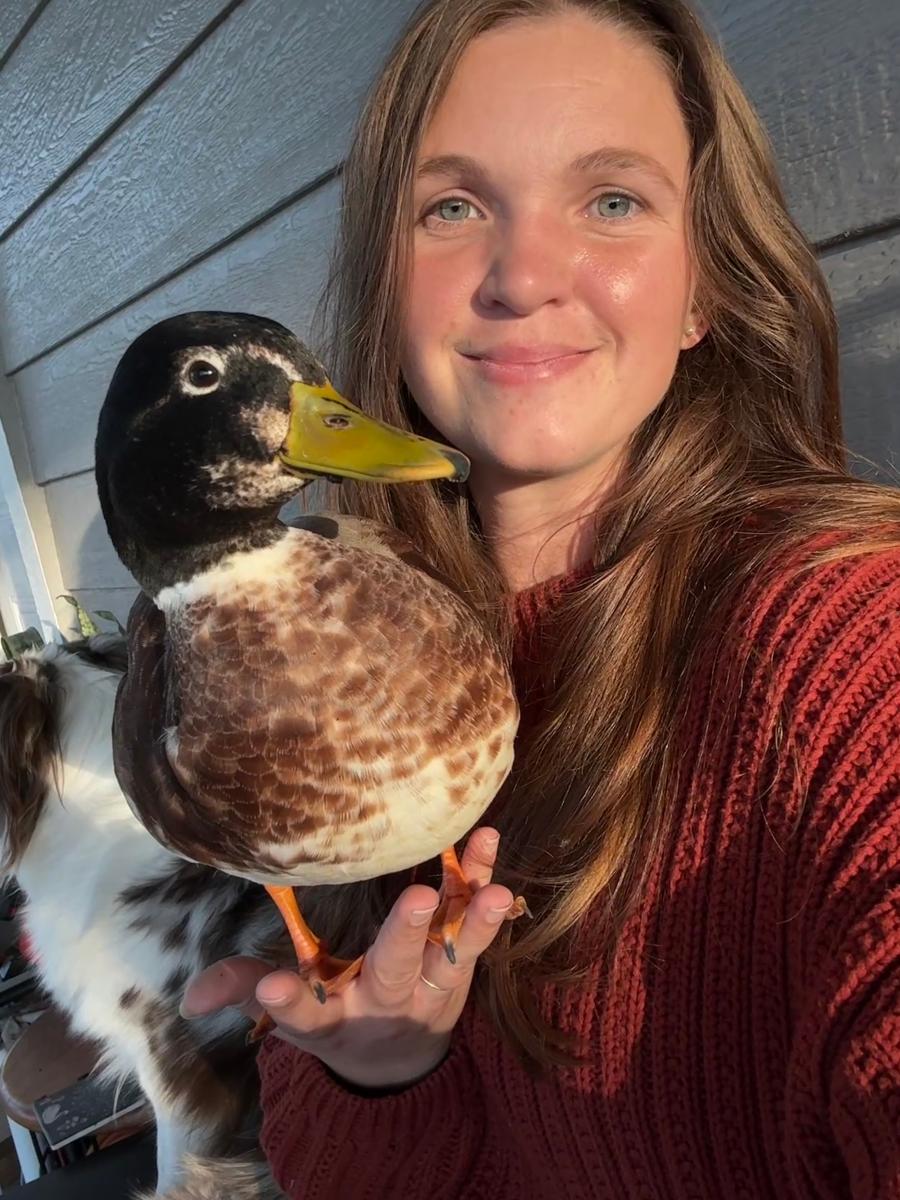
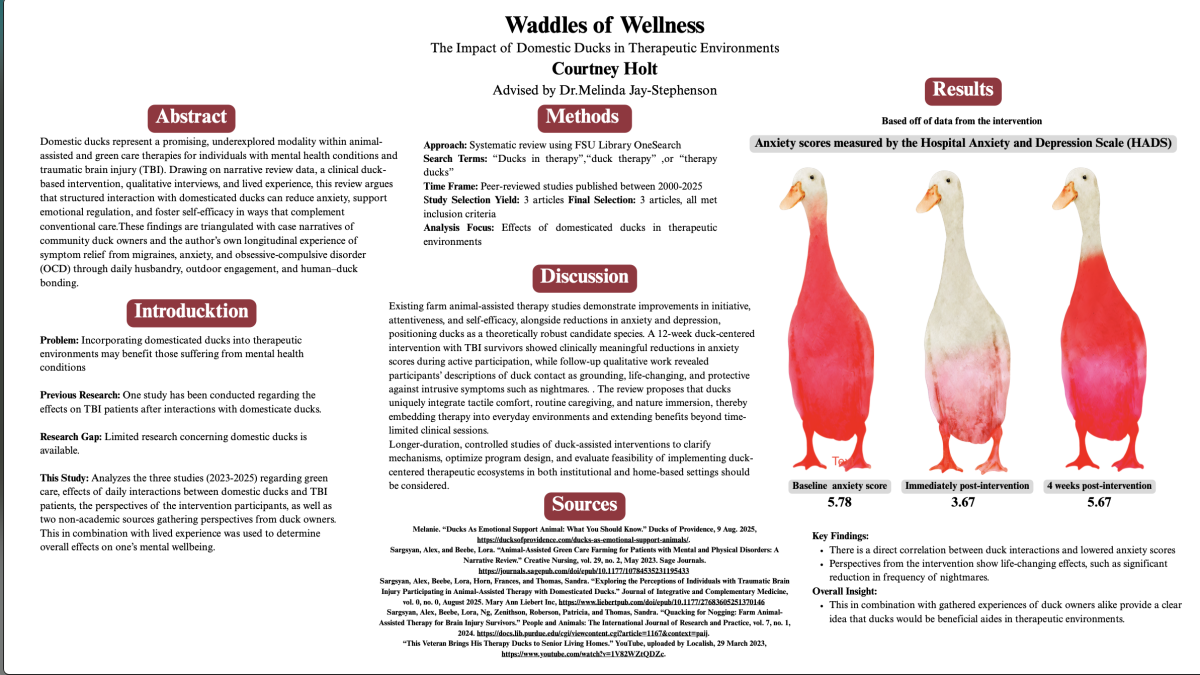
Public Health | After experiencing a traumatic brain injury (TBI) during my service in the U.S. Air Force, I found myself in the comfort of raising chickens and ducks. I noticed that I would find relief from anxiety or migraines when I would spend time outdoors tending to them. This led me to my research, wondering if there had been any previous work that suggests there is correlation between decreased symptoms in TBI patients and domestic ducks. Thankfully, there had been exactly one study regarding the subject. Currently, I have 18 ducks and they bring so much joy to my family – my husband and two children. I've become very passionate with my hobby in duck husbandry as they have given me so much joy and peace. The power of a quack should never be underestimated. | Waddles of Wellness: The Impact of Domestic Ducks in Therapeutic Environments | omestic ducks represent a promising, underexplored modality within animal-assisted and green care therapies for individuals with mental health conditions and traumatic brain injury (TBI). Drawing on narrative review data, a clinical duck-based intervention, qualitative interviews, and lived experience, this review argues that structured interaction with domesticated ducks can reduce anxiety, support emotional regulation, and foster self-efficacy in ways that complement conventional care.These findings are triangulated with case narratives of community duck owners and the author’s own longitudinal experience of symptom relief from migraines, anxiety, and obsessive-compulsive disorder (OCD) through daily husbandry, outdoor engagement, and human–duck bonding. | Dr. Milinda Jay Stephenson | FSU PC | English | mjay@pc.fsu.edu | duck therapy, therapy ducks, ducks in therapy | Complete | Waddles of Wellness.pdf1.92 MB
|
|
No | 2026 | 5th annual Undergraduate Research Symposium, April 17, 2025 | https://pc.fsu.edu/student-research/symposium/research-symposium-program-portal?element_parents=elements/student_photo&ajax_form=1&_wrapper_format=drupal_ajax&token=2TY48mry-8QLOetMbIli4Z9pC8cfQbU_aq6y6MPijog | ||||
| 247 | 9095 | Face to Face Poster session | 10:00 Graduate and Undergraduate presentations | Student Research Symposium Program Portal: Submission #247 | 1888cf93-1b7b-4187-bf32-f4dc0c3c0b7c | No | Star/flag Student Research Symposium Program Portal: Submission #247 | Lock Student Research Symposium Program Portal: Submission #247 | Add notes to Student Research Symposium Program Portal: Submission #247 | Mon, 02/02/2026 - 12:02 PM | Mon, 02/02/2026 - 12:16 PM | Fri, 04/03/2026 - 03:13 PM | Anonymous | 146.201.10.6 | Skylar | Markee | sm24dl@fsu.edu |
|
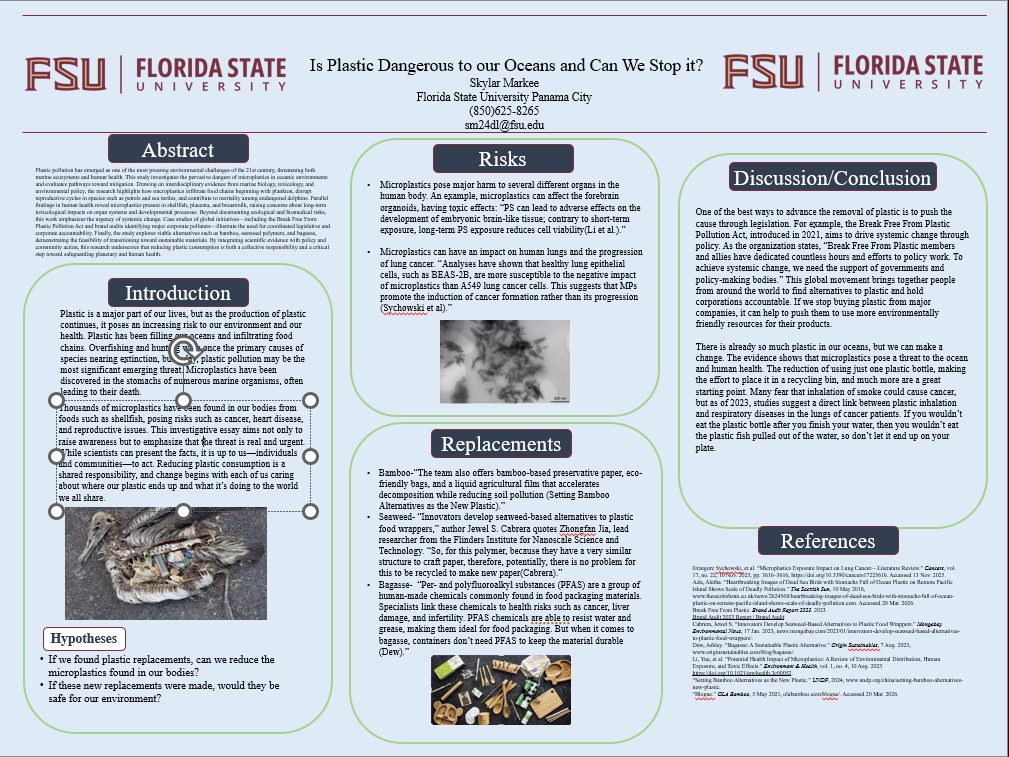
Civil Engineering | Hi, I'm Skylar Markee, and my research is on microplastics and how they are affecting the ocean and how they are affecting us and our health. Once I have completed my engineering degree, I hope to pursue a job at the national or state parks to help preserve more of our natural lands and create a way for us to safely explore our wonders without causing any environmental harm. | Investigative Field Essay: Is Plastic Dangerous to our Oceans and Can We Stop it? | Plastic pollution has emerged as one of the most pressing environmental challenges of the 21st century, threatening both marine ecosystems and human health. This study investigates the pervasive dangers of microplastics in oceanic environments and evaluates pathways toward mitigation. Drawing on interdisciplinary evidence from marine biology, toxicology, and environmental policy, the research highlights how microplastics infiltrate food chains beginning with plankton, disrupt reproductive cycles in species such as petrels and sea turtles, and contribute to mortality among endangered dolphins. Parallel findings in human health reveal microplastics present in shellfish, placentas, and breastmilk, raising concerns about long-term toxicological impacts on organ systems and developmental processes. Beyond documenting ecological and biomedical risks, this work emphasizes the urgency of systemic change. Case studies of global initiatives—including the Break Free From Plastic Pollution Act and brand audits identifying major corporate polluters—illustrate the need for coordinated legislative and corporate accountability. Finally, the study explores viable alternatives such as bamboo, seaweed polymers, and bagasse, demonstrating the feasibility of transitioning toward sustainable materials. By integrating scientific evidence with policy and community action, this research underscores that reducing plastic consumption is both a collective responsibility and a critical step toward safeguarding planetary and human health. | Dr. Milinda Jay Stephenson | FSU PC | English | mjay@fsu.edu | Microplastic Pollution | Complete | Research Symposium Poster.pdf530.88 KB
|
|
No | 2026 | 5th annual Undergraduate Research Symposium, April 17, 2025 | https://pc.fsu.edu/student-research/symposium/research-symposium-program-portal?element_parents=elements/student_photo&ajax_form=1&_wrapper_format=drupal_ajax&token=gUj00OWWzivKYjL4epTpdrpe8PzL-eaHSbYoanzF-No | ||||
| 246 | 9094 | Face to Face Poster session | 11:15 High School presentations | Student Research Symposium Program Portal: Submission #246 | bbb311a3-3451-4aeb-9d78-fa21556696e6 | No | Star/flag Student Research Symposium Program Portal: Submission #246 | Lock Student Research Symposium Program Portal: Submission #246 | Add notes to Student Research Symposium Program Portal: Submission #246 | Mon, 02/02/2026 - 11:39 AM | Mon, 02/02/2026 - 11:46 AM | Fri, 04/03/2026 - 03:12 PM | Anonymous | 2600:387:f:5912::7 | Abigail | Long | She/Her | xlongag@baystudent.org |
|
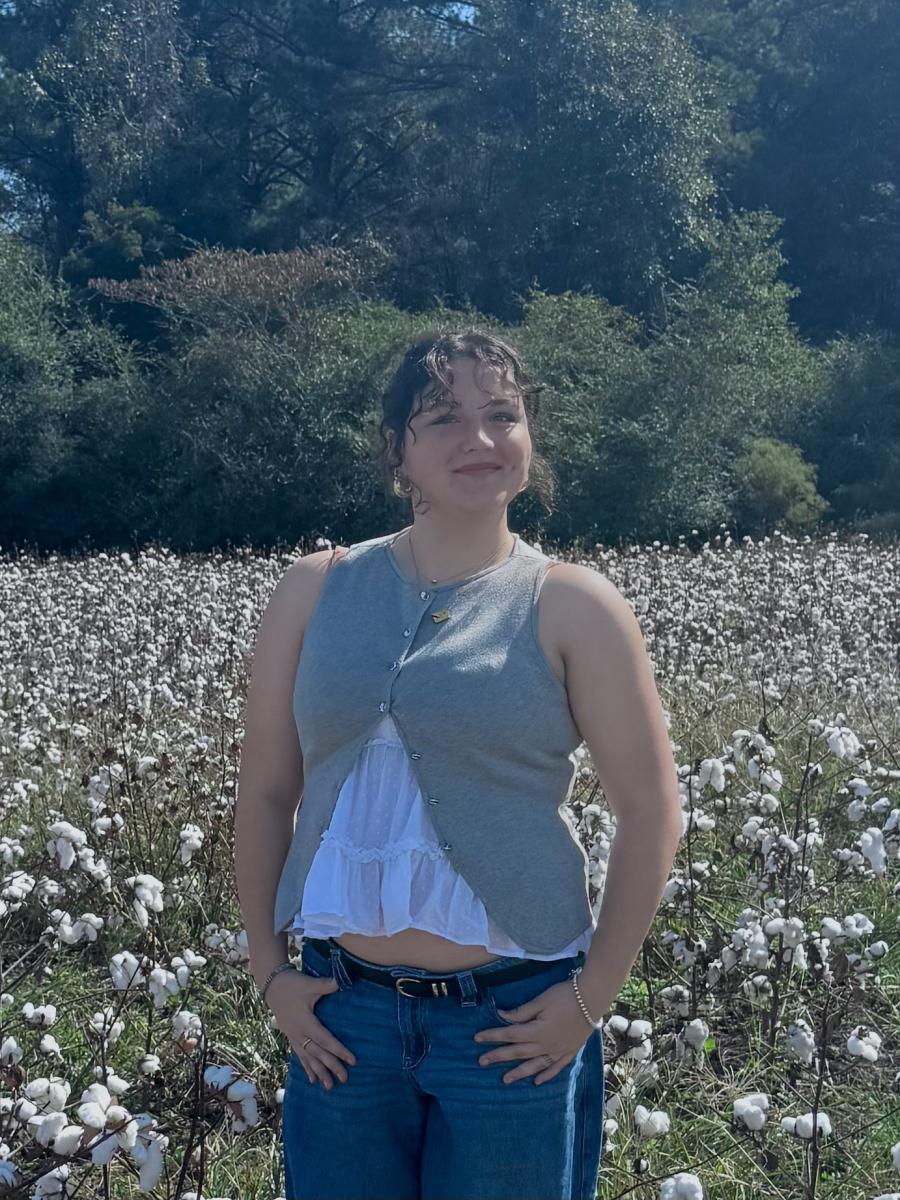
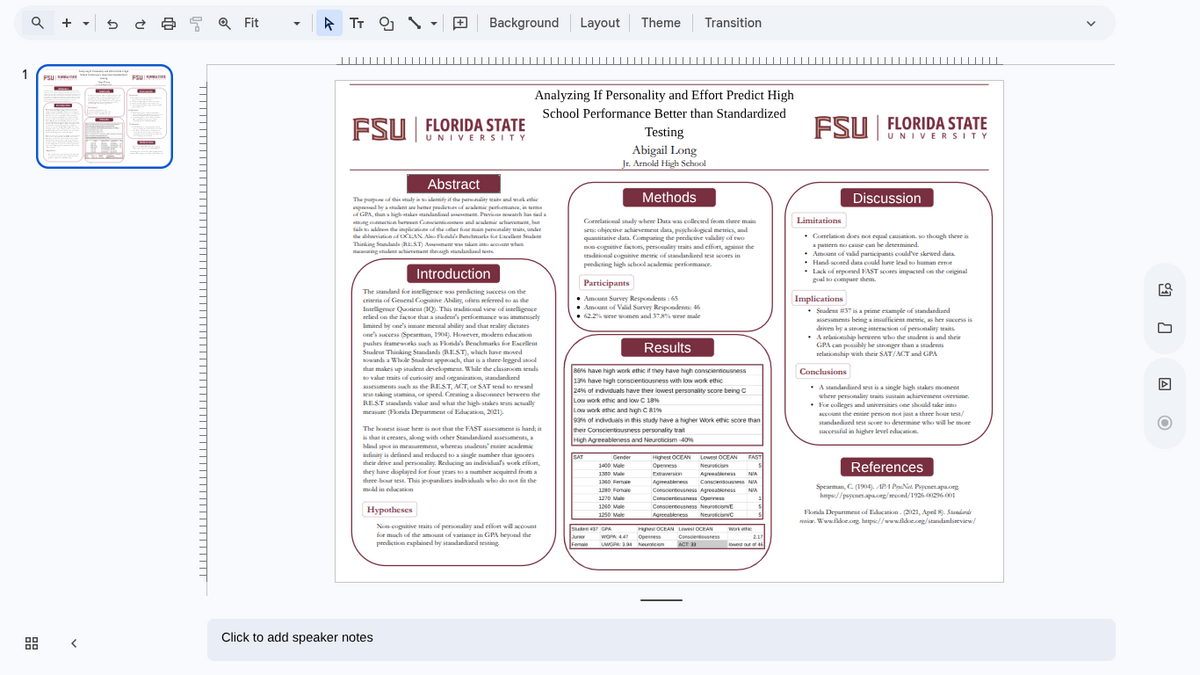
AP Research | I'm a Junior and Student-Athlete at J.R. Arnold High School. I'm interested in studying psychology in college. Overall, I'm interested in the demand for standardized assessments to measure intelligence, including college acceptances, even though students are much more than numbers. | Analyzing If Personality and Effort Predict High School Performance Better than Standardized Testing | The purpose of this study is to identify if the personality traits and work ethic expressed by a student are better predictors of academic performance, in terms of GPA, than a high-stakes standardized assessment. Previous research has tied a strong connection between Conscientiousness and academic achievement, but fails to address the implications of the other four main personality traits, under the abbreviation of OCEAN. This study aims to find if the other personality traits also impact a high school student's performance. Work ethic is another non-cognitive factor that was introduced to see if Conscientiousness and how hard some students work interconnect, with both high and low scores. Another unique attribute of this study was that Florida's Benchmarks for Excellent Student Thinking Standards (B.E.S.T) Assessment was taken into account when measuring student achievement through standardized tests. Providing a unique view to Florida inhabitants that impacts their high school career. A correlation study was conducted to determine a relationship between the cognitive and non-cognitive traits, specifically chosen to stay away from causation. A pool of 100 high school students from freshman year to senior year were sent a survey, relying on self -reported scores of GPA, Standardized test scores, and full truth when answering the adapted Personality questionnaire from The International Personality Item Pool(IPIP). 66 individuals responded and were scored through the Likert Scale. 52 respondents actually meant the requirements and were used as data to support the hypothesis. (Had to cut it, original too long) | Dodey Deal | J.R. Arnold High School | Collegiate Studies/ Capstone | dealdm@bay.k12.fl.us | Standardized Assessments, Personality Traits, Psychology, Cognitive Traits, Non-cognitive Traits, Work Ethic. | Complete |
|
No | 2026 | 5th annual Undergraduate Research Symposium, April 17, 2025 | https://pc.fsu.edu/student-research/symposium/research-symposium-program-portal?element_parents=elements/student_photo&ajax_form=1&_wrapper_format=drupal_ajax&token=LpZkj50K5VbgyW2diHVx8a3UeeKRXGAone3Ed-_j-Ig | ||||
| 245 | 9093 | Face to Face Poster session | 11:15 High School presentations | Student Research Symposium Program Portal: Submission #245 | 6802741b-3462-41f9-97df-e362593a860f | No | Star/flag Student Research Symposium Program Portal: Submission #245 | Lock Student Research Symposium Program Portal: Submission #245 | Add notes to Student Research Symposium Program Portal: Submission #245 | Mon, 02/02/2026 - 10:22 AM | Mon, 02/02/2026 - 10:27 AM | Fri, 04/03/2026 - 03:12 PM | Anonymous | 146.201.10.4 | Tyler | Zheng | He/Him | tylerzheng09@gmail.com |
|
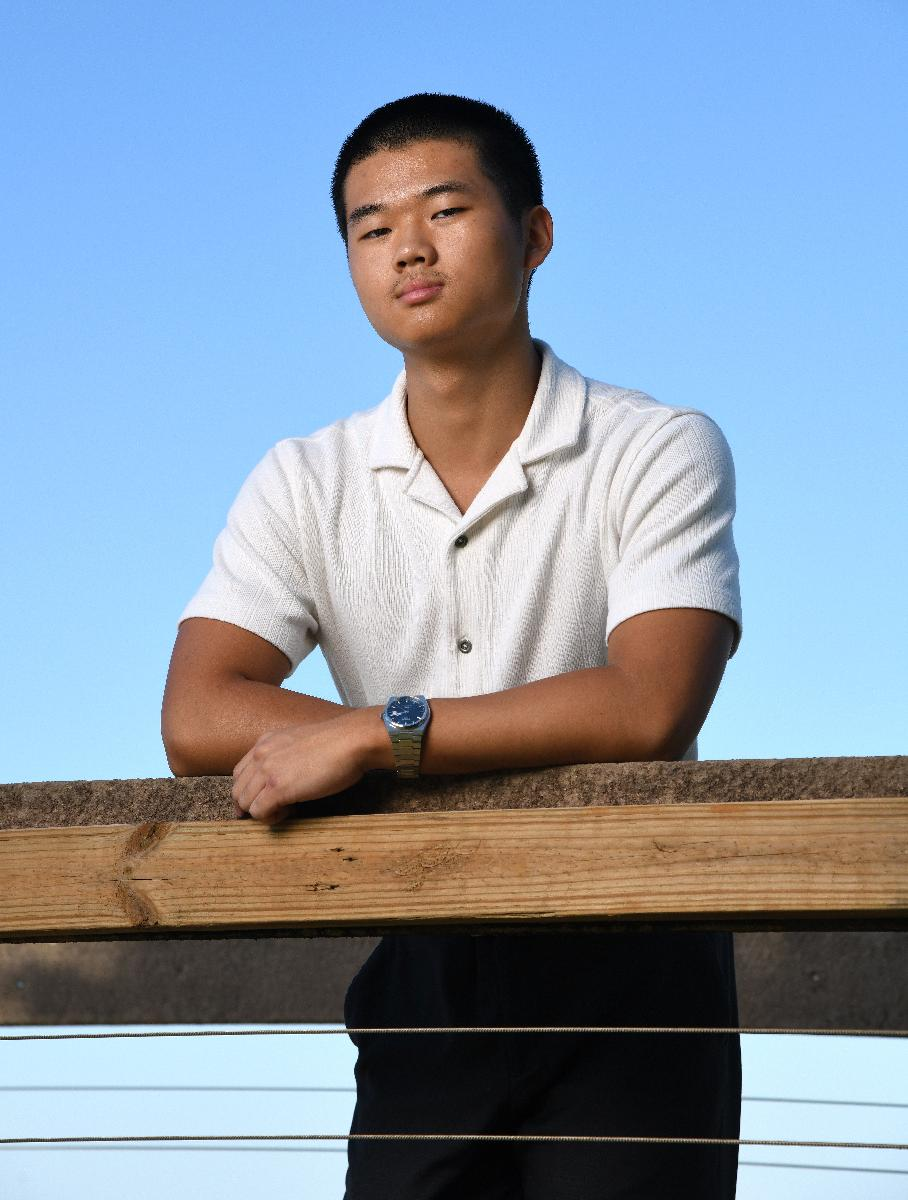
Dual Enrolled; Interdisciplinary Social Sciences | My name is Tyler Zheng. I am currently a junior, dual-enrolled at The Collegiate School at Florida State University Panama City. I am on track to finish my AA before I finish graduate high school. I am looking forward to pursuing the legal field in the future and attending law school. I am still undecided on what type of law I want to go after, but I know that is a path I want to go down. I'm heavily involved with extracurriculars inside and outside of school, including piano, working out, running, teen court, SGA at TCS, etc. | Psychological Influence in the Courtroom: How Attorneys Shape Jury Decision-Making | Litigators and attorneys often use psychological methods, consciously or unconsciously, to influence juries and judges, which can affect court rulings. Psychology plays a major role in the courtroom, and its impact varies based on how it is applied. Factors such as speech, tone, confidence, and emotional appeal can influence whether the court sides with an attorney. Jury demographics and individual perceptions are also important considerations. Beyond speech, attorneys and defendants influence the courtroom through appearance, professionalism, and etiquette, all of which can shape how they are perceived. The primary focus of this paper is to identify the psychological techniques used in the courtroom and examine how significantly they affect juror decision-making. By understanding these methods, both professionals and everyday individuals may apply similar strategies in other settings to subtly influence outcomes. This literature review will look at research from psyschology and law to understand how psychology works in the courtroom. Studies shows that jurors do not rely solely on facts but are also influenced by a multitude of other psychological factors. By reviewing and combining these studies, this paper aims to evaluate how much court room decisions are shaped by psychological factors rather than just evidence and legality. | Madisyn Flammia | The Collegiate School | Research | mjf24@fsu.edu | law psychology influence | Complete | T. Zheng Poster.pdf159.1 KB
|
No | 2026 | 5th annual Undergraduate Research Symposium, April 17, 2025 | https://pc.fsu.edu/student-research/symposium/research-symposium-program-portal?element_parents=elements/student_photo&ajax_form=1&_wrapper_format=drupal_ajax&token=NK0mLPN_yLDNC931B-BPoscnaovKcVijwXnogSBNEqQ | ||||
| 244 | 9092 | Asynchronous Online Presentation | Asynchronous Online Presentation | Student Research Symposium Program Portal: Submission #244 | c3eba51c-feb9-48c2-a37a-21506bcf1f59 | No | Star/flag Student Research Symposium Program Portal: Submission #244 | Lock Student Research Symposium Program Portal: Submission #244 | Add notes to Student Research Symposium Program Portal: Submission #244 | Sun, 02/01/2026 - 01:57 PM | Sun, 02/01/2026 - 04:24 PM | Fri, 04/03/2026 - 03:11 PM | Anonymous | 2600:1700:2160:a7f:d7db:c186:3172:8ece | Madison | Tran | She/Her | xtranmm@bayhaven.org |
|
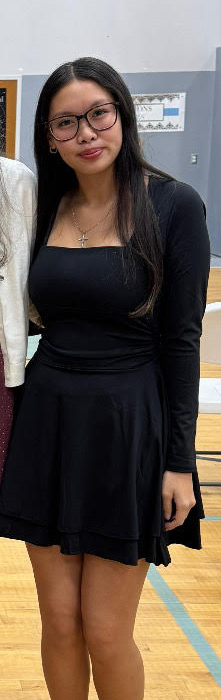
Intended major: biology | I am a current junior at North Bay Haven Charter Academy, and I am working toward my AP Capstone Diploma. I am interested in going into the dental field, and I hope to attend dental school in the future. | To What Extent Do The Different Parenting Styles Affect A Student's Academic Success? | The different parenting styles have various impacts on many aspects of a child’s life, including their beliefs, development, and success in school. The National Library of Medicine categorizes the different parenting styles into four main categories: authoritarian, authoritative, permissive, and uninvolved. These parenting styles can shape a child’s academic performance in school. Each style differs in the amount of warmth, discipline, and communication that parents use, which in turn influences how children develop motivation, confidence, and responsibility in their learning. Getting an understanding of how these parenting approaches affect academic success in children can help illuminate the connection between family dynamics and academic performance. There have been countless studies to determine the effects of different teaching styles on students, but not many take into account that parenting styles have a role in a child’s education too. In this study, I have looked at the relationship between parenting styles and their effects on a student's academic success. The gap in the importance of parental involvement and approach demonstrates that children not only perform better academically but also develop critical life skills when parents are actively supportive, communicative, and balanced in their guidance. Recognizing the role of parenting provides a better understanding of academic success and suggests that interventions to improve parental engagement could meaningfully enhance a student's education. |
Ms.Vaughn | North Bay Haven Charter Academy | English | Vaughrl@bayhaven.org | Student's Academic Motivation, Parenting styles, Student's Academic Success | Complete | 2026 | 5th annual Undergraduate Research Symposium, April 17, 2025 | https://pc.fsu.edu/student-research/symposium/research-symposium-program-portal?element_parents=elements/student_photo&ajax_form=1&_wrapper_format=drupal_ajax&token=2Q3jbODetX3ZPntICRkKQEWzm1wJ2Wem8SWiGalmkfA | ||||||
| 243 | 9091 | Asynchronous Online Presentation | Asynchronous Online Presentation | Student Research Symposium Program Portal: Submission #243 | 45a97199-a8c2-4d5a-af64-497bd693d7fe | No | Star/flag Student Research Symposium Program Portal: Submission #243 | Lock Student Research Symposium Program Portal: Submission #243 | Add notes to Student Research Symposium Program Portal: Submission #243 | Sun, 02/01/2026 - 06:37 AM | Sun, 02/01/2026 - 06:41 AM | Fri, 04/03/2026 - 03:10 PM | Anonymous | 2601:4c1:cb80:2300:2f06:6ddc:17ff:55e9 | Angelina | Li | She/Her | xlia1@bayhaven.org |

|
blah | blah blah blah | How does home life affects students in standardized testing | blah blah blah blah blah | Mrs. Vaughn | North Bay Haven | English | vaughrl@bayhaven.org | blah blah blah | Exploratory (the research question has been identified and design of approach is outlined) | 2026 | 5th annual Undergraduate Research Symposium, April 17, 2025 | https://pc.fsu.edu/student-research/symposium/research-symposium-program-portal?element_parents=elements/student_photo&ajax_form=1&_wrapper_format=drupal_ajax&token=6UgDbZpm91lMufe0Cl3KEo-DGFLFxriS7Tg5R4seRDs | ||||||
| 242 | 9090 | Face to Face Poster session | 10:00 Graduate and Undergraduate presentations | Student Research Symposium Program Portal: Submission #242 | c55c23be-6ad1-444e-aacb-63bb5492b44b | No | Star/flag Student Research Symposium Program Portal: Submission #242 | Lock Student Research Symposium Program Portal: Submission #242 | Add notes to Student Research Symposium Program Portal: Submission #242 | Sat, 01/31/2026 - 10:58 PM | Sun, 02/01/2026 - 12:12 AM | Tue, 04/14/2026 - 12:42 AM | Anonymous | 2601:4c1:cc7f:9460:147f:235b:3734:8756 | Carlos | Britt | cdb23d@fsu.edu |
|
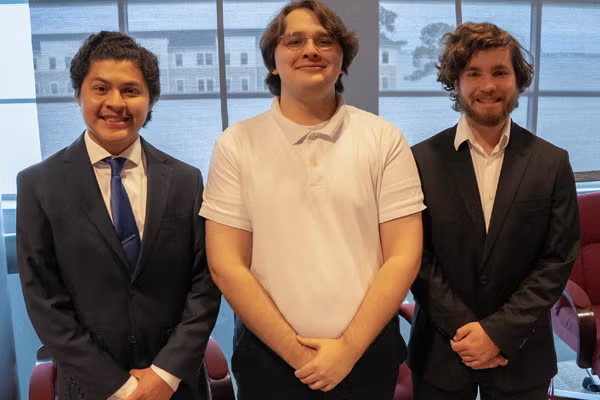
All electrical engineers | Jacob Bass is an electrical engineering student at Florida State University in his hometown of Panama City, Florida. His academic interests center on electronics, power systems, and circuit analysis. Carlos Britt is an electrical engineering student set to graduate in summer of 2026. His interests lies in microelectronics, robotics, and space exploration. Ethan Delmar is an electrical engineering student with a focus on power electronics and circuit analysis. | Solar Sync Train | This project proposes a grid-independent, variable-frequency solid-state transformer powered by a portable 18V solar panel. Unlike conventional SSTs, which are kilowatt-scale, grid-tied, and require expensive DSP/FPGA control platforms, our design uses a single STM32 microcontroller running bare-metal firmware to produce AC power at any programmable output frequency. A working breadboard prototype has been validated at 54% end-to-end efficiency, successfully powering a 120V AC toy train and demonstrating variable-speed synchronous motor control. We propose further development toward a portable, frequency-agile solar power conversion platform. | Dr. Saeed Rajput | University of Southern California | Electrical and Computer Engineering | srajput@fsu.edu | Dr. Walid Hadi | SST, Transformer, Power, Solid-State Transformer | Complete | Poster_SolarSyncTrain.pdf544.13 KB
|
No | 2026 | 5th annual Undergraduate Research Symposium, April 17, 2025 | https://pc.fsu.edu/student-research/symposium/research-symposium-program-portal?element_parents=elements/student_photo&ajax_form=1&_wrapper_format=drupal_ajax&token=PurrCIU35MZiHNlFQCrX8LgbmNtcnzqi4pAMwHotBNs | ||||
| 240 | 9088 | Face to Face Poster session | 10:00 Graduate and Undergraduate presentations | Student Research Symposium Program Portal: Submission #240 | 826f2d5d-5364-4fd6-af4d-d737233b3478 | No | Star/flag Student Research Symposium Program Portal: Submission #240 | Lock Student Research Symposium Program Portal: Submission #240 | Add notes to Student Research Symposium Program Portal: Submission #240 | Sat, 01/31/2026 - 08:21 PM | Sat, 01/31/2026 - 08:21 PM | Fri, 04/10/2026 - 03:22 PM | Anonymous | 2600:1701:410:2a90:2cd2:fad4:8598:1dc5 | Ben Brethauer, Randall Killets, | Maher Albibi, Aisha Umer | rbb24a@fsu.edu |
|
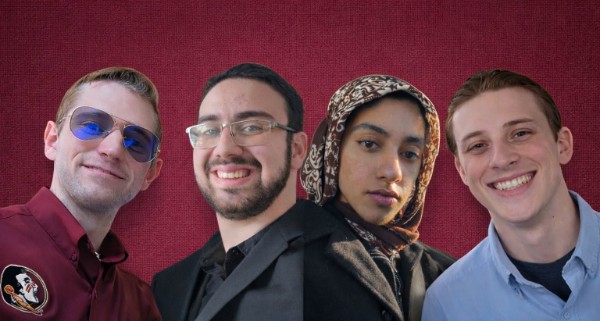
All are Civil Engineering | Ben Brethauer - I earned my AA from the Collegiate HS program at NWFSC in 2012. I am pursuing a B.S. in Civil Engineering at Florida State University. I previously worked as a logistics contractor, with experience in warehousing, inventory, and woodshop fabrication. I currently serve as an engineering technician with Okaloosa County. Maher Albibi- I am from Panama City, Florida. I graduated from Panama City Advanced School where I received my high school diploma and later gained my AA at Gulf Coast State College before transferring to FSU - PC to complete my Bachelor's degree in Civil Engineering. Randal Killets - I was raised in Panama City, getting my high school diploma at North Bay Haven Charter Academy. I then went to get my AA at Gulf Coast State College before transferring to Florida State University to obtain a Bachelor’s degree in civil engineering. Aisha Umer - I am from Panama City, Florida. I attended Panama City Advanced School where I received my high school diploma and later gained my AA at Gulf Coast State College before transferring to FSU - PC to complete my Bachelor's degree in Civil Engineering. |
Jericho Logistics Complex | Multidisciplinary civil-engineering design for the Jericho Logistics Complex. Three buildings (~22k, 150k, 50k sf), paved circulation/loading, and a stormwater system. Includes geotechnical, pavement, structural, parking, and hydraulic analyses using Civil 3D, Excel, and StormWise(TR-55). Design to include cost estimate and construction schedule. | Hafiz Ahmad, PhD, PE | FAMU-FSU College of Engineering (FSU Panama City) | Civil & Environmental Engineering | hahmad@pc.fsu.edu | Korhan Adalier, PhD | Warehouse, Civil Engineering, Logistics | Complete | Poster Template.pptx.pdf1.58 MB
|

|
No | 2026 | 5th annual Undergraduate Research Symposium, April 17, 2025 | https://pc.fsu.edu/student-research/symposium/research-symposium-program-portal?element_parents=elements/student_photo&ajax_form=1&_wrapper_format=drupal_ajax&token=8AutiwwjzqAIAxVRrTNIpbngYRBuYSlDKU4KACKc6g0 | |||
| 241 | 9089 | Face to Face Poster session | 11:15 High School presentations | Student Research Symposium Program Portal: Submission #241 | 317c576b-1619-4922-8817-d24958dee0a3 | No | Star/flag Student Research Symposium Program Portal: Submission #241 | Lock Student Research Symposium Program Portal: Submission #241 | Add notes to Student Research Symposium Program Portal: Submission #241 | Sat, 01/31/2026 - 07:01 PM | Sat, 01/31/2026 - 10:28 PM | Mon, 04/06/2026 - 10:18 PM | Anonymous | 50.4.129.236 | Alyssa | McMillan | xmcmiam@baystudent.org |
|
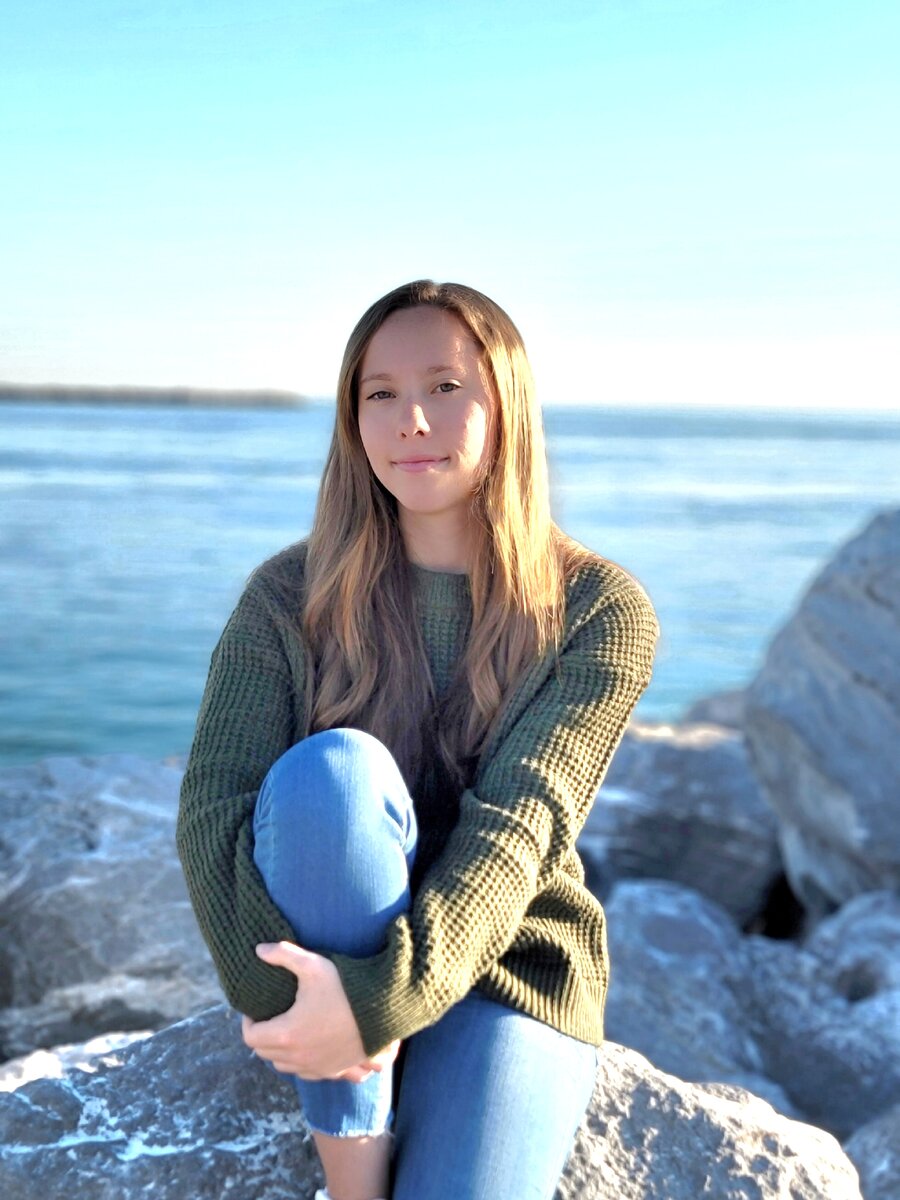
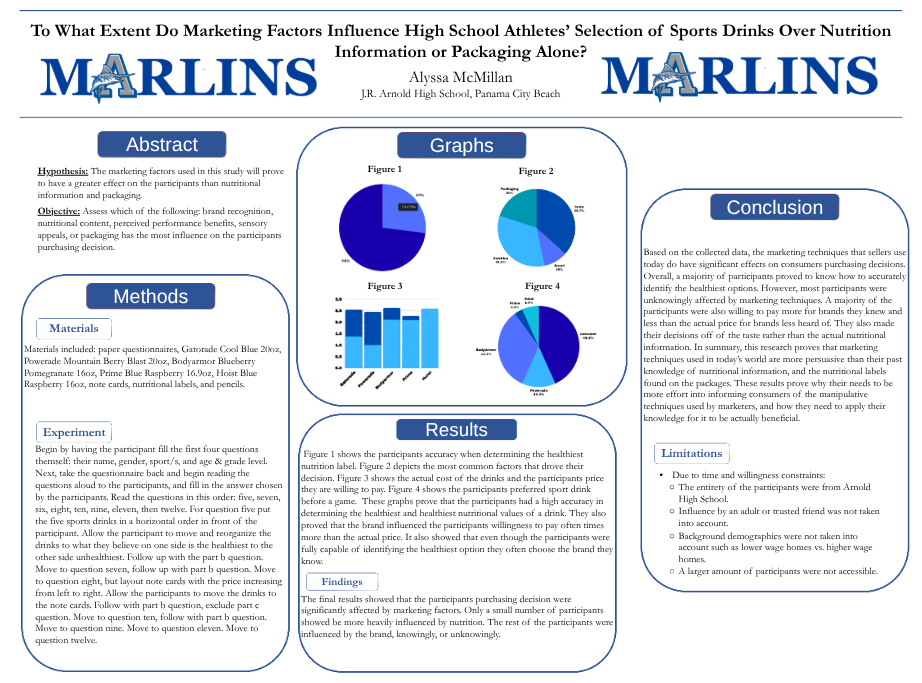
AP Research | I am a junior at Jr. Arnold High School who wants to major in Mechanical or Electrical Engineering. I plan to pursue this career at FSU PCB one day. My research topic is to what extent do factors such as brand recognition, nutritional content, and cost influence high school athletes' selection of sports drinks, and is this choice primarily driven by perceived performance benefits and sensory appeal rather than by nutrition information or packaging alone. I am also one of the team captains on the Lady Marlins Basketball team. I am also currently the President of the Student Government Association Class of 2027 at Arnold. Through my academic and sport filled life I have developed time-management skills, leadership qualities, and a strong work ethic. | To What Extent Do Marketing Factors Influence High School Athletes’ Selection of Sports Drinks Over Nutrition Information or Packaging Alone? | Currently, there has been a massive increase in products being sold with some type of packaging used to draw the attention of consumers. This increased usage was sparked by the change in needs of packaging in today's market vs packaging's original purpose which is the reason why marketers have had to get creative in their schemes to attract consumers to their brands. These extra packaging were worsened by consumers' transition from in-store transactions to online transactions. Because of this, many businesses who have no extra money to invest in special designs and color schemes have begun to suffer the consequences of this increase in the race of the most attractive and eye-catching packaging. | Doedy Deal | Jr. Arnold High School | AP Seminar/Research | dealm@bay.k12.fl.us | Sports, Marketing, Nutrition | Complete |
|
No | 2026 | 5th annual Undergraduate Research Symposium, April 17, 2025 | https://pc.fsu.edu/student-research/symposium/research-symposium-program-portal?element_parents=elements/student_photo&ajax_form=1&_wrapper_format=drupal_ajax&token=dXCx6GLz1G7Ftsj0UmmL8mtl8F2EwR5GFT2D1hjQlxc | |||||
| 239 | 9087 | Face to Face Poster session | 11:15 High School presentations | Student Research Symposium Program Portal: Submission #239 | 3e1e3019-07f0-4ed3-aeb9-f82ac8e1d1f4 | No | Star/flag Student Research Symposium Program Portal: Submission #239 | Lock Student Research Symposium Program Portal: Submission #239 | Add notes to Student Research Symposium Program Portal: Submission #239 | Sat, 01/31/2026 - 05:58 PM | Sat, 01/31/2026 - 06:48 PM | Fri, 04/10/2026 - 03:23 PM | Anonymous | 50.4.129.236 | Ashley | McMillan | xmcmiar@baystudent.org |
|
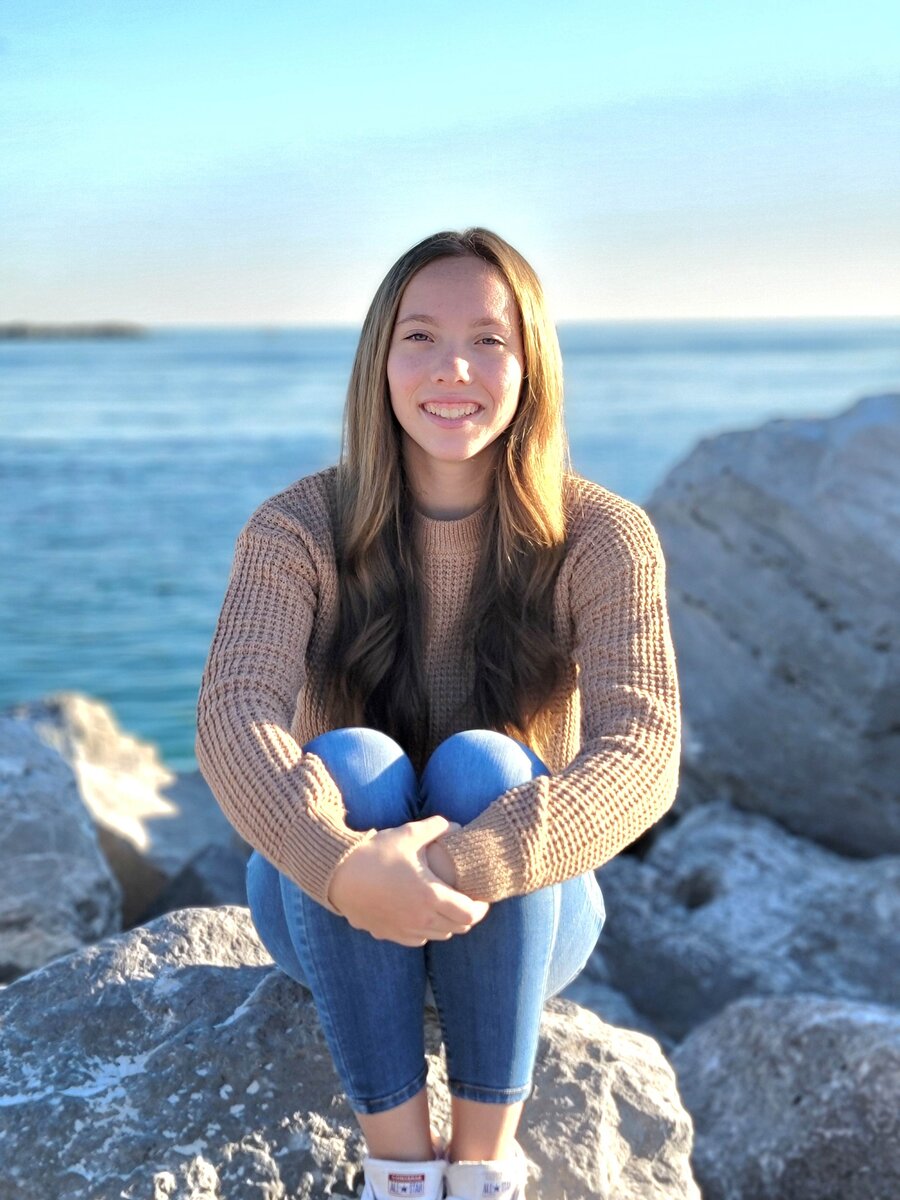
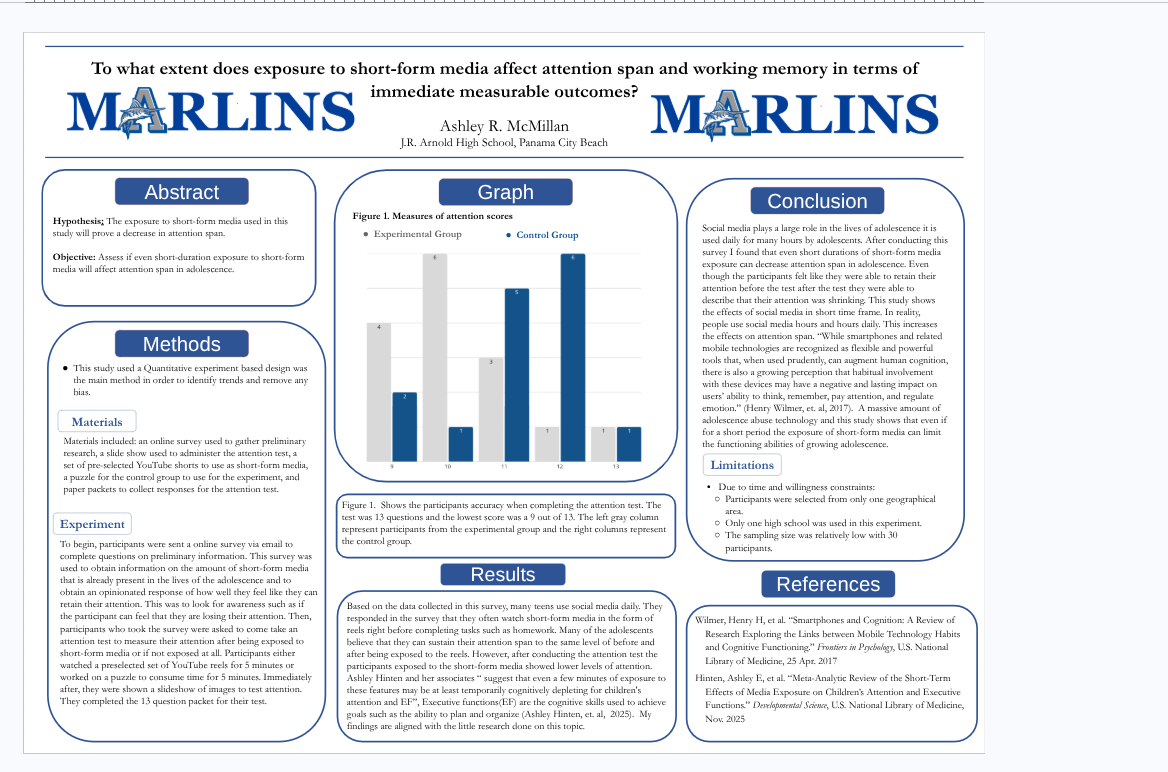
AP Research | I am an 11th-grade student from Panama City Beach with a strong academic interest in mechanical engineering. I plan to pursue a career in this field, focusing on innovative problem-solving and practical design. My research topic, Analyzing the Extent to Which Short-Form Media Affects Attention and Working Memory, examines the potential cognitive effect of short form digital content on students. In addition to my academic pursuits, I serve as one of the captains of the Lady Marlins basketball team and as the secretary of student government at my school. Through balancing leadership roles in athletics, student government, and academic research, I have developed discipline, teamwork, and time management skills that contribute to my overall growth as a student. | Analyzing the Extent of Which Short-Form Media Affects Attention And Working Memory | More recently a problem with cognitive development in teens has been on the rise along with the use of social media. Even with people being aware of the effects of social media on teens they are still consuming it at a harmful level. This problem has negatively impacted high school students because it impairs their attention span and working-memory which is needed to thrive in the classroom. A possible cause of this problem is on what form of social media they use. | Doedy Deal | J.R. Arnold High School | AP Research | dealdm@bay.k12.fl.us | Short-form media, attention, focus, working memory | Complete |
|
No | 2026 | 5th annual Undergraduate Research Symposium, April 17, 2025 | https://pc.fsu.edu/student-research/symposium/research-symposium-program-portal?element_parents=elements/student_photo&ajax_form=1&_wrapper_format=drupal_ajax&token=TqIXWlH-yi3NBf_w6ar4toOzOa0lsqxNdGTb0FZrILg | |||||
| 238 | 9086 | Face to Face Poster session | 10:00 Graduate and Undergraduate presentations | Student Research Symposium Program Portal: Submission #238 | f6971397-3458-456d-86c4-466a9107f5c9 | No | Star/flag Student Research Symposium Program Portal: Submission #238 | Lock Student Research Symposium Program Portal: Submission #238 | Add notes to Student Research Symposium Program Portal: Submission #238 | Sat, 01/31/2026 - 05:53 PM | Sat, 01/31/2026 - 06:24 PM | Fri, 04/10/2026 - 03:23 PM | Anonymous | 2601:4c1:cb00:f9f0:c8c5:cde4:84b9:cf4c | Robert | Copsey | rjc20ct@fsu.edu |
|
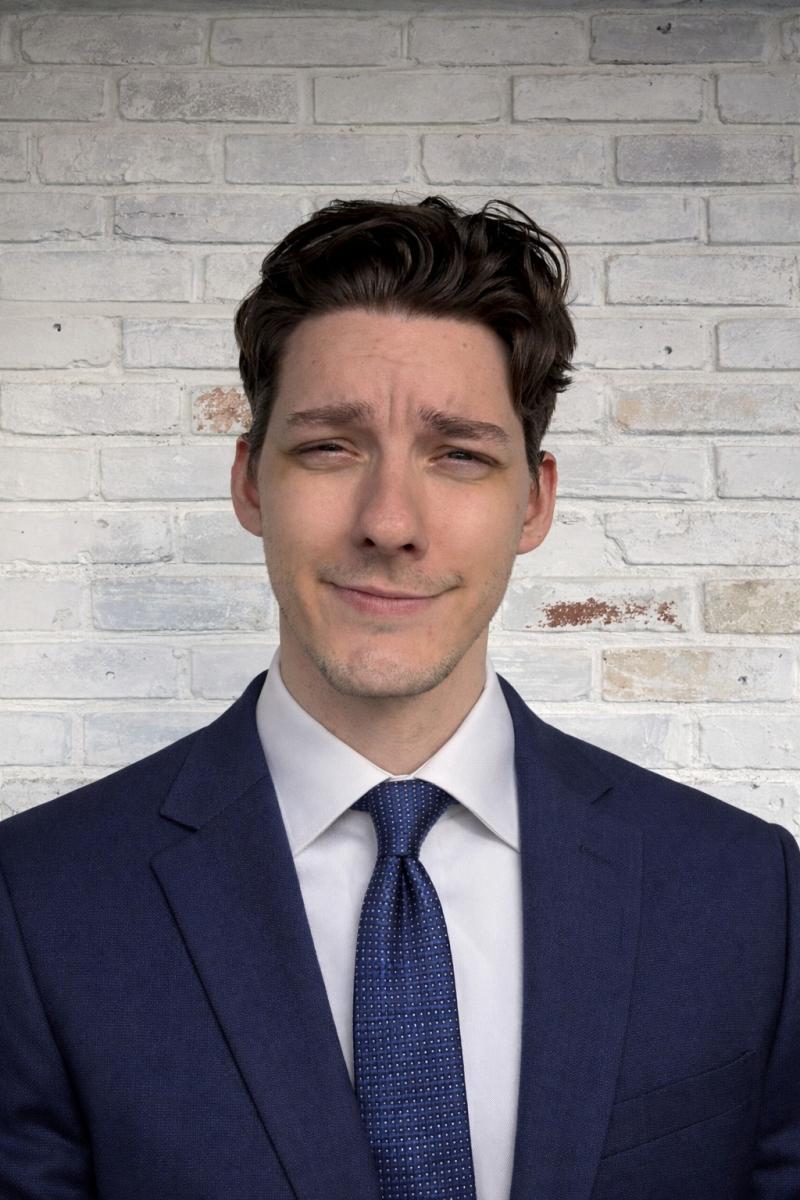
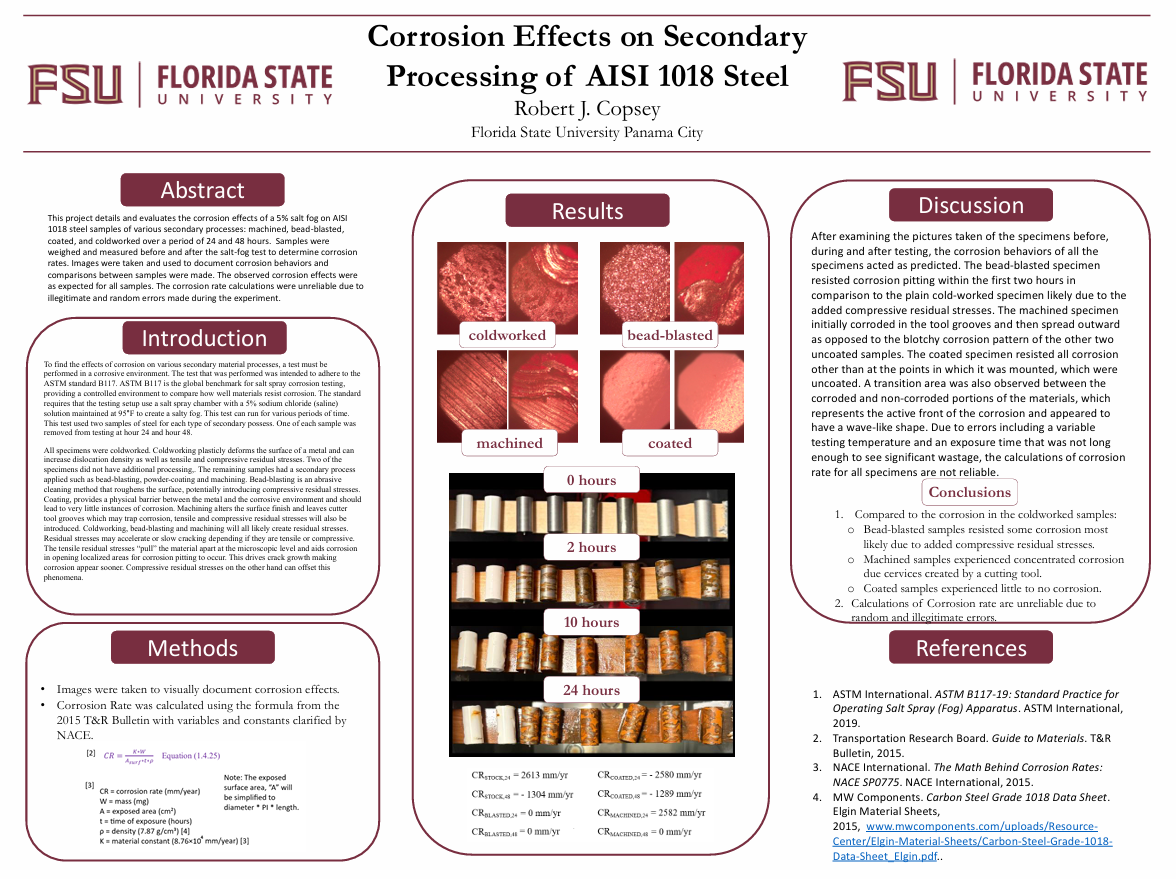
B.S. Mechanical Engineering | I am an FSU-PC Mechanical Engineering Undergraduate from Panama City, Florida with an interest in Mechanical System Design and Material Selection. | Corrosion Effects on Secondary Processing of AISI 1018 Steel | This project details and evaluates the corrosion effects of a 5% salt fog on AISI 1018 steel samples of various secondary processes: machined, bead-blasted, coated, and coldworked over a period of 24 and 48 hours. Samples were weighed and measured before and after the salt-fog test to determine corrosion rates. Images were taken and used to document corrosion behaviors and comparisons between samples were made. The observed corrosion effects were as expected for all samples. The corrosion rate calculations were unreliable due to illegitimate and random errors made during the experiment. |
Yvonne Traynham | Florida State University | Mechanical Engineering | ytraynham@eng.famu.fsu.edu | Corrosion, Steel, Experiment | Complete |
|
No | 2026 | 5th annual Undergraduate Research Symposium, April 17, 2025 | https://pc.fsu.edu/student-research/symposium/research-symposium-program-portal?element_parents=elements/student_photo&ajax_form=1&_wrapper_format=drupal_ajax&token=djNWoCsc0koHCfOdLr-_X2A8bxGsTmEn0E48Uj8D1Zw | |||||
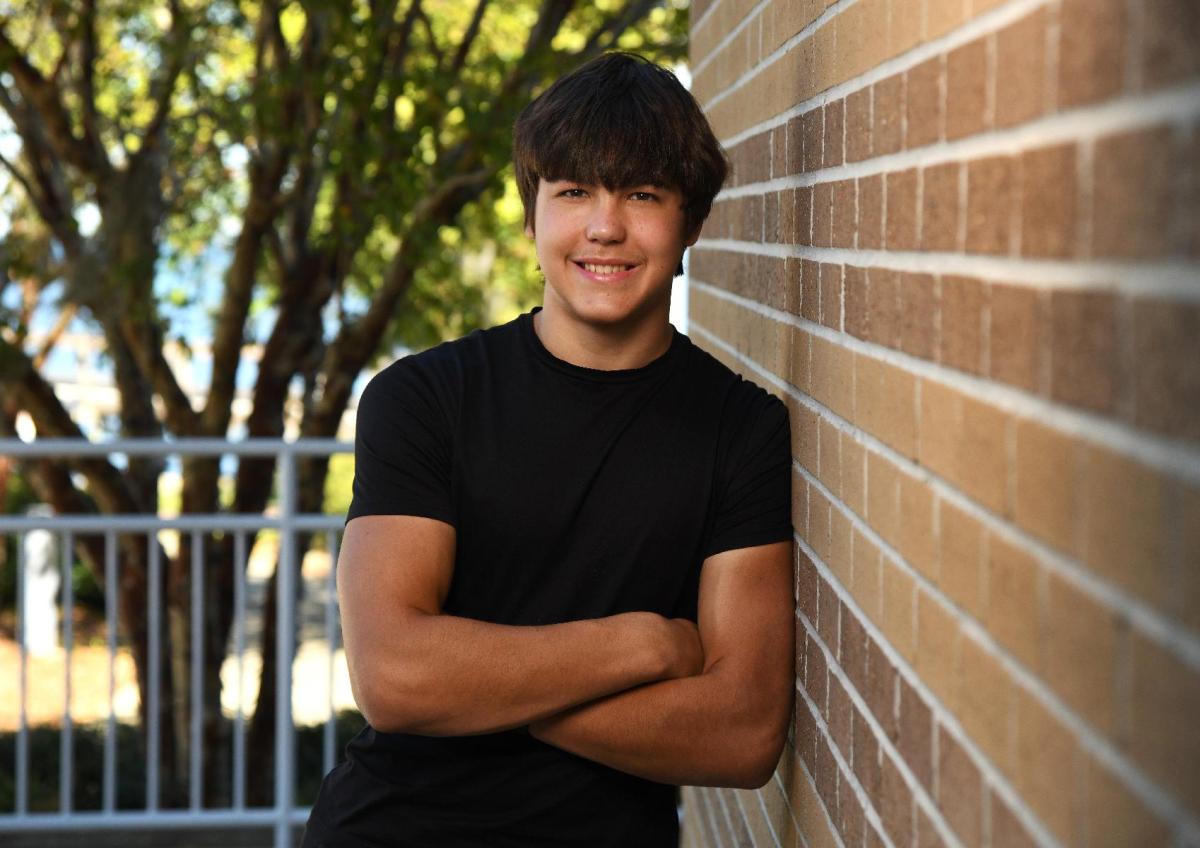
| 236 | 9084 | Face to Face Poster session | 11:15 High School presentations | Student Research Symposium Program Portal: Submission #236 | 70ea5058-6985-4318-9dae-ca1df63448bd | No | Star/flag Student Research Symposium Program Portal: Submission #236 | Lock Student Research Symposium Program Portal: Submission #236 | Add notes to Student Research Symposium Program Portal: Submission #236 | Sat, 01/31/2026 - 05:21 PM | Sat, 01/31/2026 - 05:21 PM | Fri, 04/03/2026 - 03:08 PM | Anonymous | 50.4.42.23 | Alex | Bashkinov | he him | aab23l@fsu.edu |
|
Business | My name is Alex Bashkinov, and I am a junior at The Collegiate School at FSU PC. | The Effects of Home Field Advantage in Sports | Home field advantage is a widely discussed concept in sports that suggests teams perform better when they play at their home venue rather than away. This research focuses on understanding whether home field advantage truly has a measurable impact on team performance in major professional sports leagues. The central question this study addresses is whether teams win more often and perform better statistically when playing at home compared to playing away. Previous research has shown that factors such as crowd support, familiarity with the playing environment, reduced travel, and possible referee bias may all contribute to this advantage. While many studies support the existence of home field advantage, some focus on only one sport or use older data, leaving room for further comparison using recent and consistent data. The goal of this research is to examine home field advantage across multiple sports leagues in a simple and organized way. This study is important because game location can influence coaching strategies, athlete preparation, and sports predictions. To collect data, publicly available game statistics from recent seasons will be gathered from official league websites. These records will be used to compare home and away wins as well as scoring differences. It is expected that the findings will show teams perform better at home, which would support existing research and help explain why home field advantage continues to play a significant role in sports outcomes. | Madisyn Flammia | the Collegiate School | Research | mjf24@fsu.edu | Homefield advantage research | Exploratory (the research question has been identified and design of approach is outlined) | A. Bashkinov Poster.pptx146.59 KB
|
No | 2026 | 5th annual Undergraduate Research Symposium, April 17, 2025 | https://pc.fsu.edu/student-research/symposium/research-symposium-program-portal?element_parents=elements/student_photo&ajax_form=1&_wrapper_format=drupal_ajax&token=rtnwkevuqK2sXE3JMF1DQRkiqSIDMDMRT4WsOu6XgNg | ||||
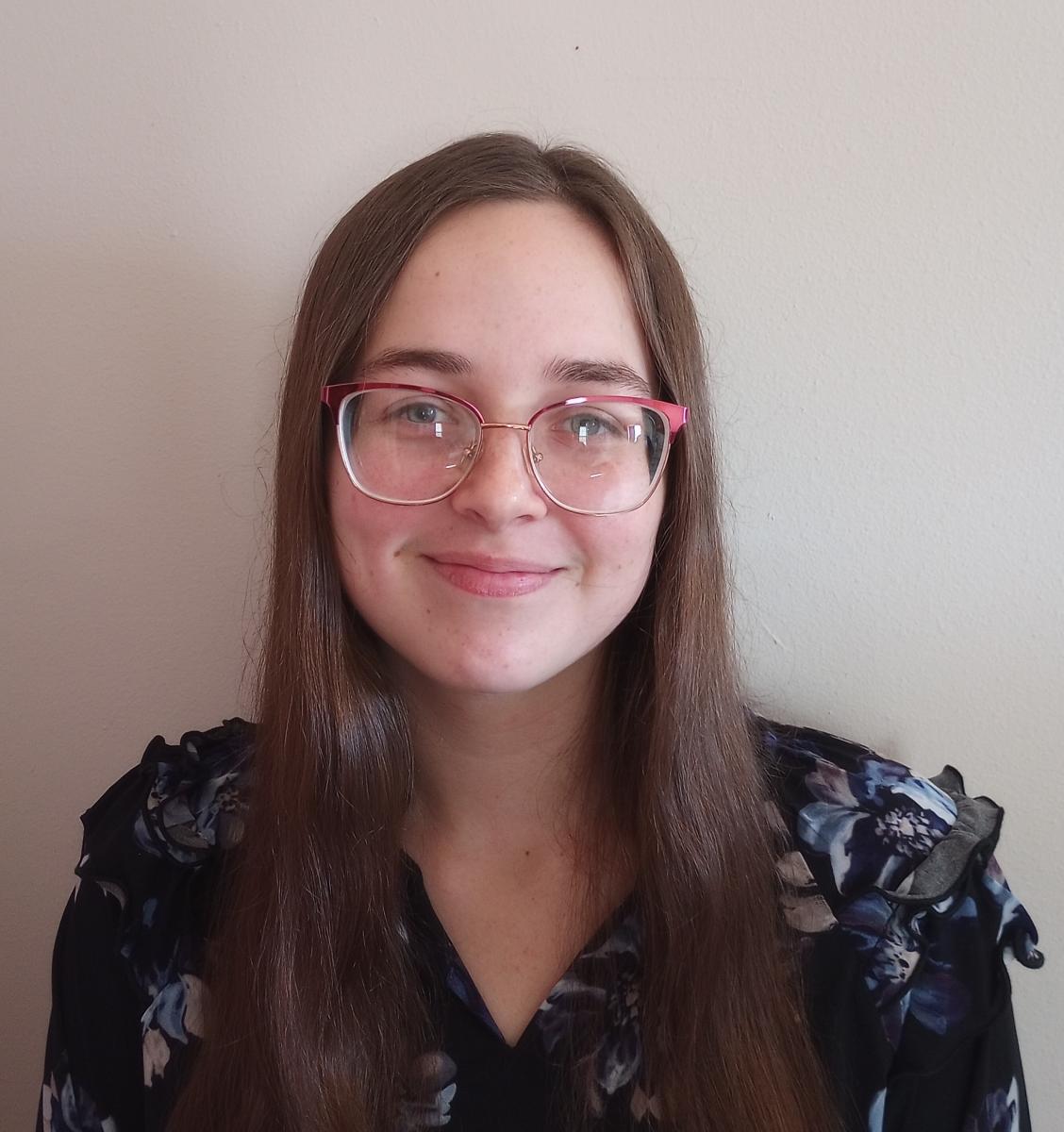
| 235 | 9083 | Face to Face Poster session | 10:00 Graduate and Undergraduate presentations | Student Research Symposium Program Portal: Submission #235 | 33013051-46b3-413c-ab8a-e1e8923f103d | No | Star/flag Student Research Symposium Program Portal: Submission #235 | Lock Student Research Symposium Program Portal: Submission #235 | Add notes to Student Research Symposium Program Portal: Submission #235 | Sat, 01/31/2026 - 01:40 PM | Sat, 01/31/2026 - 01:42 PM | Fri, 04/03/2026 - 03:07 PM | Anonymous | 2607:fb90:d504:d747:e5a5:2b6f:4ab0:3066 | Paige | Allen | pa25e@fsu.edu |
|
Psychology | My short term goal that I am currently working towards is completing my bachelors degree while gaining extensive research experience in clinical fields and my long term goal is to attend medical school. | Racial Discrimination and Hypertension in African Americans: A Systematic Review and Meta-Analysis | Systemic discrimination continues to influence cardiovascular health in African American adults. Previous studies have focused on the physiological mechanisms that could be influencing the high rates of uncontrolled blood pressure. However, this study examines the relationship between racial discrimination and the ubiquity of hypertension in African Americans. Systematic review and meta-analysis are conducted to synthesize data from landmark cohorts, such as the Jackson Heart Study, to establish a definitive baseline for how discrimination-induced stress correlates with 24-hour ambulatory blood pressure (ABPM). The Everyday Discrimination Scale (EDS) and Experiences of Discrimination (EOD) are utilized to validate data. Blood pressure outcomes are determined by collated office blood pressure, home monitoring, and 24-hour ambulatory (ABPM) data, with moderators and covariates including John Henryism, age, gender, and socioeconomic status. The research indicates a positive relationship between lifetime discrimination and burden of discrimination with a greater prevalence of hypertension. Examining the high-effort coping, known as John Henryism as a moderator and the racial disparities within clinical settings provides the potential to bridge the gap between mental health and cardiovascular physiology. | Dr. Bre Minniefield | Florida State University | Biological Sciences | bminniefield@pc.fsu.edu | Hypertension, Racial Disparities, Cardiovascular, Healthcare | Exploratory (the research question has been identified and design of approach is outlined) | No | 2026 | 5th annual Undergraduate Research Symposium, April 17, 2025 | https://pc.fsu.edu/student-research/symposium/research-symposium-program-portal?element_parents=elements/student_photo&ajax_form=1&_wrapper_format=drupal_ajax&token=St9juY6L-20-SiGpDcCl-NKumaSHkbrXKAx7yOho7Tc | ||||||
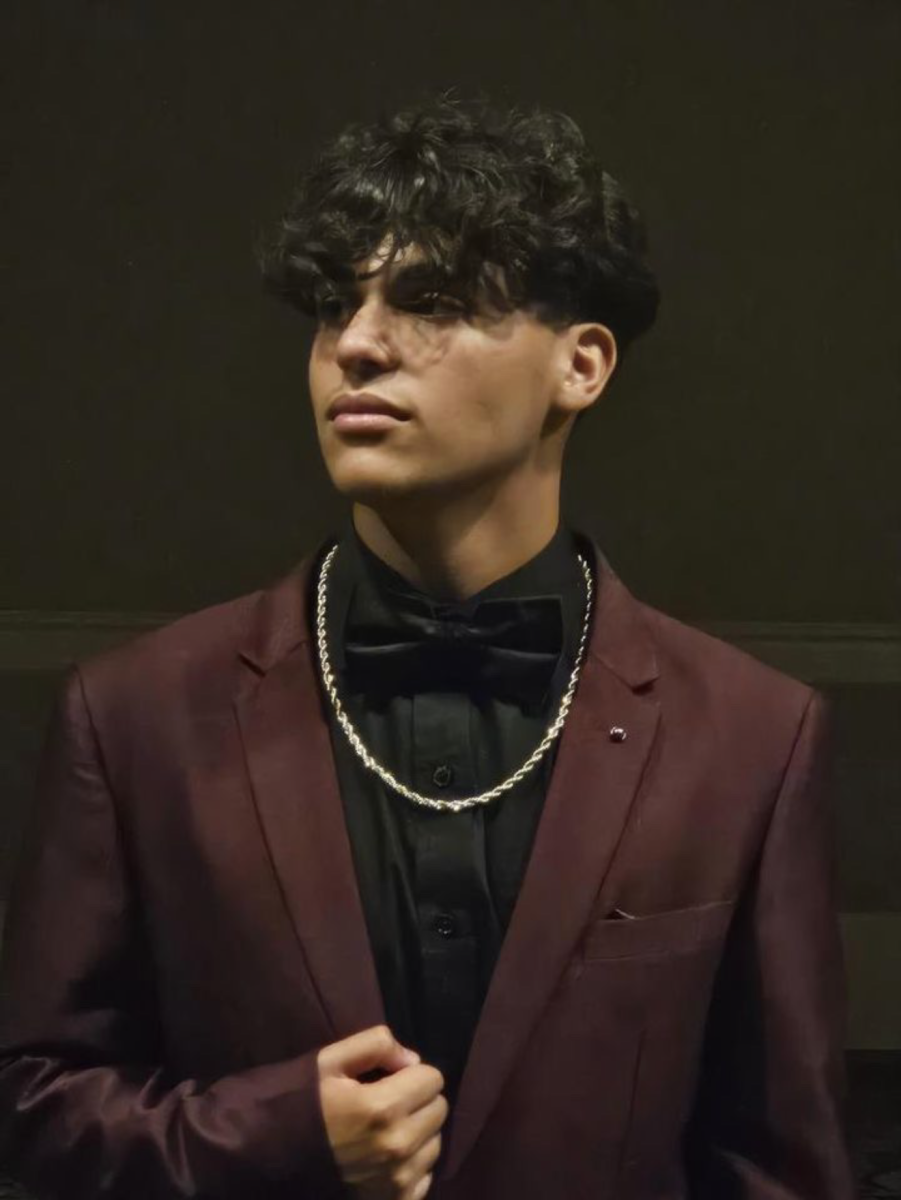
| 234 | 9082 | Face to Face Poster session | 11:15 High School presentations | Student Research Symposium Program Portal: Submission #234 | 67e15ed8-4960-41fe-865b-961ed55e9662 | No | Star/flag Student Research Symposium Program Portal: Submission #234 | Lock Student Research Symposium Program Portal: Submission #234 | Add notes to Student Research Symposium Program Portal: Submission #234 | Sat, 01/31/2026 - 01:13 PM | Sat, 01/31/2026 - 01:13 PM | Fri, 04/03/2026 - 03:07 PM | Anonymous | 2a09:bac2:6e44:2fd7::4c4:44 | Yezen | Abdelkader | He/Him | yaa24@fsu.edu |
|
Dual enrolled student, intended major is English and pre Law | My name is Yezen Abdelkader, and I am a proud junior student at The Collegiate School at FSU PC. Ever since I was young, I have always been fascinated by the complexity of our judicial system. I particularly became obsessed with the idea of becoming a lawyer. Lawyers are the officers of our judicial system, and they are essential. I have a considerable desire to master my understanding of the law, our judicial system, legal reasoning, and the client / lawyer relationship. | How is A.I transforming the practice of corporate law? | Artificial Intelligence usage is growing at a rapid pace, altering the way we live our lives, perform our jobs, complete school work, and much more. I believe that one of the most important changes is in the legal field, more specifically, in corporate law. There has been minimal research regarding how artificial intelligence is transforming the practice of corporate law, especially with regards to contract reviews, compliance, and possible risks. The goal of my research is to determine whether A.l (artificial intelligence) will be detrimental or beneficial to the practice of corporate law. This is important because corporate law is one of the largest fields of law, and A.I, having recently emerged as widely used technology, is not comprehensively regulated, and its uses may not be known by the public. I intend to collect data by speaking with lawyers directly and conducting comprehensive reviews of Al's existing uses in the corporate law space via online databases reviews of Al's existing uses in the corporate law space via online databases such as the Damien Charlotin public report on over 871 cases of A.I in the legal field. I anticipate the findings of my research will be significant in helping us better understand ways to incorporate artificial intelligence into law-related fields, whether that be with tighter regulations, looser regulations, or banning Al usage altogether in specific capacities (such as in trial preparations, etc.). |
Madi Flammia | The Collegiate school at FSU PC | Research | mjf24@fsu.edu | Yezen Abdelkader | Exploratory (the research question has been identified and design of approach is outlined) | Y. Abdelkader Poster.pdf397.66 KB
|
No | 2026 | 5th annual Undergraduate Research Symposium, April 17, 2025 | https://pc.fsu.edu/student-research/symposium/research-symposium-program-portal?token=qfXqd12AheEHCym4a9muhoQGLgCqUD50sEYmF1CLiRY | ||||
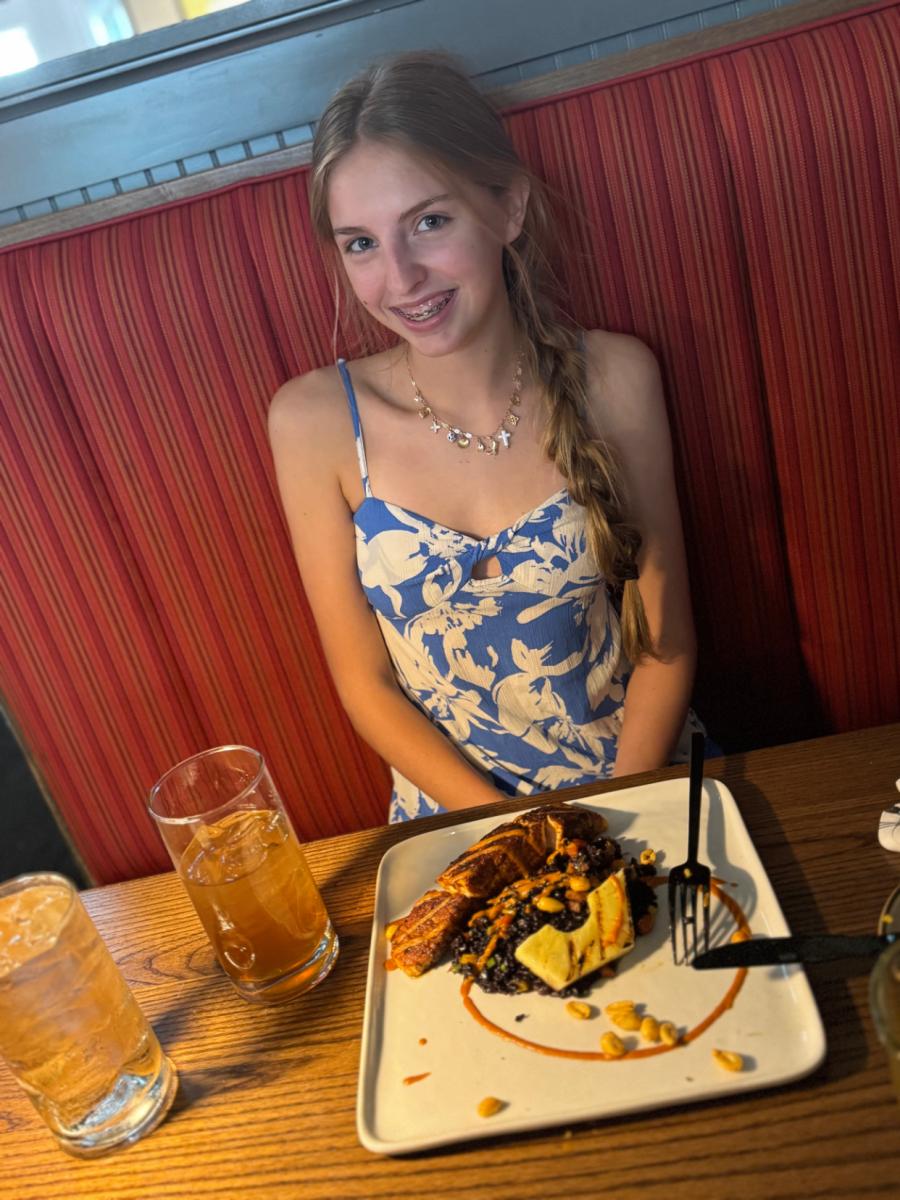
| 233 | 9081 | Face to Face Poster session | 11:15 High School presentations | Student Research Symposium Program Portal: Submission #233 | 64520dc1-23dc-4fca-83dc-07bf28603232 | No | Star/flag Student Research Symposium Program Portal: Submission #233 | Lock Student Research Symposium Program Portal: Submission #233 | Add notes to Student Research Symposium Program Portal: Submission #233 | Sat, 01/31/2026 - 10:18 AM | Sat, 01/31/2026 - 10:26 AM | Fri, 04/03/2026 - 02:01 PM | Anonymous | 24.42.202.239 | Valerie | Downing | xdownva@bayhaven.org |
|
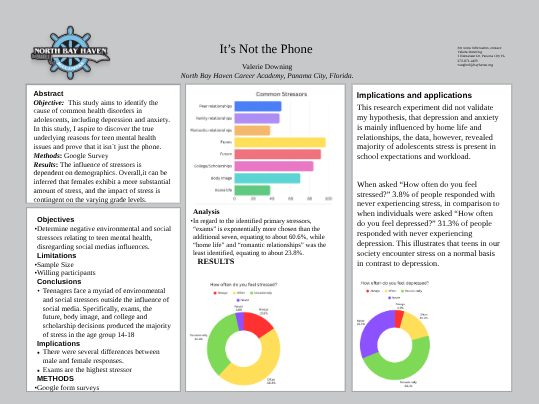
Veternarian | Hi! I'm Valerie Downing, and I'm a Junior from North Bay Haven. I've lived in Florida for most of my life, and I'm itching to explore the rest of the world. I love animals, love to read, and love to help in any way I can! However, the most important thing in my life is my faith, and that is the only reason I'm able to do everything I do. | It's Not the Phone | In today's society, adolescents are commonly diagnosed with a plethora of disorders. Researchers and doctors in this field have come to one conclusion: social media. However, this study addresses the gap that countless researchers continue to overlook, that the majority of mental health illnesses diagnosed are caused by social media. This study aims to identify the cause of common health disorders in adolescents, including depression and anxiety. In this study, I aspire to discover the true underlying reasons for teen mental health issues and prove that it isn´t just the phone. |
Robin Vaughn | North Bay Haven Career Academy | Language Arts | vaughrl@bayhaven.org | Teen Mental Health | Complete | Copy of NBH_Template.pptx.pdf397.19 KB
|
|
No | 2026 | 5th annual Undergraduate Research Symposium, April 17, 2025 | https://pc.fsu.edu/student-research/symposium/research-symposium-program-portal?element_parents=elements/student_photo&ajax_form=1&_wrapper_format=drupal_ajax&token=ToK6Q3xyQJ4Br3ec9PnXIuyQZGkUXTwgkwQ--RpFNEw | ||||
| 231 | 9079 | Face to Face Poster session | 11:15 High School presentations | Student Research Symposium Program Portal: Submission #231 | 26279ba4-b14d-420c-80a2-470f4a3d8916 | No | Star/flag Student Research Symposium Program Portal: Submission #231 | Lock Student Research Symposium Program Portal: Submission #231 | Add notes to Student Research Symposium Program Portal: Submission #231 | Fri, 01/30/2026 - 11:37 PM | Sat, 01/31/2026 - 12:09 AM | Fri, 04/03/2026 - 02:01 PM | Anonymous | 23.28.168.43 | Zoey | Cajote | She/Her | zhc23@fsu.edu |
|
High School Dual-Enrollment, Intended Major: Psychology | I am Zoey Cajote, a student at The Collegiate School at Florida State University. I intend to major in psychology and have strong interests in developmental psychology, political science, and pre-law. I wish to pursue a career in children’s psychology so that I can foster positivity in the upcoming generations of my community. Through this, I hope to help children from all walks of life become the best versions of themselves. | Understanding the Development of Cluster B Personality Disorders | In the field of psychology, personality disorders are recognized as serious and disruptive mental illnesses that can significantly affect an individual’s quality of life and interpersonal functioning. These disorders involve long-term maladaptive patterns including thinking, feeling, and behaving that do not align with cultural expectations and often cause distress or impairment. Among these conditions, Cluster B personality disorders such as borderline, narcissistic, antisocial, and histrionic personality disorders, are often considered particularly difficult to manage due to their association with emotional instability, impulsivity, and problematic relationships. When studying these disorders, an important question arises regarding what factors contribute to their development. Current research suggests that the development of Cluster B personality disorders is influenced by multiple factors, including childhood experiences and biological predispositions. Early life adversity, such as trauma or neglect, may play a significant role in shaping emotional regulation and behavioral patterns, while genetic and neurological vulnerabilities may also increase risk. This paper analyzes existing literature, identifies gaps in research, and proposes directions for future study. | Madisyn Flammia | The Collegiate School | Research | mjf24@fsu.edu | development, psychology, personality, disorder, perspective | Complete | Z. Cajote Poster.pdf433.86 KB
|
No | 2026 | 5th annual Undergraduate Research Symposium, April 17, 2025 | https://pc.fsu.edu/student-research/symposium/research-symposium-program-portal?element_parents=elements/student_photo&ajax_form=1&_wrapper_format=drupal_ajax&token=RCdnAxbSJOng2WTnrFc8caklp2GV6WopTjzLOW8pphU | ||||
| 230 | 9078 | Face to Face Poster session | 10:00 Graduate and Undergraduate presentations | Student Research Symposium Program Portal: Submission #230 | b4a56468-325d-4d32-9927-461f870039f3 | No | Star/flag Student Research Symposium Program Portal: Submission #230 | Lock Student Research Symposium Program Portal: Submission #230 | Add notes to Student Research Symposium Program Portal: Submission #230 | Fri, 01/30/2026 - 11:02 PM | Fri, 01/30/2026 - 11:02 PM | Fri, 04/03/2026 - 02:00 PM | Anonymous | 146.201.10.27 | Krieg | Conrad | He/Him | kc22bq@fsu.edu |
|
Krieg Conrad - Mechanical Engineering | Krieg Conrad is a senior Mechanical Engineering student at Florida State University Panama City with interests in embedded systems, wearable technology, and multidisciplinary engineering design. He serves as President of the FSU Panama City Student Government Council, where he leads student-focused initiatives and manages large-scale budgets and projects. Krieg has professional experience in precision machining, shipbuilding, and defense-related engineering through internships with Maritech Machine Inc. and Eastern Shipbuilding Group, where he supported CAD development, system verification, and fabrication workflows for U.S. Coast Guard vessels. He has also worked as a Digital Design Studio Technician and Peer Tutor, supporting student projects in CAD, fabrication, and electronics. In addition to his academic work, Krieg is the Project Leader for FSU’s NASA University Student Launch Initiative (USLI) team, overseeing system design, analysis, and integration for the competition rocket. His technical interests include PCB design, sensor integration, additive manufacturing, and open-source hardware development aimed at improving accessibility and educational impact. |
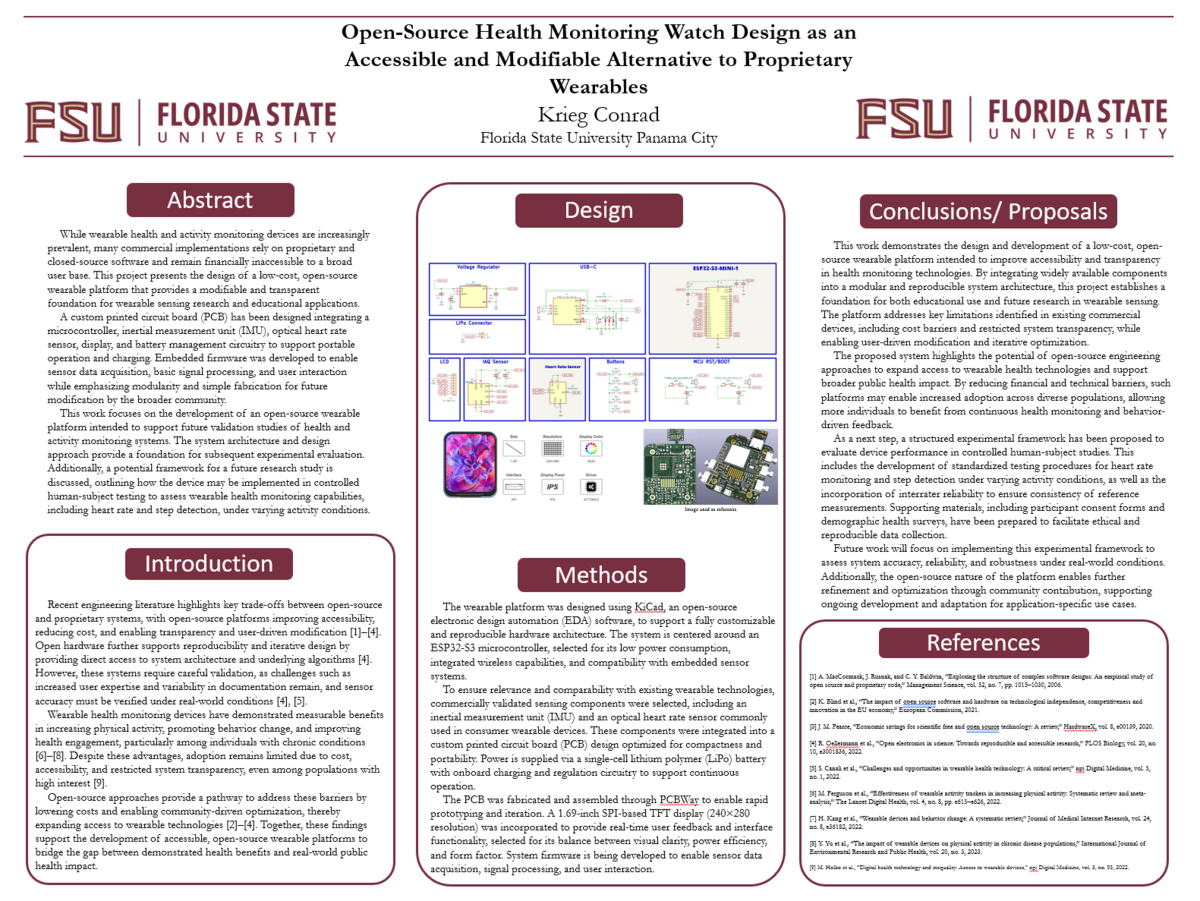
Open-Source Health Monitoring Watch Design as an Accessible and Modifiable Alternative to Proprietary Wearables | While wearable health and activity monitoring devices are increasingly prevalent, many commercial implementations rely on proprietary and closed-source software and remain financially inaccessible to a broad user base. This project presents the design of a low-cost, open-source wearable platform that provides a modifiable and transparent foundation for wearable sensing research and educational applications. A custom printed circuit board (PCB) has been designed integrating a microcontroller, inertial measurement unit (IMU), optical heart rate sensor, display, and battery management circuitry to support portable operation and charging. Embedded firmware was developed to enable sensor data acquisition, basic signal processing, and user interaction while emphasizing modularity and simple fabrication for future modification by the broader community. This work focuses on the development of an open-source wearable platform intended to support future validation studies of health and activity monitoring systems. The system architecture and design approach provide a foundation for subsequent experimental evaluation. Additionally, a potential framework for a future research study is discussed, outlining how the device may be implemented in controlled human-subject testing to assess wearable health monitoring capabilities, including heart rate and step detection, under varying activity conditions. |
Twan Capehart | Florida State University | Mechanical Engineering | tcapehart@pc.fsu.edu | health monitoring, proprietary technology, open source technology, wearables | Exploratory (the research question has been identified and design of approach is outlined) |
|
No | 2026 | 5th annual Undergraduate Research Symposium, April 17, 2025 | https://pc.fsu.edu/student-research/symposium/research-symposium-program-portal?element_parents=elements/student_photo&ajax_form=1&_wrapper_format=drupal_ajax&token=QYo7tUP4BQQlUQMcV2hSqfnt2CnvxNkgMdf-LynBEk4 | ||||
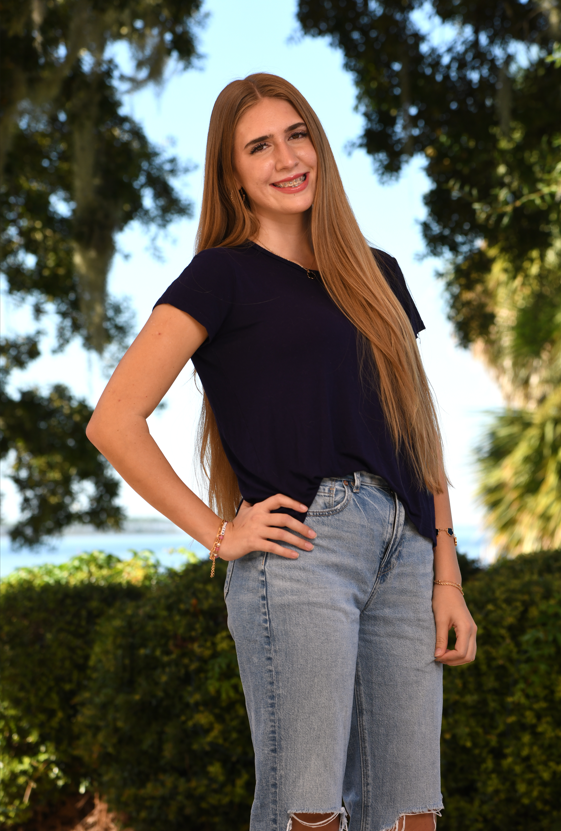
| 227 | 9075 | Face to Face Poster session | 11:15 High School presentations | Student Research Symposium Program Portal: Submission #227 | 6ed714c8-60fa-4b0a-a4ff-08c02c8caaea | No | Star/flag Student Research Symposium Program Portal: Submission #227 | Lock Student Research Symposium Program Portal: Submission #227 | Add notes to Student Research Symposium Program Portal: Submission #227 | Fri, 01/30/2026 - 10:05 PM | Fri, 01/30/2026 - 10:06 PM | Fri, 04/03/2026 - 01:59 PM | Anonymous | 67.177.84.222 | Tariana | Trzaska | She/Her | trt25b@fsu.edu |
|
Dual Enrolled Student; Intended Major - Communications | My name is Tariana Trzaska, and I am an eleventh-grade student at The Collegiate School at FSU PC. I was born and raised in Panama City, Florida. My major is currently undecided. I am passionate about travel, and I enjoy spending time with friends and family. | The Adventure Algorithm: Social Media and the Struggle for Adventure Tourism in New Zealand. | Adventure tourism has seen rapid growth in recent years, with social media playing a major role in how destinations and experiences are promoted. This study examines whether social media engagement may help explain why adventure tourism to New Zealand appears to be falling behind. To test this, a comparative content analysis was conducted using social media posts from adventure tourism businesses in New Zealand, Brazil, and Costa Rica. A total of 45 posts were analyzed, with 15 posts from businesses in each country. Engagement metrics such as likes, shares, and comments were examined along with content type and creator information. These engagement patterns were then compared across the three countries. Results showed that Brazil received the most online engagement overall, while New Zealand posts generated significantly higher numbers of shares. Costa Rica demonstrated the lowest engagement numbers overall. The significance of this research is that it may provide insight into how social media marketing strategies influence tourism interest and help identify ways New Zealand adventure tourism businesses could improve their online promotion. | Madi Flammia | The Collegiate School at FSU PC | Research | mjf24@fsu.edu | Dr. Wendy Ritz | Adventure Tourism, Social Media, Marketing | Complete | T. Trzaska Poster.pdf168.6 KB
|
No | 2026 | 5th annual Undergraduate Research Symposium, April 17, 2025 | https://pc.fsu.edu/student-research/symposium/research-symposium-program-portal?element_parents=elements/student_photo&ajax_form=1&_wrapper_format=drupal_ajax&token=8Rti7OQSXcDylHHqwX1egoUEY6Yloqy6Ccu7069lSR8 | |||
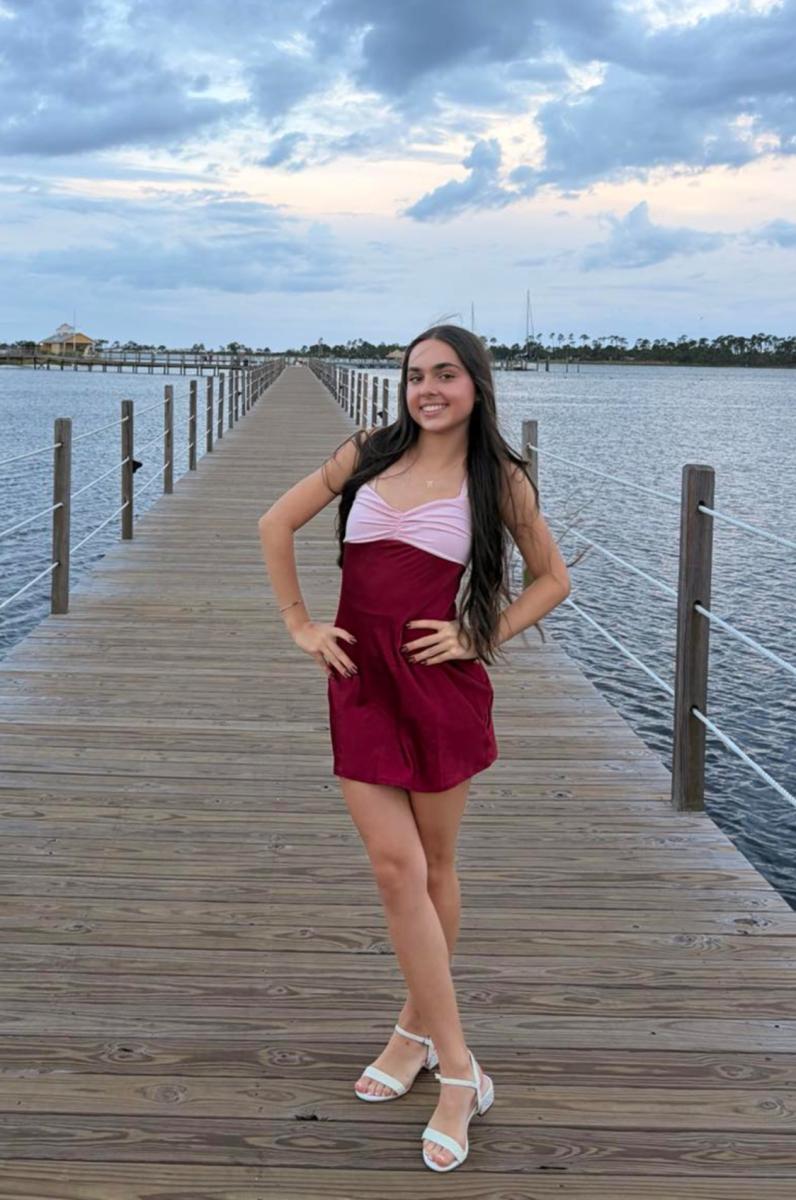
| 229 | 9077 | Face to Face Poster session | 11:15 High School presentations | Student Research Symposium Program Portal: Submission #229 | 8a09453a-2454-4381-895a-d850c3c64c73 | No | Star/flag Student Research Symposium Program Portal: Submission #229 | Lock Student Research Symposium Program Portal: Submission #229 | Add notes to Student Research Symposium Program Portal: Submission #229 | Fri, 01/30/2026 - 09:49 PM | Fri, 01/30/2026 - 10:51 PM | Fri, 04/03/2026 - 01:59 PM | Anonymous | 2601:4c1:c001:3db0:376:c25c:920:a014 | Yelyzaveta | Kovalenko | She/Her | xkovay@baystudent.org |
|
AP Research | My name is Yelyzaveta Kovalenko, I am a junior at J.R. Arnold High School, and I am enrolled in the AP Research course. I was born and raised in Ukraine until I moved to the United States at the age of 10. One of the biggest differences I noticed after moving was the difference in what types of cartoons my peers and I grew up watching. I saw how differently the cartoons shaped my identity and how the cartoons that my peers grew up watching have shaped their personalities and identities. I found it very interesting to learn more about how diverse cartoons shape children's identity and development. |
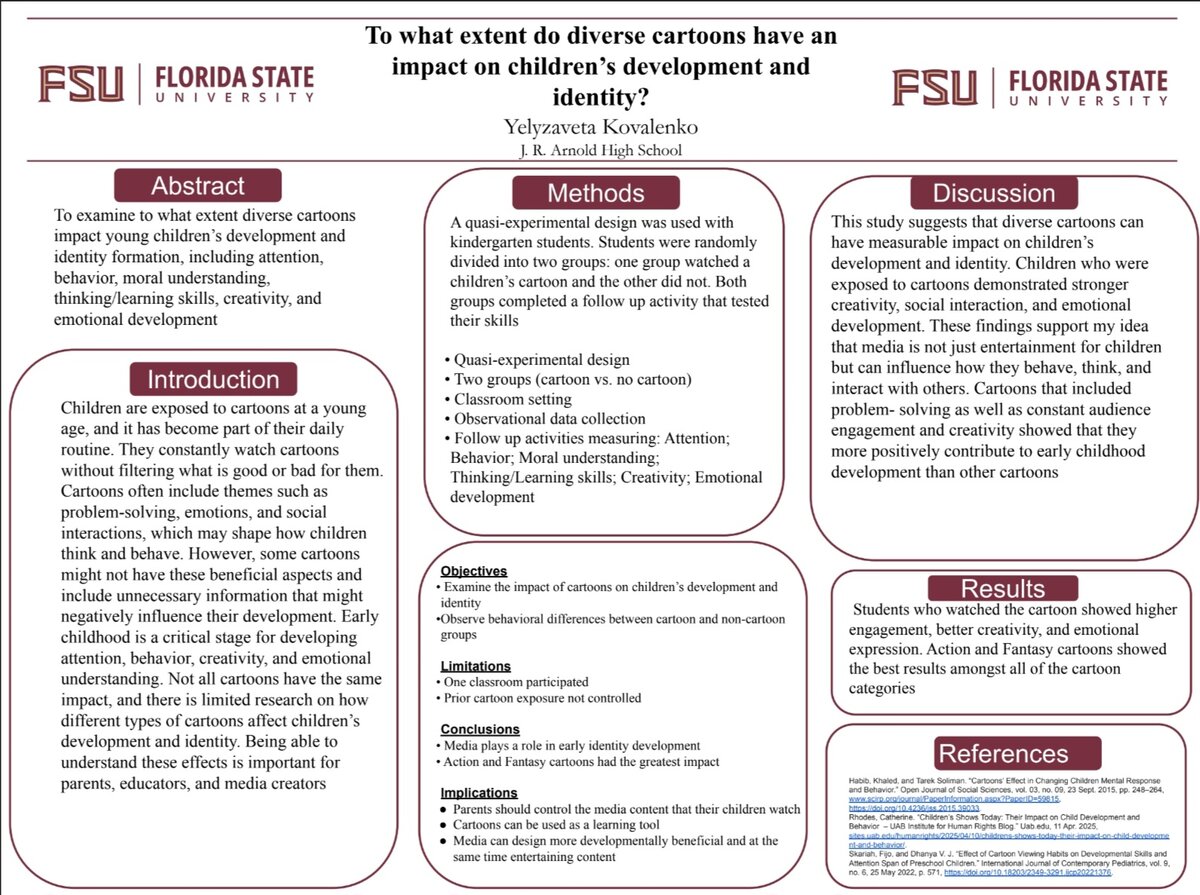
To what extent do diverse cartoons have an impact on children's development and identity? | This study examines how cartoons impact children's development and identity formation. I wanted to focus specifically on diverse cartoons, meaning researching the effect of different genre categories and not grouping all cartoons into a single category. The categories are educational, moral/value- based, action, comedy, fantasy, emotional/social learning, problem-solving, and friendship cartoons. My research focuses on finding out the relationship between the cartoons and how they affect children's aspects in development, such as attention, behavior, moral understanding, thinking/learning skills, creativity, and emotional development. In order to find out the effects of the cartoons, I did an experiment in a kindergarten class, where I observed the difference in children's behavior and actions between the ones that watched a cartoon and the ones that did not. I used the quasi-experimental research design with an observational method in order to examine how diverse cartoons affect children's development and identity at a young age. My main findings from this experiment are that children tend to show better results after watching comedy, action, and fantasy cartoons, as they are more engaged in the process and communicate more and give more and better answers. Cartoons such as problem-solving, educational, value-based, and emotional cartoons did not impact the tested aspects as much as the other cartoons did. | Doedy Deal | J.R. Arnold High School | AP Research | dealdm@bay.k12.fl.us | Cartoons, Diverse Cartoons, Identity Formation, Development | Complete | 1FSU_20241114_0.pdf236.92 KB
|
|
No | 2026 | 5th annual Undergraduate Research Symposium, April 17, 2025 | https://pc.fsu.edu/student-research/symposium/research-symposium-program-portal?element_parents=elements/student_photo&ajax_form=1&_wrapper_format=drupal_ajax&token=W3q-d7g4XRXNCYSnWB5LeE6PtPGDdDzBoRDefnSS1_M | |||
| 225 | 9073 | Face to Face Poster session | 10:00 Graduate and Undergraduate presentations | Student Research Symposium Program Portal: Submission #225 | 120b4a2b-8bc4-49fe-897f-ef87f8e5e97a | No | Star/flag Student Research Symposium Program Portal: Submission #225 | Lock Student Research Symposium Program Portal: Submission #225 | Add notes to Student Research Symposium Program Portal: Submission #225 | Fri, 01/30/2026 - 09:39 PM | Fri, 01/30/2026 - 09:40 PM | Fri, 04/10/2026 - 03:25 PM | Anonymous | 2601:4c1:c400:61e0:78ef:da58:295e:b9a0 | Jacob Hernandez, Addie Cope, Branden Hardtke, | Ryan Furniss, Jared Williams | jah22s@fsu.edu |
|
All Civil Engineering | N/A | Pine Log State Forest Expansion | Research Symposium Abstract The Pine Log State Forest Expansion involves the planning and design of numerous structures and amenities developed to support increased public use while preserving the site’s natural environmental character. The project is located in Washington County, Florida, just 14 miles north of Panama City Beach, on a site encompassing approximately 90 acres of mixed uplands, wetlands, and open-water features. Facilities include a two-story visitor center with an 80 ft 60 ft floorplan (9600 square feet total), a parking lot, a multi-use path, public pavilions, pedestrian bridges, a boardwalk, restroom facilities, and the associated utilities/roadway improvements. The project will consist of one stormwater retention pond located downslope of the parking lot and main visiting center area. The water flow will be directed towards the SWMF through natural drainage patterns and roadside swales. A wastewater lift station will also be implemented to reliably convey wastewater from the visitor center and restroom facilities to the designated treatment system. A natural vegetative buffer will also be present downslope of the pavilion area to protect the nearby wetland systems. |
Dr. Hafiz Ahmad | N/A | N/A | hahmad@pc.fsu.edu | Civil Engineering | Complete | PineLog_Poster.pptx5.88 MB
|
No | 2026 | 5th annual Undergraduate Research Symposium, April 17, 2025 | https://pc.fsu.edu/student-research/symposium/research-symposium-program-portal?element_parents=elements/student_photo&ajax_form=1&_wrapper_format=drupal_ajax&token=wYFj-9fKgpcRch-wPxR9YLWBp7jcRAGjXdD7y9MFdgA |