
Student Research Symposium Program Portal
220 submissions
| # | SID | Presentation Modality | Poster Session/Number | Submission title | UUID | In draft | Starred | Locked | Notes | Created | Completed | Changed | User | IP address | Primary Student Contact First Name | Primary Student Contact Last Name | Pronouns | Primary Student Contact FSU Student Email | Photo of all individuals presenting this work | Major(s) of all individuals presenting this work | Bio of all individuals presenting this work | Poster Title | Abstract | Research Mentor Name | Research Mentor's College (or High School) | Research Mentor's Department (or Subject) | Research Mentor's Email | Additional Research Mentor(s) | Co-presenter(s) | Keywords | Work | Poster PDF or Powerpoint | Poster Thumbnail | I will be printing my poster | Year | Annual description | Update URL | Operations |
|---|---|---|---|---|---|---|---|---|---|---|---|---|---|---|---|---|---|---|---|---|---|---|---|---|---|---|---|---|---|---|---|---|---|---|---|---|---|---|
| 224 | 9072 | Face to Face Poster session | 10:00 Graduate and Undergraduate presentations | Student Research Symposium Program Portal: Submission #224 | c2cfe217-489b-46c3-abe9-4454474d917b | No | Star/flag Student Research Symposium Program Portal: Submission #224 | Lock Student Research Symposium Program Portal: Submission #224 | Add notes to Student Research Symposium Program Portal: Submission #224 | Fri, 01/30/2026 - 08:40 PM | Fri, 01/30/2026 - 08:49 PM | Fri, 04/10/2026 - 03:26 PM | Anonymous | 50.4.49.203 | Lin Ai | Liao | LL23T@FSU.EDU |

|
Accounting | I am a junior accounting major at FSU Panama City. I am from Tallahassee, Florida. I enjoy gardening, pickleball, volleyball, and ping pong. | Achieving Financial Stability for Nonprofit Organizations: A Strategic Approach to Revenue Generation and Cost Management | This study analyzed the strengths and weaknesses of a nonprofit organization. It provided a strategic approach to improving financial stability through revenue generation and cost management. The research method included financial forecast and financial ratio analysis. The findings showed that a nonprofit organization can optimize its revenues while keeping operating costs well-managed. |
Dr. Wendy Ritz | FSU Panama City | Business Administration | writz@fsu.edu | Financial Stability Nonprofit Organizations | Complete | No | 2026 | 5th annual Undergraduate Research Symposium, April 17, 2025 | https://pc.fsu.edu/student-research/symposium/research-symposium-program-portal?element_parents=elements/student_photo&ajax_form=1&_wrapper_format=drupal_ajax&token=bP8IBxx4j6JCBztr4m4uBUyOs8juR8xBQo-3hMZOoTI | ||||||
| 226 | 9074 | Face to Face Poster session | 10:00 Graduate and Undergraduate presentations | Student Research Symposium Program Portal: Submission #226 | 19b5f3cc-393a-4f90-98c7-7b733f8f9863 | No | Star/flag Student Research Symposium Program Portal: Submission #226 | Lock Student Research Symposium Program Portal: Submission #226 | Add notes to Student Research Symposium Program Portal: Submission #226 | Fri, 01/30/2026 - 06:41 PM | Fri, 01/30/2026 - 09:47 PM | Fri, 04/03/2026 - 01:58 PM | Anonymous | 2600:8807:9203:7000:7dad:d797:977b:2718 | Reagan | Hodges | reh25c@fsu.edu |
|
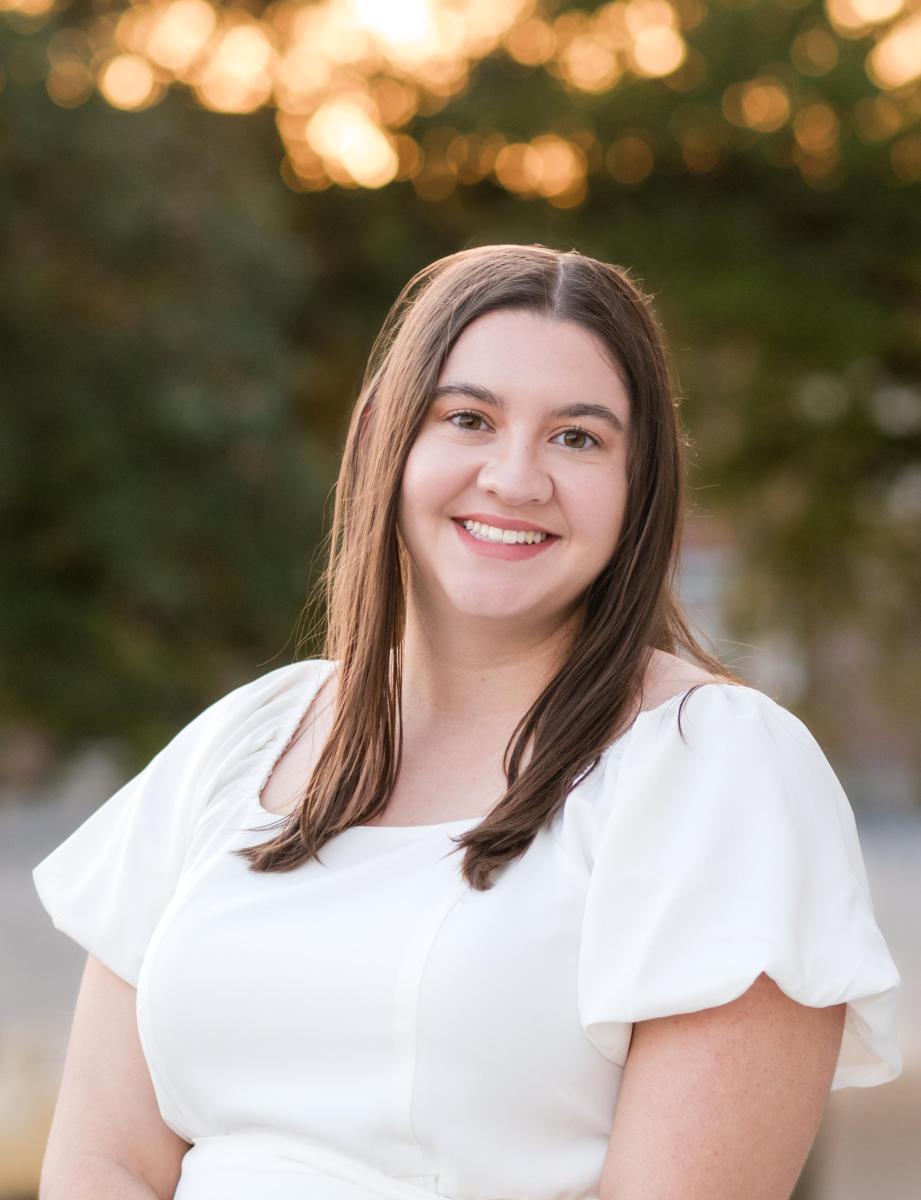
Psychology ABA - MS | Reagan Hodges has been a Registered Behavior Technician since July of 2024. She is a 2025 Graduate of Troy University with a BS in Psychology and a minor in Applied Behavior Analysis. She is currently a graduate student at Florida State University working on her MS in Psychology-Applied Behavior Analysis. | Decreasing Fingernail and Skin Picking During Academic Activities Through Replacement Behaviors | This self-management project examines a differential reinforcement of alternative behaviors (DRA) procedure aimed to decrease fingernail and skin picking during academic activities. The student self-recorded all instances of the target behavior and hypothesized the behavior to be automatically reinforced. Intervention consisted of having the student engage in the alternative behavior of playing with putty. The results found that the putty served as an effective alternative behavior to fingernail and skin picking, evidenced by a decrease in fingernail and skin picking. | Leah Koehler, Ph.D., BCBA-D | Florida State University | Applied Behavior Analysis | lkoehler@fsu.edu | Self-Management, Differential Reinforcement, Skin Picking | Complete | No | 2026 | 5th annual Undergraduate Research Symposium, April 17, 2025 | https://pc.fsu.edu/student-research/symposium/research-symposium-program-portal?element_parents=elements/student_photo&ajax_form=1&_wrapper_format=drupal_ajax&token=VQI0BBOT6E_21wrggHK9ePhWkR-eAVkJTgkRpGT4osM | ||||||
| 222 | 9070 | Face to Face Poster session | 10:00 Graduate and Undergraduate presentations | Student Research Symposium Program Portal: Submission #222 | 6fe29438-65bc-4d70-9665-d3cf72c6ff8b | No | Star/flag Student Research Symposium Program Portal: Submission #222 | Lock Student Research Symposium Program Portal: Submission #222 | Add notes to Student Research Symposium Program Portal: Submission #222 | Fri, 01/30/2026 - 05:54 PM | Fri, 01/30/2026 - 06:02 PM | Fri, 04/17/2026 - 04:42 AM | Anonymous | 146.201.10.21 | Jennifer Giraldo, Jaiden Smith, | and Brent Cerney | she/her | jag25a@fsu.edu |
|
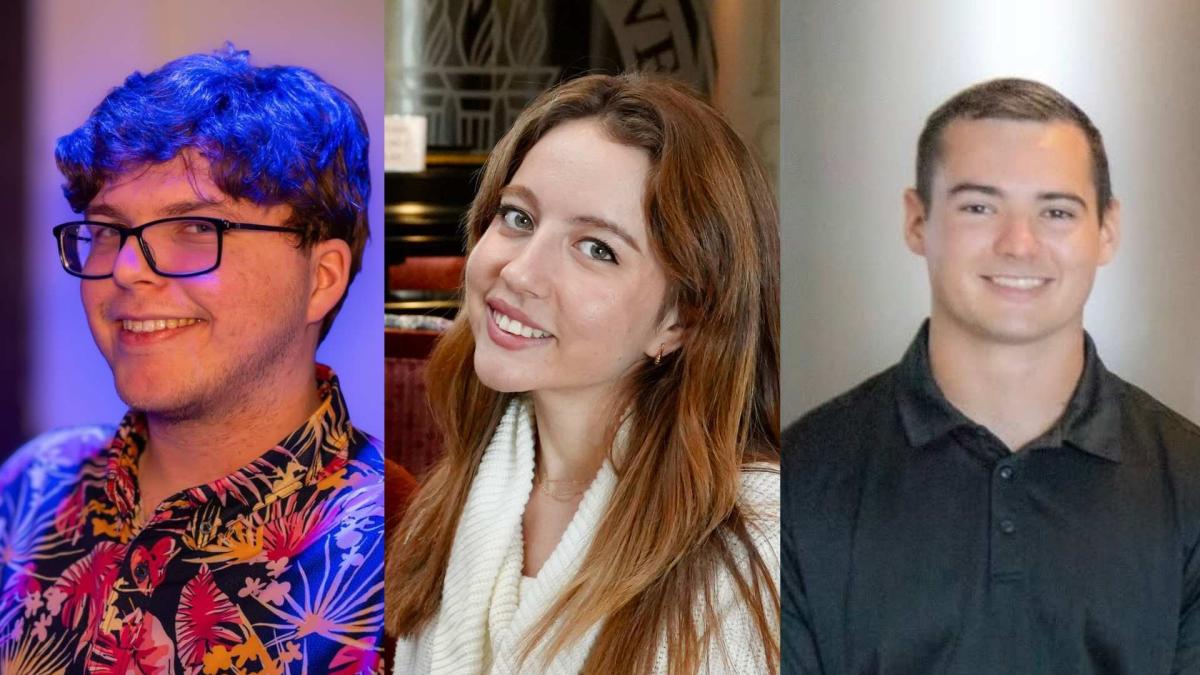
Public Health + Political Science (Dual Major), Electrical Engineering, Computer Science | Jennifer Giraldo- Hello, and thank you for stopping for our presentation! I am a freshman majoring in Public Health with a concentration in Environmental Health. These disciplines focus on how everyday activities impact our bodies in the long run, and led me to the fascinating study of microplastics in the human body. I'm proud to work with Jaiden and Brent on my first research presentation, and have my sights set on Masters-level research at Oxford University. Jaiden Smith - I am currently a senior in Electrical Engineering, and I am taking part in two research projects this symposium; One of my special interests in Electrical Engineering is how biological and environmental sciences can be integrated into overarching engineering applications, which aligns with this sustainable, environmentally conscious repurposing of plastic into 3D printable filament. Brent Cerney- Hello, I am a senior Computer Science student with a strong background in sustainability-focused systems design and applied computational longevity. In this project I focused heavily on system design, software control, and optimization of the printing process. My goal is to raise awareness for sustainability initiatives and student-led environmental innovation, to bridge technology, leadership, and tangible impact through responsible engineering solutions. |
Evaluating the Properties and Environmental Impact of PET Filament Production Using a DIY Recreator 3D MK5Kit | When recycling on an individual level, we tend to ask ourselves: “How much of a difference can recycling one bottle make?” The cost of plastic production, and its consequent pollution, are issues of global priority. A majority of pollutants come from single-use soda and water bottles, made from Polyethylene terephthalate (PET). While this material is recyclable, the majority of its products end up in landfills. Today, small-scale recycling technology presents an opportunity to recycle PET “waste” into valuable material: 3D printer filament. This project describes the benefits of producing recycled PET (rPET) filament on a small-scale level using the inexpensive Recreator 3D MK5Kit. Compared to commercial 3D printer filament, rPET filament would reduce the need for plastic production, and reuse pre-existing materials. Over a 3 month period, used PET bottles will be collected, cleaned, and cut into strips before being converted into filament through a pultrusion nozzle. Filament yield and consistency will be documented using calipers and measuring tape. Energy consumption will be estimated based on processing time and power usage. The total mass of plastic waste and energy used per kilogram of rPET filament will be compared to data from the manufacture of commercial filament. The resulting rPET filament will be tested for printability and consistency to determine its potential for long-term use. The resulting data will be used to study the environmental and economic effects of small-scale plastic recycling. Our results will indicate that individual recycling, specifically through rPET production, can have powerful economic and environmental benefits. |
Dr. John "Tory" Peek | Florida State University | Public Health | jtpeek@pc.fsu.edu | plastic, 3D Printer, filament, rPET | Exploratory (the research question has been identified and design of approach is outlined) | Yes | 2026 | 5th annual Undergraduate Research Symposium, April 17, 2025 | https://pc.fsu.edu/student-research/symposium/research-symposium-program-portal?element_parents=elements/student_photo&ajax_form=1&_wrapper_format=drupal_ajax&token=aQSkywv88ScJUpNFdYjYdOFkTXp0bhMFez91cyWLQs0 | |||||
| 223 | 9071 | Face to Face Poster session | 10:00 Graduate and Undergraduate presentations | Student Research Symposium Program Portal: Submission #223 | 6331b9d7-3646-4d6a-b884-f8afcf8ff96f | No | Star/flag Student Research Symposium Program Portal: Submission #223 | Lock Student Research Symposium Program Portal: Submission #223 | Add notes to Student Research Symposium Program Portal: Submission #223 | Fri, 01/30/2026 - 05:50 PM | Fri, 01/30/2026 - 06:17 PM | Fri, 04/10/2026 - 03:27 PM | Anonymous | 24.96.114.162 | Emily | Kasprowicz | She, her, hers | erk21g@fsu.edu |

|
Professional Communication | I have been a student at FSU Panama City since Fall 2021. I used my Associate's Degree from Gulf Coast State College to transfer to a top Florida university. I was invited to the undergraduate research symposium by Dr. Irvin Clark in the 2022-2023 Academic year, and I presented at it a year later in the 2023-2024 Academic year. I am an AB Honor Roll student, and I hope to one day receive a scholarship to a seminary school where I plan to study to become a minister. I hope to pursue a career in the ministry in the near future. | The Brain and the Alarm Clock Theory | This is continued research on an experimental project completed in the 2023-2024 academic year. This continued research evaluates the theory of how the brain interacts with our alarm clocks. Observational research was done with me as the participant and the researcher on the experiment. Peer-Reviewed journals are used this time, along with certain techniques, to prepare the participant for the school days, including the Get-Up and Go Technique and going to bed at a reasonable hour. The dependent variable is based on the two alarm types, and the independent variable is going to bed at a reasonable or unreasonable hour. Alarms were set between 6:00 AM and 6:30 AM. Sometimes, the alarm was set at 5:50 AM to allow myself extra time in the mornings to complete tasks and responsibilities before school, such as making my bed and preparing clothes and school lunches the night before. The wake-up times were set between a traditional alarm clock and a cellphone alarm. The alarm clock had a traditional "beeping" alarm sound while the cellphone alarm had the tone "Sunny". Volumes were set on a scale of 1 through 4; 1 being the lowest volume possible and 4 being the loudest "fall out of bed" volume. I am a hard sleeper due to suffering from depression, so the volume on my alarm clock has to be set between levels 3 and 4 in volume. | Erika Goines | University of West Florida | Communication | ekb7991@fsu.edu | None | Alarm Clocks, Waking theories, sleeping and dreaming theories, bedtime experiments, Psychology experiments, Experimental Research, | Complete | Yes | 2026 | 5th annual Undergraduate Research Symposium, April 17, 2025 | https://pc.fsu.edu/student-research/symposium/research-symposium-program-portal?element_parents=elements/student_photo&ajax_form=1&_wrapper_format=drupal_ajax&token=-8lxyfEKK4Zlhe7YMDx-NC01fJ72dkFRzTtpMueIICk | ||||
| 221 | 9069 | Face to Face Poster session | 11:15 High School presentations | Student Research Symposium Program Portal: Submission #221 | ea601827-8ab3-4782-aa6b-90915623d5ca | No | Star/flag Student Research Symposium Program Portal: Submission #221 | Lock Student Research Symposium Program Portal: Submission #221 | Add notes to Student Research Symposium Program Portal: Submission #221 | Fri, 01/30/2026 - 05:25 PM | Fri, 01/30/2026 - 05:25 PM | Fri, 04/03/2026 - 01:56 PM | Anonymous | 24.236.84.61 | Addisyn | Bottorf | ab23da@fsu.edu |
|
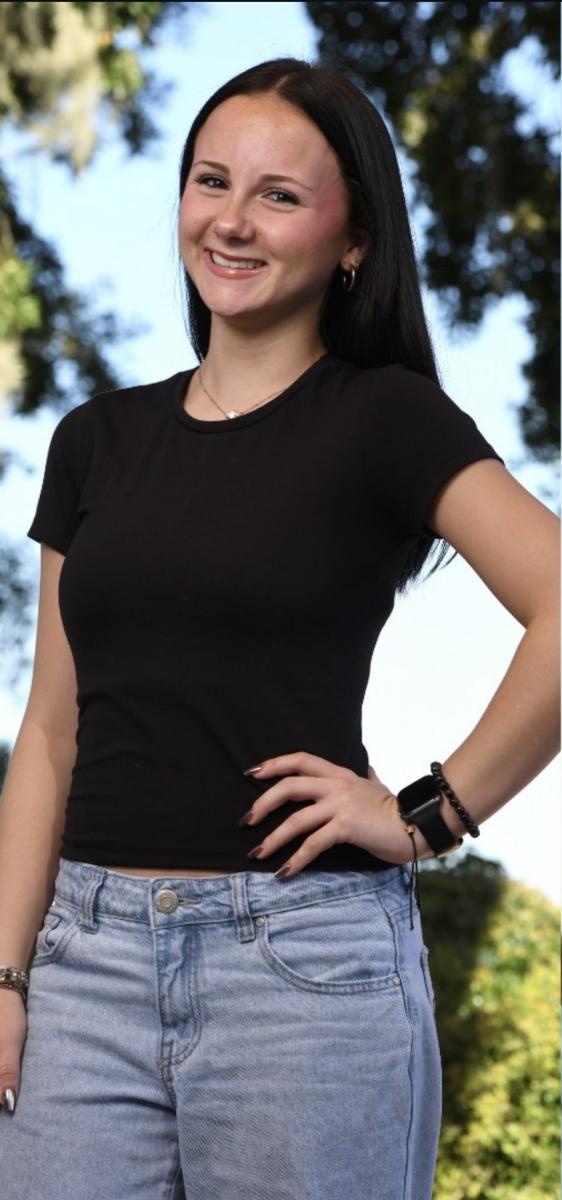
Dual Enrolled Student; Intended Major- Nursing | My name is Addisyn Bottorf. I was born in Panama City, FL and have lived here my whole life. I am passionate about healthcare and ensuring the wellbeing of my community. | Caffeine Costs: Examining Energy Drink Effects on Mood and Sleep | Energy drinks are widely consumed, particularly among adolescents, yet many people are unaware of the potential negative effects associated with their ingredients. The purpose of this study is to examine these effects through self-reported experiences rather than experimental testing. This research is necessary because energy drink consumption has become increasingly common, while knowledge about its possible impact on sleep and emotional well-being remains limited. Data will be collected through a literature review examining energy drink intake and whether it affects individuals' sleep, causes irritability, or leads to changes in mood or focus. Participants of varying ages will be included to compare reported effects among different age groups. These findings are expected to aid individuals in making informed decisions about their energy drink consumption. | Madisyn Flammia | The Collegiate School at FSU Panama City, FL. | Research | mjf24@fsu.edu | Energy Drinks, Nutrition, Cognitive Ability, | Complete | A. Bottorf Poster.pdf237.67 KB
|
No | 2026 | 5th annual Undergraduate Research Symposium, April 17, 2025 | https://pc.fsu.edu/student-research/symposium/research-symposium-program-portal?element_parents=elements/student_photo&ajax_form=1&_wrapper_format=drupal_ajax&token=3l6pMbjZ8_4u-DCxPTSMNfmqng43ZnjNvmjNkqegxOY | |||||
| 220 | 9068 | Face to Face Poster session | 11:15 High School presentations | Student Research Symposium Program Portal: Submission #220 | c6b3afea-2021-462f-b216-7f04bc42930f | No | Star/flag Student Research Symposium Program Portal: Submission #220 | Lock Student Research Symposium Program Portal: Submission #220 | Add notes to Student Research Symposium Program Portal: Submission #220 | Fri, 01/30/2026 - 04:16 PM | Fri, 01/30/2026 - 04:16 PM | Fri, 04/03/2026 - 01:56 PM | Anonymous | 2607:fb90:3e0d:777:6c5:19e8:8e93:ed1d | Kylie | Ngo | xngokn@bayhaven.org |
|
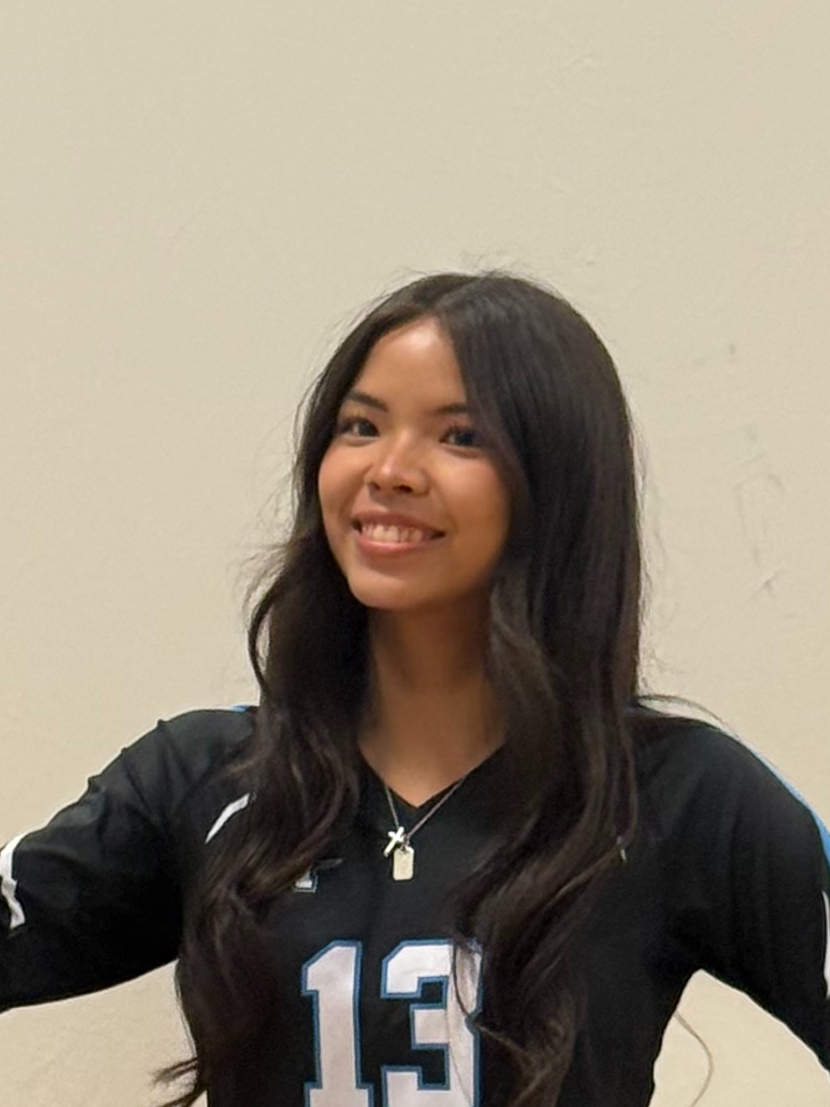
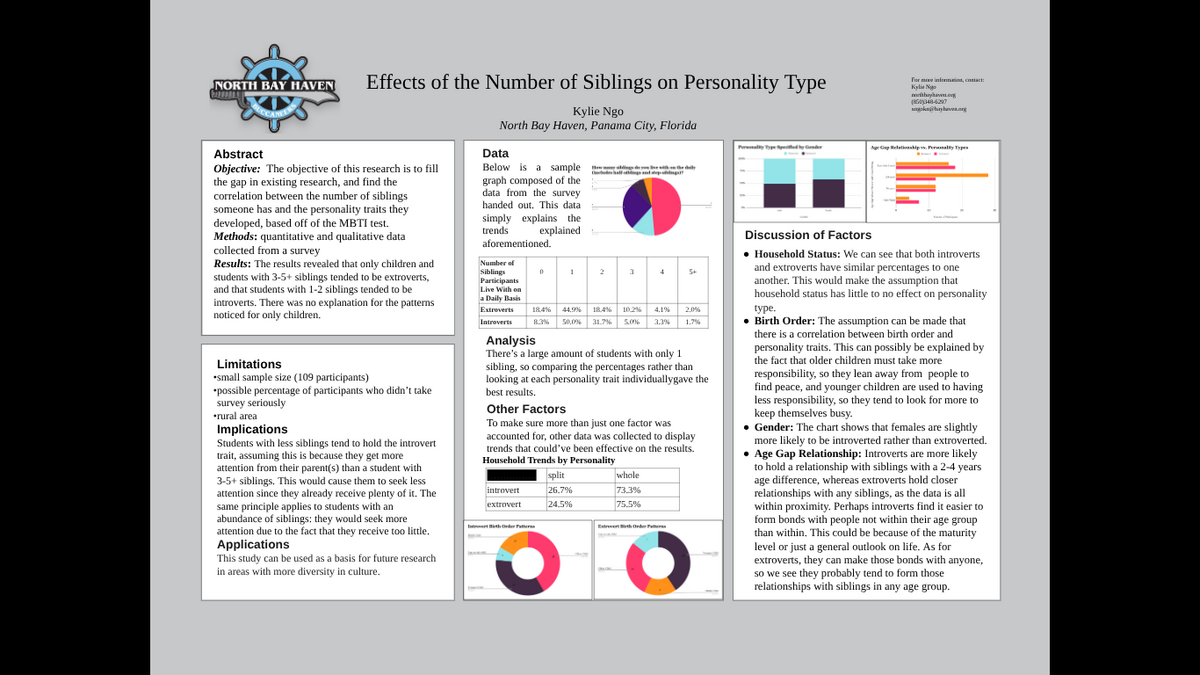
Chemical Engineering | Kylie Ngo is a junior enrolled at North Bay Haven High School. She has main interests in chemistry, math, cosmetic science, and psychology. | Effects of the Number of Siblings on Personality Type | This study is finding the correlation between the number of siblings someone has and the personality traits they develop. Siblings are defined as those living within your home the majority of the time. Data for this study will take into account several factors: birth order, household status, and split families. | Robin Vaughn | North Bay Haven | English | vaughrl@bayhaven.org | MBTI, personality, siblings | Complete | KYLIESYMPOSIUM.pptx.pdf432.73 KB
|
|
No | 2026 | 5th annual Undergraduate Research Symposium, April 17, 2025 | https://pc.fsu.edu/student-research/symposium/research-symposium-program-portal?element_parents=elements/student_photo&ajax_form=1&_wrapper_format=drupal_ajax&token=Q2HynAKdnuod0xVMa9XlcHy6I-peIpQxdc6ZpMFmOA4 | ||||
| 219 | 9067 | Face to Face Poster session | 10:00 Graduate and Undergraduate presentations | Student Research Symposium Program Portal: Submission #219 | a83fd92c-3de2-407d-8e53-809bc0a45460 | No | Star/flag Student Research Symposium Program Portal: Submission #219 | Lock Student Research Symposium Program Portal: Submission #219 | Add notes to Student Research Symposium Program Portal: Submission #219 | Fri, 01/30/2026 - 01:38 PM | Fri, 01/30/2026 - 02:17 PM | Sun, 04/12/2026 - 03:44 PM | Anonymous | 96.27.201.147 | Noah | Owens | no24a@fsu.edu |
|
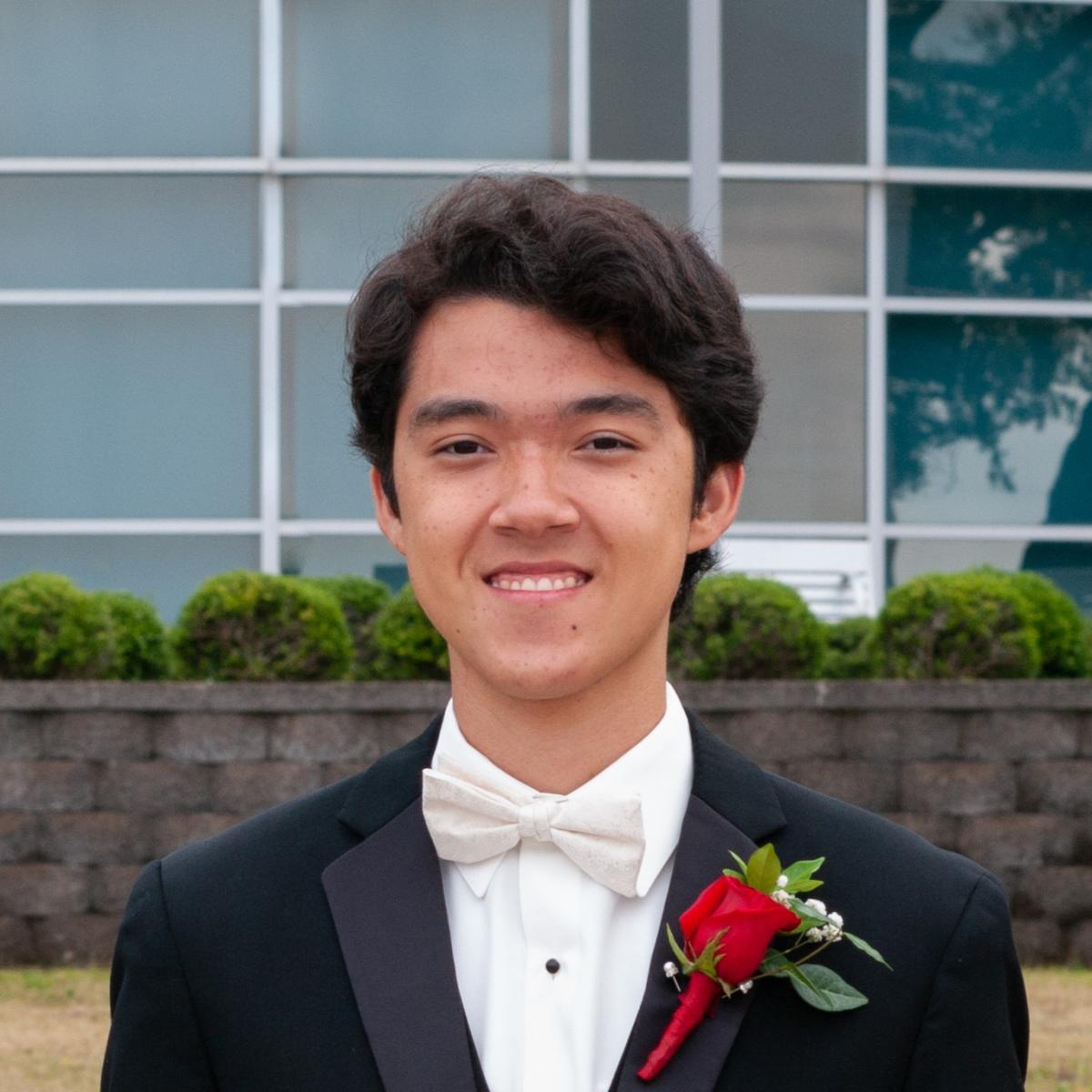
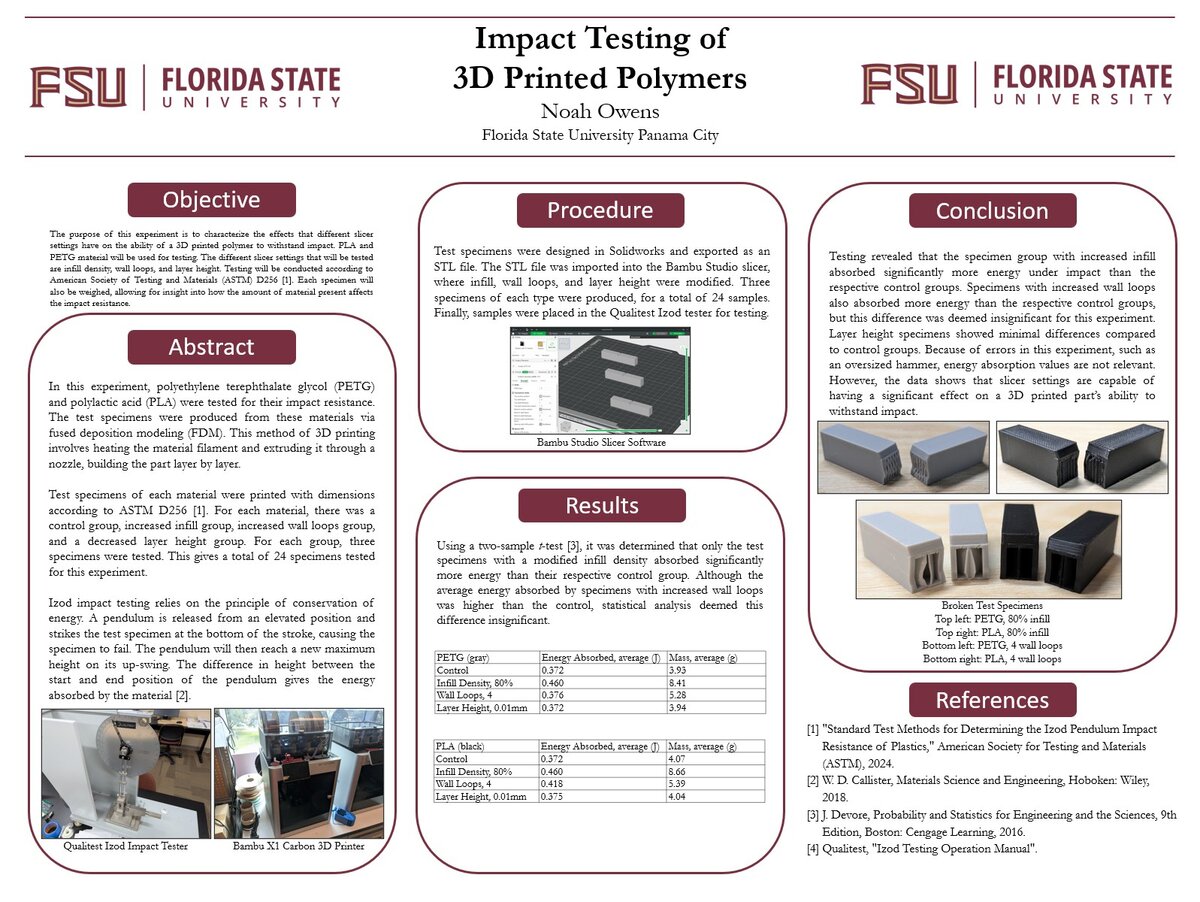
Mechanical Engineering | Noah is a senior mechanical engineering student from Panama City, Florida. His primary educational and research interests include materials engineering and mechanics. By integrating these fields, he hopes to push the design and development of innovative technologies to the next level. More specifically, Noah hopes to be at the forefront of the development of additive manufacturing for a variety of military applications. Having lived minutes from the Gulf his whole life, Noah wants to implement technologies that will keep people safe, whether they are in or on the sea. | Izod Impact Testing of 3D-Printed Polymers | In this experiment, polyethylene terephthalate glycol (PETG) and polylactic acid (PLA) were tested for their impact resistance. The test specimens were produced from these materials via fused deposition modeling (FDM). This method of 3D printing involves heating the material filament and extruding it through a nozzle, building the part layer by layer. Test specimens of each material were printed with dimensions according to ASTM D256 [1]. For each material, there was a control group, increased infill group, increased wall loops group, and a decreased layer height group. For each group, three specimens were tested. This gives a total of 24 specimens tested for this experiment. Testing of each specimen occurred using a pendulum Izod tester. The purpose of this experiment was to characterize the effects that 3D printer slicer settings have on a PETG and PLA additive manufacturing (AM) parts’ ability to absorb energy in an impact. Testing revealed that the specimen group with increased infill absorbed significantly more energy under impact than the respective control groups. Specimens with increased wall loops also absorbed more energy than the respective control groups, but this difference was deemed insignificant for this experiment. Layer height specimens showed minimal differences compared to control groups. Because of errors in this experiment, such as an oversized hammer, energy absorption values are not relevant. However, the data shows that slicer settings are capable of having a significant effect on a 3D printed part’s ability to withstand impact. |
Dr. Yvonne Traynham | Florida State University | Mechanical Engineering | ytraynham@eng.famu.fsu.edu | 3D Printing, Impact Testing, Polymers | Complete |
|
No | 2026 | 5th annual Undergraduate Research Symposium, April 17, 2025 | https://pc.fsu.edu/student-research/symposium/research-symposium-program-portal?element_parents=elements/student_photo&ajax_form=1&_wrapper_format=drupal_ajax&token=xygE-yvQ4SiR9YlcA7ld-gqne0mZppqkohYoto6DXck | |||||
| 218 | 9066 | Face to Face Poster session | 11:15 High School presentations | Student Research Symposium Program Portal: Submission #218 | c3b6aac4-b784-4161-9dc8-998c1f5b0008 | No | Star/flag Student Research Symposium Program Portal: Submission #218 | Lock Student Research Symposium Program Portal: Submission #218 | Add notes to Student Research Symposium Program Portal: Submission #218 | Fri, 01/30/2026 - 12:59 PM | Fri, 01/30/2026 - 01:01 PM | Fri, 04/03/2026 - 01:55 PM | Anonymous | 146.201.10.0 | Ari | Amromin | He/Him | aa23cx@fsu.edu |

|
Dual Enrolled; Intended major is Electrical Engineering | My name is Ari Amromin, I am a junior at TCS at FSU PC, and I intend to major in either electrical engineering or nuclear engineering. | What are the limits of wireless power transfer? | The research below is rooted in the field of electrical engineering, more specifically, wireless power transfer. The central question being examined in the following research is the extent of the uses of wireless power transfer in modern life. While wireless power transfer is a technology that has been around for well over a century, its applications have increased, and it has been adopted by multiple fields. Common examples of wireless power transfer include wireless phone charging or charging electric vehicles. The main goal behind this research is to investigate how many realistic applications there are for wireless power transfer in everyday life. For instance, could it be used to power entire buildings, or could we use it to power advanced medical implants? By systematically reviewing the existing literature using databases such as the FSU Online Library, I intend to look specifically at the effects of wireless power transfer fields on the human body and the potential cost of making a wireless power transfer field big enough to power a whole office building. This will allow me to determine the realistic limits of wireless power transfer. These findings will help future engineers know the extent to which it is beneficial to implement wireless power transfer into their new technologies. | Madison Flammia | The Colligate School at FSUPC | Reasearch | mjf24@fsu.edu | Electrical Engineering, Wireless Power Transfer | Complete | A. Amromin Poster.pdf529.71 KB
|
No | 2026 | 5th annual Undergraduate Research Symposium, April 17, 2025 | https://pc.fsu.edu/student-research/symposium/research-symposium-program-portal?element_parents=elements/student_photo&ajax_form=1&_wrapper_format=drupal_ajax&token=7lwbjTJfOyG-F7iEViVO6Kr2x6o8pXlu_OS_AoVI9rY | ||||
| 215 | 9063 | Face to Face Poster session | 11:15 High School presentations | Student Research Symposium Program Portal: Submission #215 | e6194f72-b7c2-4b1c-9ef9-f824cda94be6 | No | Star/flag Student Research Symposium Program Portal: Submission #215 | Lock Student Research Symposium Program Portal: Submission #215 | Add notes to Student Research Symposium Program Portal: Submission #215 | Fri, 01/30/2026 - 12:52 PM | Fri, 01/30/2026 - 12:52 PM | Fri, 04/03/2026 - 01:54 PM | Anonymous | 146.201.10.47 | Nick | Brantley | Him | njb23d@fsu.edu |
|
Highschool dual enrolled student - intended major: exercise physiology | My name is Nick, and I am dual enrolled at The Collegiate School at FSU PC. Outside of academics, I like to run track, do food reviews, workout, hangout with friends, and go shopping/thrifting. I intend to major in exercise physiology because I am very passionate about sports and athletics, as well as other health disciplines. With my passion, I want to strive to become a sports medicine physician and help and treat athletes striving for a common goal. | From Risk to Resilience: The Impact of Plyometrics on Athletic Performance | In pursuit of peak athletic performance, particularly in high-velocity sports like track and field, athletes may be inherently exposed to significant risk of injury. Understanding sprint biomechanics and optimizing running technique can reduce injury risk and enhance overall performance. This research addresses the question of what roles sprinting form and biomechanics play in reducing muscle related injuries. I chose plyometrics because it is an effective type of exercise that athletes use to improve and boost performance. A plyo routine affects sprint biomechanics by activating fast twitch muscle fibers, strengthening ankle stiffness, and reducing ground contact time. The connection between injury prevention and athletic performance is plyometrics. The overall objective for this project was to measure how and if plyometric exercises improved athletic performance and form in high school athletes by performing a literature review. This research can be used to show coaches the effects of plyometrics and implement it into school and gym workouts to reduce injury risks and increase the performance of all athletes. | Madisyn Flammia | The Collegiate School at FSU PC | Research | mjf24@fsu.edu | Athletic, Plyometric, Prevention, Factor, Reduce | Complete | N. Brantley Poster.pptx1.14 MB
|
No | 2026 | 5th annual Undergraduate Research Symposium, April 17, 2025 | https://pc.fsu.edu/student-research/symposium/research-symposium-program-portal?element_parents=elements/student_photo&ajax_form=1&_wrapper_format=drupal_ajax&token=CswaiKtLTe1ZFztuIadMDP8AktbF3392dHj7VpiIkoc | ||||
| 214 | 9062 | Asynchronous Online Presentation | https://drive.google.com/file/d/1CfTOkkOAwIfl38Z-rOfiXZ-G1N295MPk/view?usp=sharing | Student Research Symposium Program Portal: Submission #214 | 3817531a-1b47-43bc-acb2-4f08cd185f4f | No | Star/flag Student Research Symposium Program Portal: Submission #214 | Lock Student Research Symposium Program Portal: Submission #214 | Add notes to Student Research Symposium Program Portal: Submission #214 | Fri, 01/30/2026 - 12:51 PM | Fri, 01/30/2026 - 12:51 PM | Thu, 04/02/2026 - 07:53 AM | Anonymous | 146.201.10.32 | Emma | Henson | ehenson@my.tcs.fsu.edu |
|
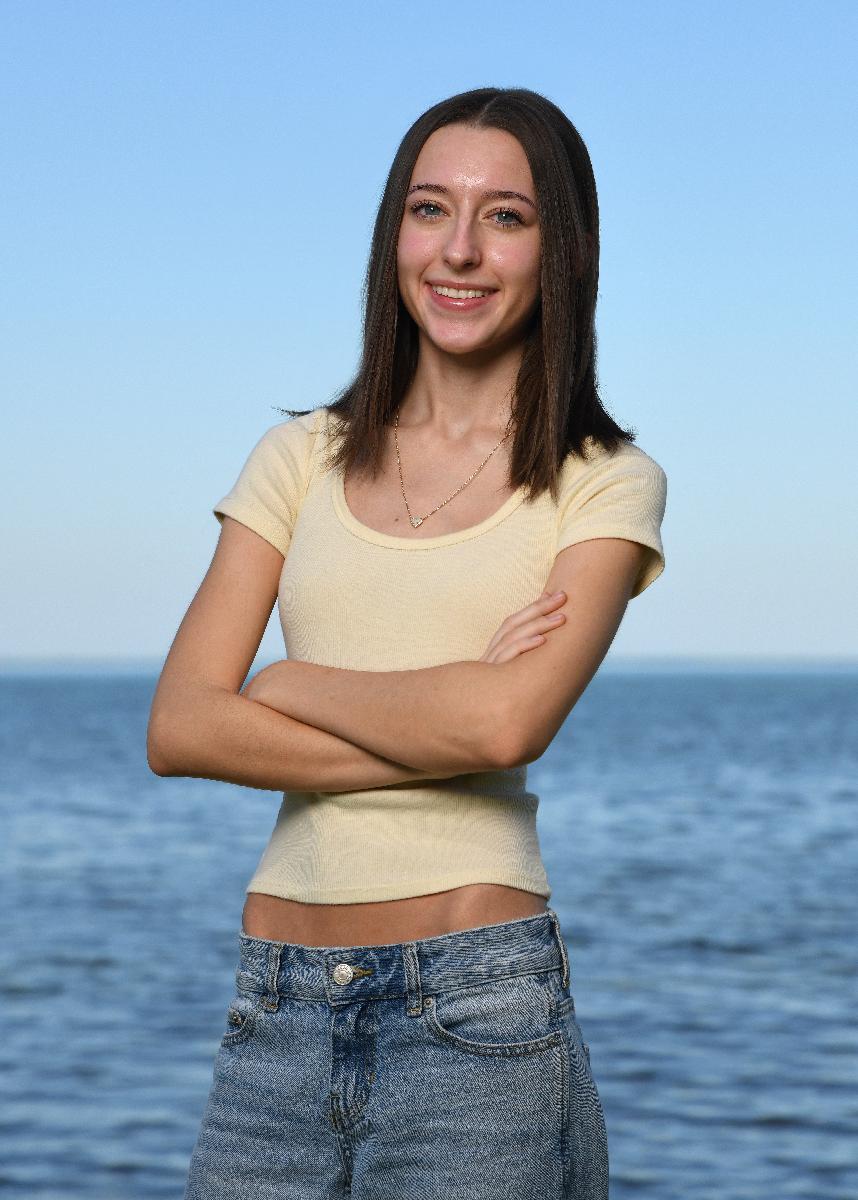
Dual Enrolled; Intended major is Nursing | My name is Emma; I am a dual enrolled high school junior at The Collegiate School at FSU PC. I am currently pursuing my AA degree and set to earn it by the end of 12th grade. I am from Panama City Beach, FL, and I am interested in the medical field and passionate about becoming a pediatric nurse. | Emotional Intelligence in Nursing: A Foundation for Empathy | Emotional Intelligence is essential to all aspects of our human social life and societal norms. It is necessary to cultivate this skill to be a successful worker, businessowner, even student. In the field of nursing, emotional intelligence has a greater meaning and needs to be specially worked on to be able to fully implement into everyday life. Some important and relatively unexplored aspects of cultivating emotional intelligence in nursing is when involved in direct patient care, the need to develop new courses on emotional intelligence in nursing programs, and the effect that being able to harness emotional intelligence has on teamwork in the work environment. I intend to collect data through credible multimodal studies, academic journals, scholastic articles. This data will be qualitative, and no experiments, studies, or interviews will be conducted by me personally. I hope that in doing this research I will be able to educate readers on the significance of nurses cultivating emotional intelligence. | Madi Flammia | The Collegiate School at FSU PC | Research | mjf24@fsu.edu | Nursing, Emotional Intelligence, Burnout, Mental Health, Patient Care | Exploratory (the research question has been identified and design of approach is outlined) | 2026 | 5th annual Undergraduate Research Symposium, April 17, 2025 | https://pc.fsu.edu/student-research/symposium/research-symposium-program-portal?element_parents=elements/student_photo&ajax_form=1&_wrapper_format=drupal_ajax&token=ZEcjpX3c8mt0C0TAaNTJSlmtnk7YZpFHm6H89OUeIZw | |||||||
| 213 | 9061 | Face to Face Poster session | 11:15 High School presentations | Student Research Symposium Program Portal: Submission #213 | f2226717-9cbb-4308-b8c4-d2e84760b0d0 | No | Star/flag Student Research Symposium Program Portal: Submission #213 | Lock Student Research Symposium Program Portal: Submission #213 | Add notes to Student Research Symposium Program Portal: Submission #213 | Fri, 01/30/2026 - 12:46 PM | Fri, 01/30/2026 - 12:47 PM | Fri, 04/03/2026 - 01:52 PM | Anonymous | 146.201.10.14 | Sophia | Rieser | She/her | smr23f@fsu.edu |
|
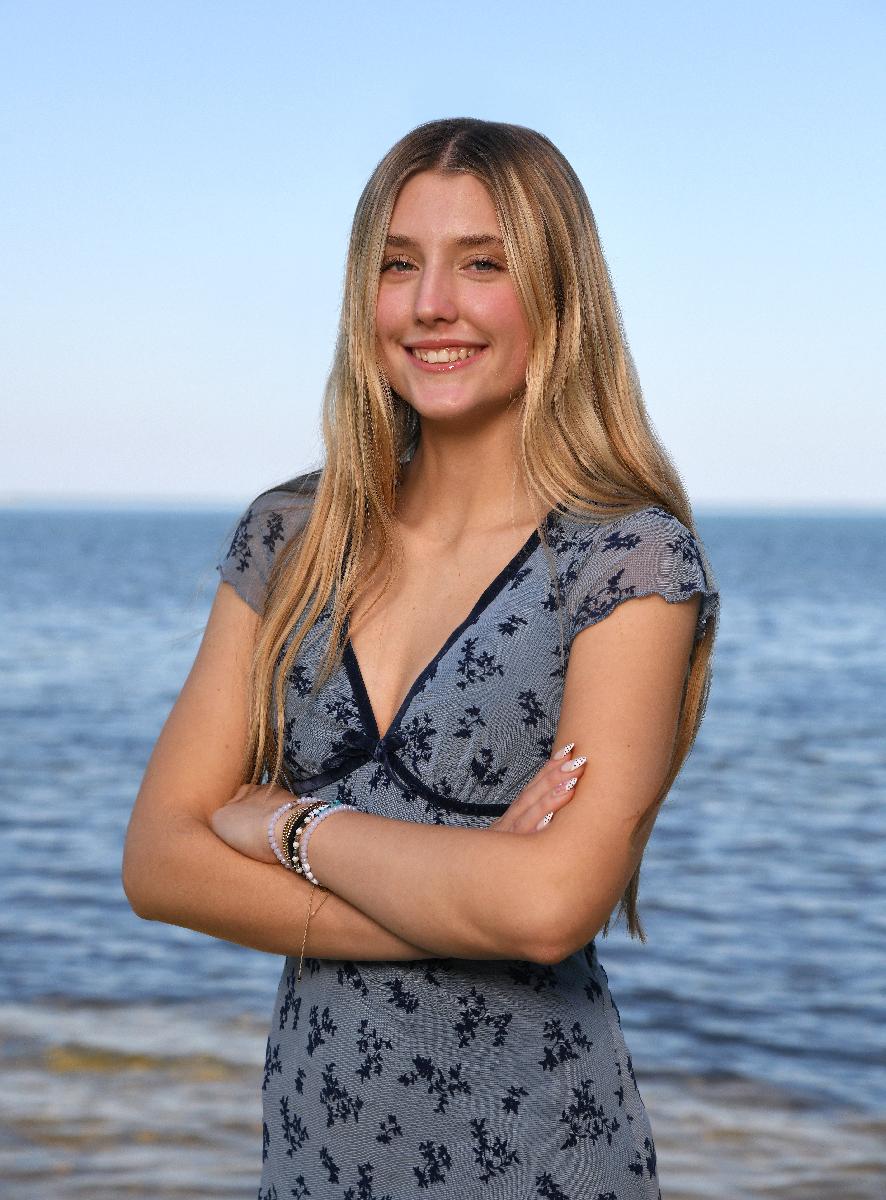
Dual enrolled ; Intended Major : Nursing | My name is Sophia, and I am an 11th grade dual enrolled student at The Collegiate School. I am born and raised in Panama City Beach, Florida. I am very passionate about the medical field and plan to major in Nursing. In my future, I would like to be a trauma nurse and a part time paramedic. | Artificial Scenarios, Authentic Outcomes: Simulation in Pediatric Education | Simulation learning is a teaching method that uses realistic and interactive scenarios to help you prepare and practice skills in a controlled environment. However, there is very little research regarding simulation learning in the pediatric field. So far, in simulation learning labs, there is only research based on simulation learning for everyone, but no specifics with children. Children are very different than adults, they can be more sporadic, and aren’t predictable, so they need providers who are trained in these skills. My goal for this research is to create an online prototype website that trains professionals to be able to respond to these unpredictable cases. I will be interviewing pediatric doctors/nurses to gain insight into work-related struggles and how they feel nursing school could have better prepared them. and what they could have been more prepared on in school. This software will ideally target the unpredictability of working with children, with scenarios such as a child not wanting to take medicine, or a child refusing to answer questions and it may suggest different ways to get them to open up and help them to help you to be able to do you job. The expected outcome of this is to help future pediatric nurses and doctors be more confident in their skills before going into the field. | Madi Flammia | The Collegiate School at FSU PC | Research | mjf24@fsu.edu | Nursing, Simulation, Pediatric | Complete | S. Rieser Poster.pdf194.52 KB
|
No | 2026 | 5th annual Undergraduate Research Symposium, April 17, 2025 | https://pc.fsu.edu/student-research/symposium/research-symposium-program-portal?element_parents=elements/student_photo&ajax_form=1&_wrapper_format=drupal_ajax&token=V02BsaN89c2TfUwNRsZ637gNt0I9-FiSyLHX0s_TL9w | ||||
| 216 | 9064 | Face to Face Poster session | 11:15 High School presentations | Student Research Symposium Program Portal: Submission #216 | 0345b8e8-d08c-49c8-a3c8-fec0bdf9997c | No | Star/flag Student Research Symposium Program Portal: Submission #216 | Lock Student Research Symposium Program Portal: Submission #216 | Add notes to Student Research Symposium Program Portal: Submission #216 | Fri, 01/30/2026 - 12:27 PM | Fri, 01/30/2026 - 12:55 PM | Fri, 04/03/2026 - 01:54 PM | Anonymous | 146.201.10.45 | Auvrie | McCollough | am23ep@fsu.edu |
|
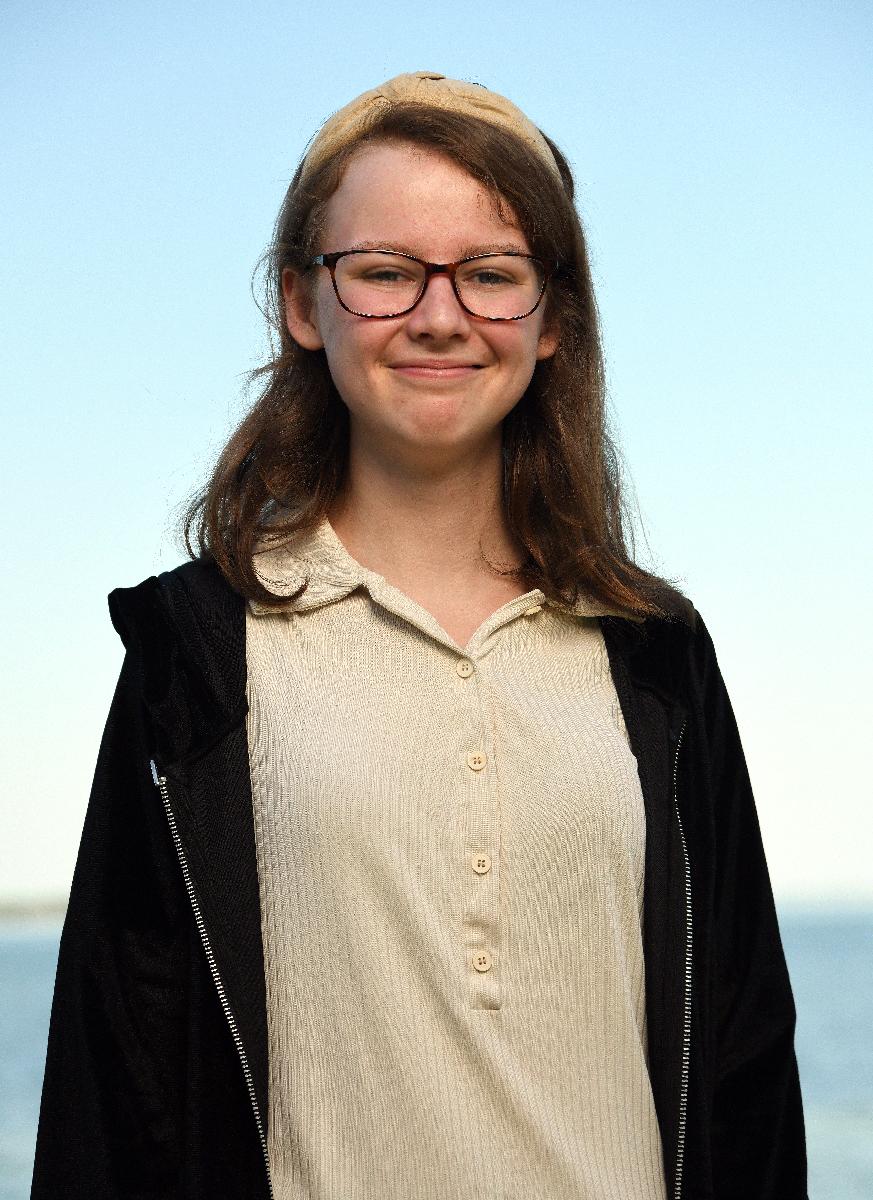
Psychology | My name is Auvrie McCollough. I am an 11th grade dual enrollment student at The Collegiate School at FSU PC. I am interested in psychology and want to learn more about it through my major and research. I also volunteer with community and school fundraising, including community parades and Culver's school fundraising. | Peer Tutoring Effect on Metacognition | Metacognition is the knowledge of knowledge. (Schraw, 1995) Metacognition is necessary for individuals to know how to learn and how they relate to others. While studies have been conducted exploring the benefits of peer learning, it has not been extensively tested and repeated in scholarly situations. It is important to learn about peer learning to find the significant effects and benefits and to explore different metacognitive strategies. With this information, students could potentially improve their study habits and information retention. The significance of this study is that individuals can discover methods of furthering their educational understanding. | Madisyn Flammia | The Collegiate School | Research | mjf24@fsu.edu | Peer Tutoring, Metacognition, Studying | Complete | No | 2026 | 5th annual Undergraduate Research Symposium, April 17, 2025 | https://pc.fsu.edu/student-research/symposium/research-symposium-program-portal?element_parents=elements/student_photo&ajax_form=1&_wrapper_format=drupal_ajax&token=MhAoK9WS5_qyzKb1_4QF6VMyeuUZX1fpRV3_dtCOzPA | ||||||
| 217 | 9065 | Face to Face Poster session | 11:15 High School presentations | Student Research Symposium Program Portal: Submission #217 | 264eee4b-9d52-46e4-8ae4-9adaf7179253 | No | Star/flag Student Research Symposium Program Portal: Submission #217 | Lock Student Research Symposium Program Portal: Submission #217 | Add notes to Student Research Symposium Program Portal: Submission #217 | Fri, 01/30/2026 - 12:25 PM | Fri, 01/30/2026 - 12:59 PM | Fri, 04/03/2026 - 01:55 PM | Anonymous | 146.201.10.0 | Caleb | Harder | cbh23c@fsu.edu |
|
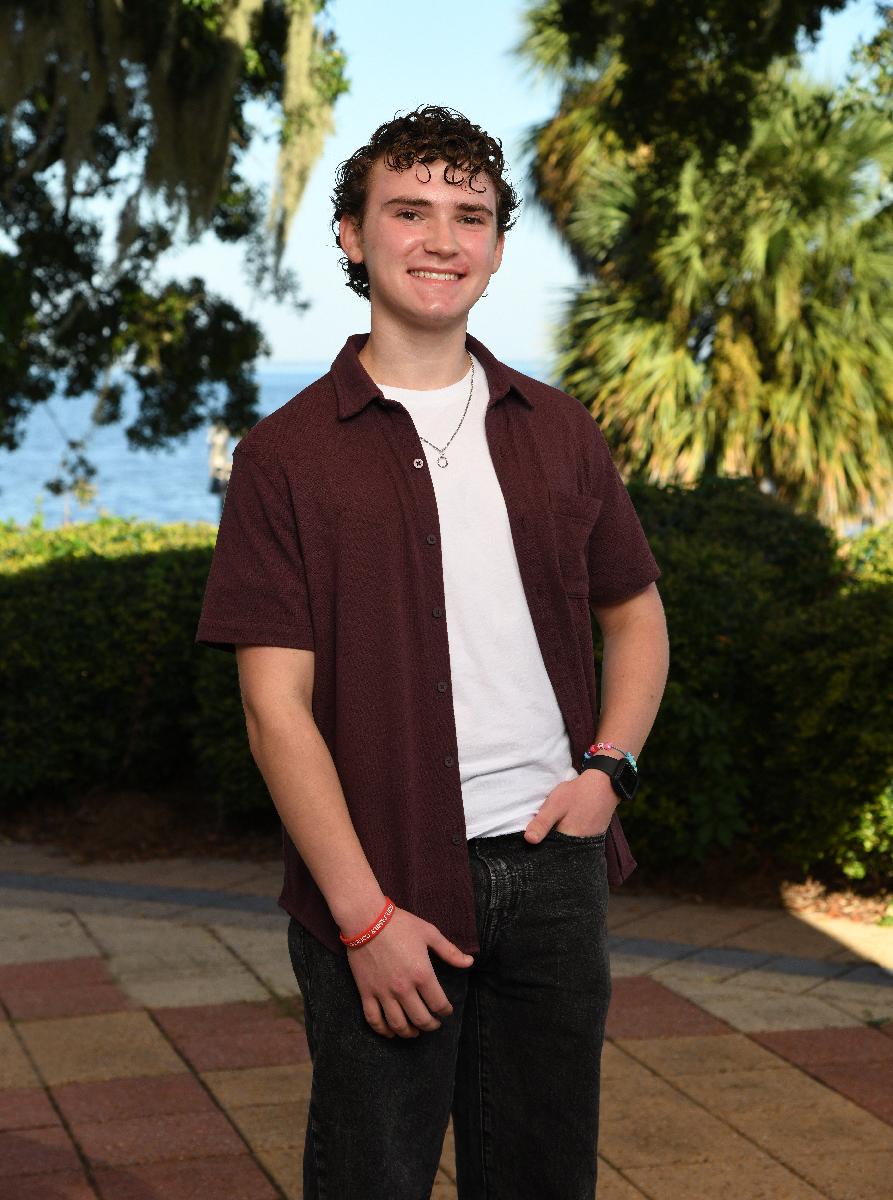
Dual Enrolled; intended major is computer engineering | My name is Caleb Harder, and I am an 11th grade dual-enrolled high school student at The Collegiate School at FSUPC. I am driven by curiosity and a strong interest in how things work, especially when it comes to technology. I enjoy exploring computers, software, and emerging innovations, and I plan to pursue a future career as a computer engineer. Outside of academics, I like going to the gym, where I stay active and build discipline through consistent training. I value hard work, problem-solving, and continuous learning, and I’m motivated to challenge myself both intellectually and physically every single day. | Reducing Procrastination Through a Sensor-Based Smart Desk Assistant | Many students or engineers lose focus or procrastinate tasks while studying or coding. Digital distractions can lead to procrastination and loss of focus, and with the prevalence of computer-based work environments, this issue only becomes larger. Furthermore, digital distractions are linked to lower productivity. Previously, engineers have utilized digital reminders to solve this problem. However, these notifications can be easily ignored, and potentially worsen the problem by opening the door to digital distractions. In addition, there isn’t much significant research on combining psychological research with a physical desktop assistant. So, can a smart desk assistant that uses sensors (e.g. motion, light, or sound) to detect when you get distracted help reduce procrastination and distraction by giving you reminders to stay focused? To address this question, I will be building and testing an Arduino powered smart desk assistant. An app for the desktop assistant will also be created to work with the physical robot. The app will detect the user’s procrastination and distraction and then send a signal to the robot to remind the user to stay focused. Testing will then determine the effectiveness of the proposed solution. The significance of this study is in the integration of psychology and computer engineering to create a working tool that reduces procrastination and distraction, thus increasing productivity. | Madison Flammia | The Collegiate School at FSUPC | Research | mjf24@fsu.edu | Procrastination, technology, engineering | Exploratory (the research question has been identified and design of approach is outlined) | C. Harder Poster.pdf223.04 KB
|
No | 2026 | 5th annual Undergraduate Research Symposium, April 17, 2025 | https://pc.fsu.edu/student-research/symposium/research-symposium-program-portal?element_parents=elements/student_photo&ajax_form=1&_wrapper_format=drupal_ajax&token=s44TINuDuD1ls79yBFCS2j3kSOkL9w-upO0vKIuLlkw | |||||
| 211 | 9059 | Face to Face Poster session | 11:15 High School presentations | Student Research Symposium Program Portal: Submission #211 | b8bf57e0-7683-4b82-8a28-bf77cff2ab51 | No | Star/flag Student Research Symposium Program Portal: Submission #211 | Lock Student Research Symposium Program Portal: Submission #211 | Add notes to Student Research Symposium Program Portal: Submission #211 | Fri, 01/30/2026 - 11:43 AM | Fri, 01/30/2026 - 11:43 AM | Fri, 04/03/2026 - 01:52 PM | Anonymous | 24.96.57.70 | Walter | McDermott | He/Him | wmm23a@fsu.edu |
|
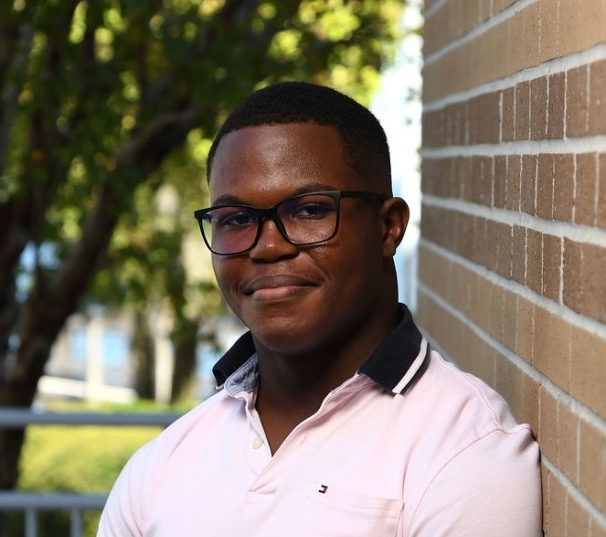
(Projected) Aerospace Engineering | My name is Walter McDermott, and I attend FSUPC through The Collegiate School as a Dual Enrolled Student. My interests have always been in space and how things operate there. | How is Space a Legitimate Option for Expanding AI Data Centers | With a growing and more complex demand for technology, the physical land mass needed for data centers will inevitably exceed safe limits. That being said, moving data centers to space is a legitimate option for this expansion to compensate for the demand. Questions about this arise from the feasibility of this task, as it is complex to carry out. The way electricity will be handled, the cost of this operation, and how communication will work between the satellites and Earth are all major setbacks associated with this operation. In the past, people have launched satellites and other forms of spacecraft into orbit, all of which communicate with Earth and have their main computational tasks done on Earth. However, with the growing demand for computers, these satellites will need to have their own compute power capable of tackling the complex data that is handled in ground data centers. The goal for this research is to uncover the general feasibility (power and weight constraints) of this topic. The collected data will consist of quantative data from relevant companies in the space. A synopsis of the research details that there are not systems in place to power these systems in space, it would take multiple trips to put these servers into space, and new sattelite linking technology would need to be developed.The significance of my findings is that AI companies will be presented with concrete evidence as to how space industrialization may be an option for the expansion of their business. | Madisyn Flammia | The Collegiate School | Research | mjf24@fsu.edu | Space, Ai, Cloud Computing, Industrialization | Complete | W. McDermott Poster.pdf378.48 KB
|
No | 2026 | 5th annual Undergraduate Research Symposium, April 17, 2025 | https://pc.fsu.edu/student-research/symposium/research-symposium-program-portal?element_parents=elements/student_photo&ajax_form=1&_wrapper_format=drupal_ajax&token=mNEh2yfLC4zK4-02od-7bVgf6kZtJj3UZklc7v78Beg | ||||
| 210 | 9058 | Asynchronous Online Presentation | Asynchronous Online Presentation | Student Research Symposium Program Portal: Submission #210 | 3537ecce-e91f-45d3-817a-c7035fa8abba | No | Star/flag Student Research Symposium Program Portal: Submission #210 | Lock Student Research Symposium Program Portal: Submission #210 | Add notes to Student Research Symposium Program Portal: Submission #210 | Fri, 01/30/2026 - 10:45 AM | Fri, 01/30/2026 - 10:45 AM | Fri, 04/10/2026 - 03:29 PM | Anonymous | 96.27.64.86 | Mia | Blank | she/her | mianguyen942@gmail.com |
|
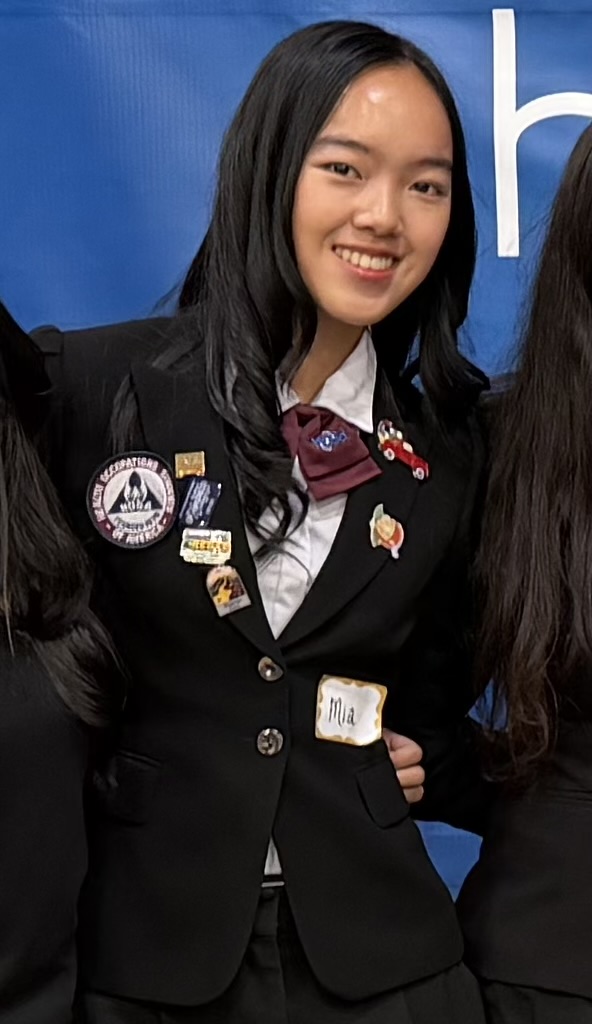
Intended major in college: Cognitive Science, and Neuroscience minor in Linguistics | Mia Blank is a junior in high school at North Bay Haven Career Academy with an interest in Cognitive Neuroscience and Linguistics. Mia is deeply involved in her school's HOSA (Health Occupations Students of America) chapter, serving as an active board member for two consecutive years. She looks forward to majoring in Cognitive Neuroscience and Linguistics in college on the pre-med path. With future endeavors to become a surgeon, Mia wants to go to medical school and pursue Neurosurgery. | The Relationship between MBTI Personality and Student Academic Success | Despite the contemporary and societal trend of focusing on MBTI personality types, currently, only a small number of studies have been conducted to identify the factors that influence an individual’s academic achievement. This study seeks to reveal the unresearched perspective pertaining to the effects a person’s MBTI personality type has on their academic achievement in school. In order to achieve this, a survey was given to over 100 students in high school, ranging in age from 14 to 18 years old. Consequently, the survey required each participant to take one online survey, including the Myers-Briggs Type Indicator test by Isabel Briggs Myers and her mother, Katherine Cook Briggs. Additionally, a form will consist of questions pertaining to the individual’s demographics, GPAs, and academic achievement. The raw data were then analyzed, and conclusions were drawn based on each participant’s primary MBTI and academic fulfillment. The experiments’ outcomes offer a myriad of applications, especially in relation to teenagers, which can be extremely advantageous for providing a comprehensive understanding regarding the factors that affect an individual’s academic endeavors. Furthermore, as aforementioned, this experiment identifies the unresearched perspective concerning how a person’s MBTI influences their scholastic accomplishments, thus allowing for personalizations, whether it be in learning methods or academic motivation. When concluding this investigation, accurate data and results culminated, in cogent insight into how certain MBTI types can affect an individual’s academic fulfillment and motivation. Nevertheless, extensive research beyond this experiment needs to be performed in order to increase lucidity and eliminate any limitations. |
Robin Vaughn | Murray State University | English | vaughrl@bayhaven.org | Psychology , Personality, Academic Success, Mentality , Academic Motivation, Student Lifestyles, MBTI | Complete | 2026 | 5th annual Undergraduate Research Symposium, April 17, 2025 | https://pc.fsu.edu/student-research/symposium/research-symposium-program-portal?element_parents=elements/student_photo&ajax_form=1&_wrapper_format=drupal_ajax&token=7DqcCDOV3_lnDVYRw59YwKx1uT0kvW4z_PT7w_rTyRU | ||||||
| 207 | 9055 | Face to Face Poster session | 11:15 High School presentations | Student Research Symposium Program Portal: Submission #207 | ef93c6d6-f557-477a-85c2-07b0941c0278 | No | Star/flag Student Research Symposium Program Portal: Submission #207 | Lock Student Research Symposium Program Portal: Submission #207 | Add notes to Student Research Symposium Program Portal: Submission #207 | Fri, 01/30/2026 - 09:54 AM | Fri, 01/30/2026 - 09:55 AM | Fri, 04/03/2026 - 12:52 PM | Anonymous | 146.201.10.32 | Zachariah | Zawahry | zz23f@fsu.edu |
|
Biology | I am a dual-enrolled student at The Collegiate School at FSU PC. I was born and raised in Panama City, Florida. I volunteer for multiple organizations, such as AMAL and Florida Springs Watch, as well as play varsity soccer for Bay High School. I am deeply intrigued by microbiology and plan to go into the medical field. | Machine learning in respect to P53 protien | The p53 protein, or the “guardian of the genome,” is one of the body's biggest natural defenses against cancer. Therefore, understanding this protein could lead to big improvements in cancer research. But P53 is an incredibly dynamic protein, constantly moving and changing into different conformational states, because of this its extremely hard to model with traditional methods. Modeling the P53 protein using machine learning technology could be the thing to get accurate and insightful models. To research whether machine learning could create more accurate models than traditional methods, I will utilize AlphaFold to generate multiple models of the p53 protein and compare them to p53 models created using traditional methods that are found online in large databases such as ChimerX. If the models are as accurate or more accurate than traditional models, then I will use AlphaFold to create rarer conformational states of p53 and compare them to rare models created using traditional methods. If these models are as accurate or more accurate than traditional ones, I will finally attempt to create extremely rare or unknown conformational states. The real world significance of my research is not only a huge leap in cancer research but also a huge leap in complex protein modeling, which has a significant number of applications in many different fields. | Madyson Flamia | FSU Collegiate School | Research departmant | mjf24@fsu.edu | Machine learning, Micro biology, protein modeling | Complete | Z. Zawahry Poster.pdf231.98 KB
|
No | 2026 | 5th annual Undergraduate Research Symposium, April 17, 2025 | https://pc.fsu.edu/student-research/symposium/research-symposium-program-portal?element_parents=elements/student_photo&ajax_form=1&_wrapper_format=drupal_ajax&token=w4WZjkT7KN-w2dmOJJpe2thTjlQv8a9MmYMOYm4mBdk | |||||
| 206 | 9054 | Face to Face Poster session | 11:15 High School presentations | Student Research Symposium Program Portal: Submission #206 | 3dc08c1d-0e8b-4a55-8c81-e0e18e0a84ef | No | Star/flag Student Research Symposium Program Portal: Submission #206 | Lock Student Research Symposium Program Portal: Submission #206 | Add notes to Student Research Symposium Program Portal: Submission #206 | Fri, 01/30/2026 - 09:53 AM | Fri, 01/30/2026 - 09:53 AM | Fri, 04/03/2026 - 12:52 PM | Anonymous | 146.201.10.5 | Caroline | Messer | cam24q@fsu.edu |

|
Political Science | My name is Amalie Messer, I'm 16 and I'm a dual-enrolled Junior at the Collegiate School at FSU Panama City and I play beach volleyball at Arnold High School. I love going to the beach, my amazing (and fast) car, and playing and watching sports- but mostly, I am intrigued in criminal law and love to watch and listen to court cases on criminal activity. I hope to continue my collegiate time at the US Naval Academy, and pure a career as a naval pilot, following the footsteps my father and many family members with a career in the military. I am so grateful to have the opportunity to present my work and study at FSU, and cannot wait to further my studies in Political Science. | Beyond the Evidence: The Role of Public Media’s Influence on Criminal Law Trials | Public media’s intervention with the courtroom is a complex environment where the principals of justice and fairness meet the pervasive influence of public opinion. With all our available media outlets, ranging from newspaper headlines to what we hear on the news channels, it all wields a significant power in shaping public perception. This influence reaches criminal law cases, where it can impact jury decisions and partiality, credibility to the accused or lack thereof, and scrutiny towards legal proceedings as the media acts as watchdogs waiting for the next thing to go down. The media’s role in cases such as the Menendez Brothers, O.J. Simpson, and Ted Bundy are the focuses on this research as we dive into the perception of justices and injustices through the public media’s watchful eyes. The data collected in this research will show no biases, or any partiality towards one side or another. These cases occurred during a similar time frame, with OJ Simpson and the Menendez brothers in the same decade. I used sources from online databases found by utilizing FSU's library. | Mrs. Flammia-Moreno | The Collegiate School at FSU | Research | mjf24@fsu.edu | criminal law, media perception | Exploratory (the research question has been identified and design of approach is outlined) | No | 2026 | 5th annual Undergraduate Research Symposium, April 17, 2025 | https://pc.fsu.edu/student-research/symposium/research-symposium-program-portal?element_parents=elements/student_photo&ajax_form=1&_wrapper_format=drupal_ajax&token=c_Tdmhic-tp1F8bDkLVoDD8NuhzEJcsTBonmZNU4WwY | ||||||
| 208 | 9056 | Face to Face Poster session | 11:15 High School presentations | Student Research Symposium Program Portal: Submission #208 | 81085074-a362-4799-aabc-61d46df961f4 | No | Star/flag Student Research Symposium Program Portal: Submission #208 | Lock Student Research Symposium Program Portal: Submission #208 | Add notes to Student Research Symposium Program Portal: Submission #208 | Fri, 01/30/2026 - 09:39 AM | Fri, 01/30/2026 - 10:08 AM | Fri, 04/03/2026 - 12:52 PM | Anonymous | 146.201.10.39 | Anthony | Hinson | ahh23c@fsu.edu |
|
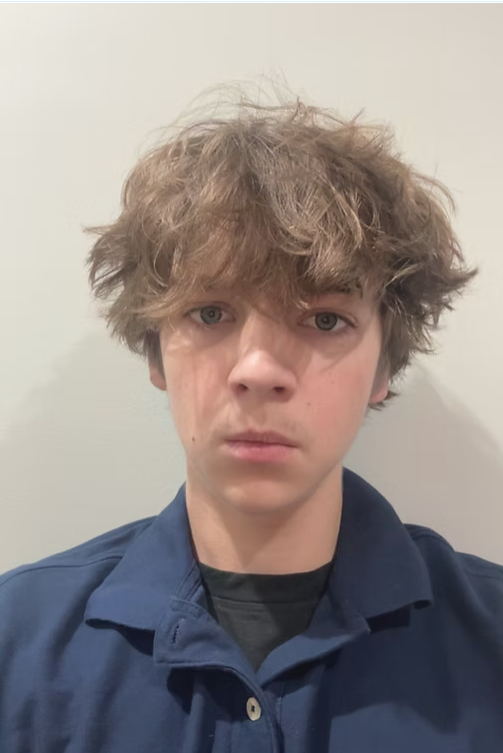
Biology | My name is Anthony Hinson. I am a dual enrolled student at the Collegiate School Panama City. I was born in Dhahran, Saudi Arabia. I wish to become a doctor in the future and work in a cardio specialty such as cardiology. I have 40-50 hours of shadowing specialties including cardiothoracic surgery, orthopedic surgery, pulmonology, and anesthesia. I have around 150 hours of volunteering at Ascension Sacred heart. My hobbies include jiujitsu, sea scouts, and weightlifting. | Literature Review on Factors Influencing Long-Term Adherence After Cardiac Surgery | This study presents a literature review examining long-term adherence to lifestyle and medical recommendations following cardiac surgery. While surgical procedures often improve immediate health outcomes, long-term recovery largely depends on patients maintaining recommended behaviors such as regular physical activity, medication adherence, and heart-healthy dietary practices. However, many patients struggle to sustain these changes after the initial recovery period. Peer-reviewed clinical studies and scholarly literature were analyzed to identify common barriers to adherence and trends in patient behavior during long-term recovery. The reviewed research highlights several key factors influencing adherence, including patient motivation, psychological well-being, physical limitations during recovery, access to cardiac rehabilitation programs, and the level of social support available to patients. By synthesizing existing research, this review aims to better understand the challenges patients face in maintaining recovery behaviors after cardiac surgery. Identifying these patterns may help inform improved post-surgical support strategies, patient education efforts, and healthcare interventions designed to promote sustained recovery and better long-term cardiovascular outcomes. | Madisyn Flammia | The Collegiate School | Research | mjf24@fsu.edu | Cardiac Surgery Adherence, Healthy Habits, Post Cardiac Surgery | Complete | A. Hinson Poster.pdf562.28 KB
|
No | 2026 | 5th annual Undergraduate Research Symposium, April 17, 2025 | https://pc.fsu.edu/student-research/symposium/research-symposium-program-portal?element_parents=elements/student_photo&ajax_form=1&_wrapper_format=drupal_ajax&token=Cj2rdWEqseCNFVRkRShlLRybbw0BxybvGGXDYJSADas | |||||
| 201 | 9049 | Face to Face Poster session | 11:15 High School presentations | Student Research Symposium Program Portal: Submission #201 | 6e8d2a38-e917-470a-9180-75a95e5e9eeb | No | Star/flag Student Research Symposium Program Portal: Submission #201 | Lock Student Research Symposium Program Portal: Submission #201 | Add notes to Student Research Symposium Program Portal: Submission #201 | Fri, 01/30/2026 - 09:38 AM | Fri, 01/30/2026 - 09:49 AM | Fri, 04/03/2026 - 12:50 PM | Anonymous | 146.201.10.46 | Katie | Walker | kwalker@my.tcs.fsu.edu |
|
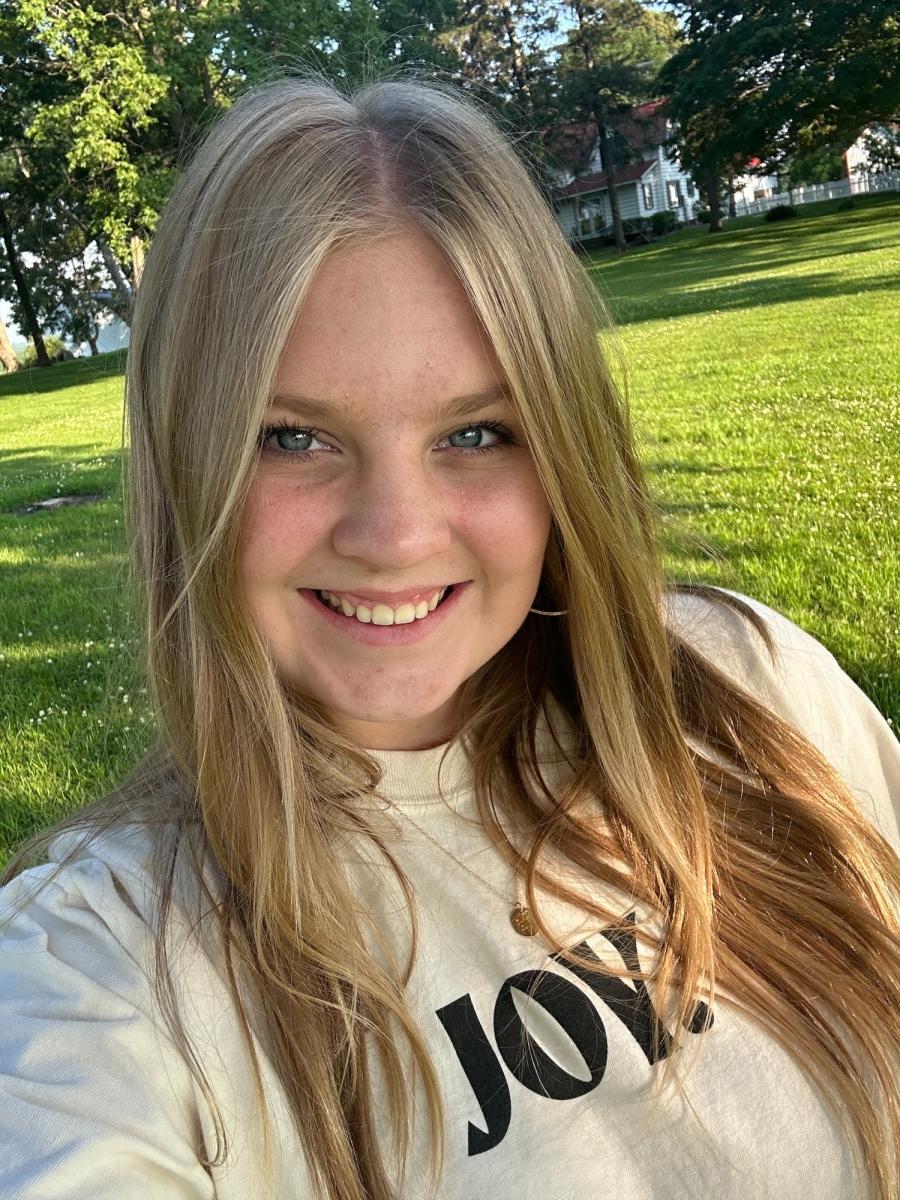
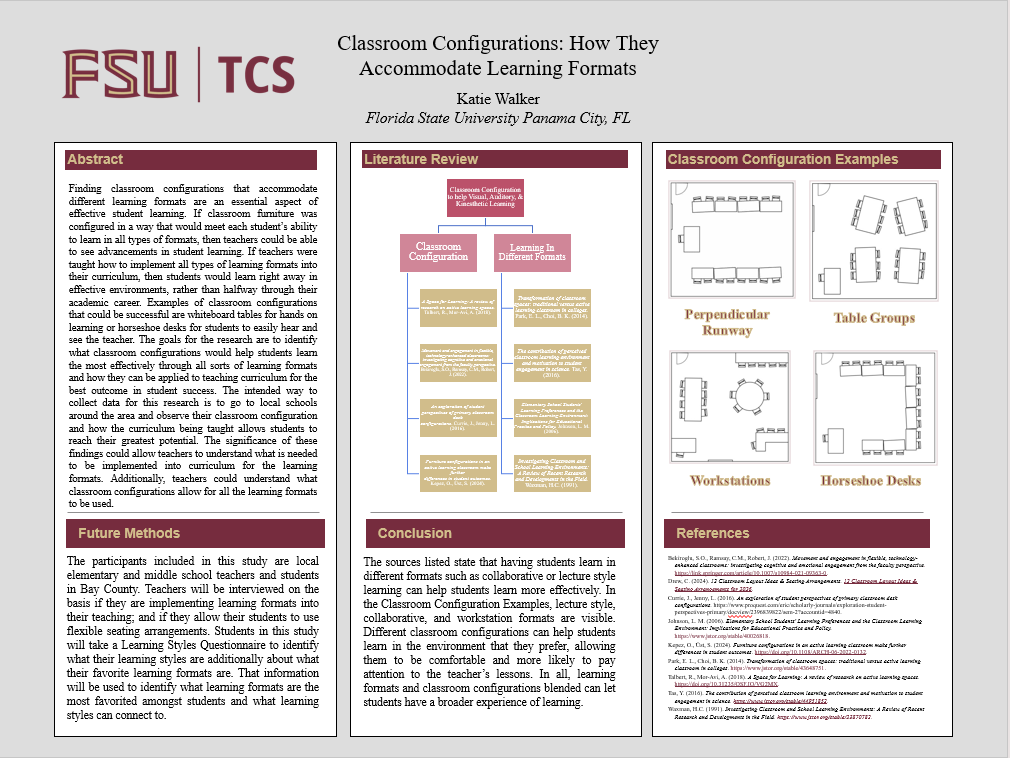
High School Student; intended major Elementary Education | I am a high school dual enrolled student at The Collegiate School at FSU Panama City. My intended major is Elementary Education. I am interested in writing my own music, playing the piano and guitar, and singing. Additionally, I am a military child in the United States Air Force. | Classroom Configurations: How They Accommodate Learning Formats | Finding classroom configurations that accommodate different learning formats are an essential aspect of effective student learning. If classroom furniture was configured in a way that would meet each student’s ability to learn in all types of formats, then teachers could be able to see advancements in student learning. If teachers were taught how to implement all types of learning formats into their curriculum, then students would learn right away in effective environments, rather than halfway through their academic career. Examples of classroom configurations that could be successful are whiteboard tables for hands on learning or horseshoe desks for students to easily hear and see the teacher. The goals for the research are to identify what classroom configurations would help students learn the most effectively through all sorts of learning formats and how they can be applied to teaching curriculum for the best outcome in student success. The intended way to collect data for this research is to go to local schools around the area and observe their classroom configuration and how the curriculum being taught allows students to reach their greatest potential. The significance of these findings could allow teachers to understand what is needed to be implemented into curriculum for the learning formats. Additionally, teachers could understand what classroom configurations allow for all the learning formats to be used. | Madisyn Flammia | The Collegiate School at FSU PC | Research | mjf24@fsu.edu | Classroom configuration, visual, auditory, kinesthetic | Complete |
|
No | 2026 | 5th annual Undergraduate Research Symposium, April 17, 2025 | https://pc.fsu.edu/student-research/symposium/research-symposium-program-portal?element_parents=elements/student_photo&ajax_form=1&_wrapper_format=drupal_ajax&token=mlewdneeZrEwyKMVTlWuGR7wMzFjCbO_i0Msp6guNdg | |||||
| 200 | 9048 | Face to Face Poster session | 11:15 High School presentations | Student Research Symposium Program Portal: Submission #200 | 042823b1-cd26-44d9-b9ed-960339896031 | No | Star/flag Student Research Symposium Program Portal: Submission #200 | Lock Student Research Symposium Program Portal: Submission #200 | Add notes to Student Research Symposium Program Portal: Submission #200 | Fri, 01/30/2026 - 09:35 AM | Fri, 01/30/2026 - 09:49 AM | Fri, 04/03/2026 - 12:50 PM | Anonymous | 146.201.10.37 | Ethan | Toole | et23k@fsu.edu |
|
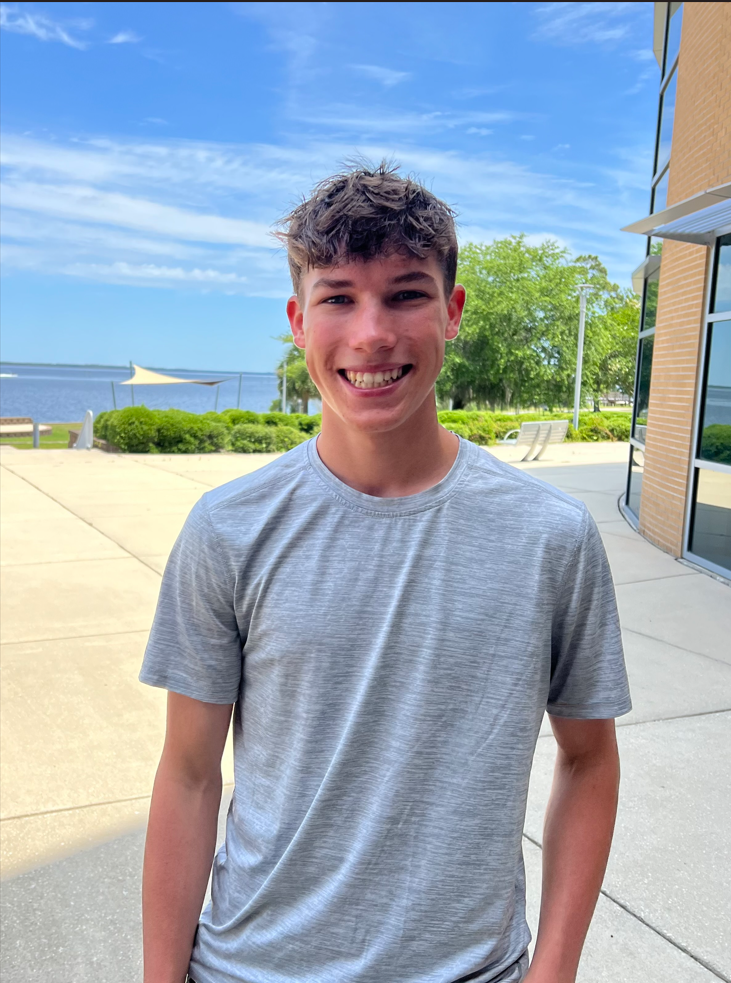
TCS High School Student, Mechanical Engineering | I am a high school student at The Collegiate School. I am looking to become a mechanical, civil, or electrical engineer. I plan to go to college and then move forward with my career. | FWD, RWD, or AWD: Which is the Best Choice for the Daily Driver | This study compares front-wheel drive (FWD), rear-wheel drive (RWD), and all-wheel drive (AWD) systems to determine which offers the most balanced combination of performance, safety, and fuel efficiency for the average driver. Existing research highlights clear trade-offs between efficiency, traction, and handling across drivetrain types. By analyzing peer-reviewed engineering studies, safety reports, and consumer data, this project evaluates how each system performs in real-world driving conditions. The findings suggest that drivetrain selection depends largely on driver priorities and environment. | Madisyn Flammia | The Collegiate School at FSU PC | Research | mjf24@fsu.edu | Vehicles, Cars, Drivelines | Complete | E. Toole Poster.pdf152.56 KB
|
No | 2026 | 5th annual Undergraduate Research Symposium, April 17, 2025 | https://pc.fsu.edu/student-research/symposium/research-symposium-program-portal?element_parents=elements/student_photo&ajax_form=1&_wrapper_format=drupal_ajax&token=oswO0q6lZRrn9sGlBD9aMLh-LxcYEigz6npbYTjHfoM |