
Student Research Symposium Program Portal
220 submissions
| # | SID | Presentation Modality | Poster Session/Number | Submission title | UUID | In draft | Starred | Locked | Notes | Created | Completed | Changed | User | IP address | Primary Student Contact First Name | Primary Student Contact Last Name | Pronouns | Primary Student Contact FSU Student Email | Photo of all individuals presenting this work | Major(s) of all individuals presenting this work | Bio of all individuals presenting this work | Poster Title | Abstract | Research Mentor Name | Research Mentor's College (or High School) | Research Mentor's Department (or Subject) | Research Mentor's Email | Additional Research Mentor(s) | Co-presenter(s) | Keywords | Work | Poster PDF or Powerpoint | Poster Thumbnail | I will be printing my poster | Year | Annual description | Update URL | Operations |
|---|---|---|---|---|---|---|---|---|---|---|---|---|---|---|---|---|---|---|---|---|---|---|---|---|---|---|---|---|---|---|---|---|---|---|---|---|---|---|
| 90 | 7981 | Face to Face Poster session | C- 2 R - 2 | Student Research Symposium Program Portal: Submission #90 | 390a34c5-70b0-4386-8112-c6787f957095 | No | Star/flag Student Research Symposium Program Portal: Submission #90 | Lock Student Research Symposium Program Portal: Submission #90 | Add notes to Student Research Symposium Program Portal: Submission #90 | Thu, 02/06/2025 - 10:55 PM | Thu, 02/06/2025 - 11:42 PM | Mon, 04/14/2025 - 01:22 PM | Anonymous | 67.177.123.226 | Zachary | Porter | zp23a@fsu.edu |
|
Biological Science | I am a sophomore more here at FSU PC and was born and raised in Panama City, Florida. I enjoy participating in any physical activity, and spending time outdoors. For my career goal, I am on track to apply and go through dental school to become a dentist where I plan to apply to residency in order to specialize ie in orthodontics. I also enjoy researching history and science and I am looking forward to participating in the research symposium. | The Melting Point Phase Diagram of a Cocrystal Between Citric Acid and Paracetamol | Cocrystals are significant in the medical and pharmaceutical industries as they function in pharmaceutical development. Cocrystals provide a way to tailor and modify a drug molecule's physical properties, such as the stability and dissolution rate, without altering its chemical makeup. This research will address the cocrystal of citric acid and paracetamol. This cocrystal is formed through hydrogen bonding that causes the molecules of citric acid and paracetamol to take a crystalline form. When these crystals are formed potentially improved properties are created in comparison to the individual components. With paracetamol, a common pain reliever, these improved properties make it more readily absorbed by the body when administered orally, essentially making it a more efficient drug. Prior to this research, a melting point phase diagram was not known for this cocrystal. A melting point phase diagram of cocrystals is important as it provides a visual representation to determine the composition and stability of the resulting cocrystal. This research will determine and present the melting point phase diagram of the citric acid and paracetamol cocrystal which will allow researchers to identify the optimal conditions for cocrystal formation. |
Paul baures | Florida State University - Panama City | Chemistry | pbaures@pc.fsu.edu | cocrystals, melting point, phase diagram | Complete | Presentation Template FSU_new.pdf617.39 KB
|
No | 2025 | 5th annual Undergraduate Research Symposium, April 17, 2025 | https://pc.fsu.edu/student-research/symposium/research-symposium-program-portal?element_parents=elements/student_photo&ajax_form=1&_wrapper_format=drupal_ajax&token=b5rSXjyJOK5yiJTSB6ZtBnCB4HmFrms2fgx7PkdtGQU | |||||
| 89 | 7976 | Asynchronous Online Presentation | https://pc.fsu.edu/student-research/symposium/symposium-program-2025/systems-engineering | Student Research Symposium Program Portal: Submission #89 | 975201ce-e896-4b66-8c66-578105428e55 | No | Star/flag Student Research Symposium Program Portal: Submission #89 | Lock Student Research Symposium Program Portal: Submission #89 | Add notes to Student Research Symposium Program Portal: Submission #89 | Thu, 02/06/2025 - 10:38 PM | Thu, 02/06/2025 - 10:38 PM | Tue, 04/01/2025 - 07:05 AM | Anonymous | 23.112.119.60 | Mike | Howell | Meh24@fsu.edu |
|
Master of Systems Engineering | I am a prior service United States Marine with an interest in leadership. I have eight years of engineering experience and ten years of leadership and management experience. I will obtain my graduate degree in systems engineering in May 2025. | “Hit hard, hit fast, hit often” – Lt. Gen. Lewis B. “Chesty” Puller | Lewis B. Puller was one of, if not the most, highly decorated Marines within the history of the United States Marine Corps. With a career that spanned 37 years through multiple conflicts and three wars, he became a mythical figure known for his leadership, combat prowess, and unwavering commitment and dedication in service of the Marine Corps. Through constant demonstrations of exceptional tactical skill and resilience under first, Chesty Puller exhibited outstanding discipline and dedication to his craft. His decisive leadership through battles such as Guadalcanal, Peleliu, and the Chosin Reservoir cemented his status as a legendary commander. Puller embodied the Marine Corps ethos of honor, courage, and commitment and continues to inspire generations of Marines through his extensive legacy. | Dr. Daniel Georgiadis | George Washington University, PhD. | Industrial and Manufacturing Engineering | dgeorgiadis@pc.fsu.edu | Lewis Chesty Puller | Complete | 2025 | 5th annual Undergraduate Research Symposium, April 17, 2025 | https://pc.fsu.edu/student-research/symposium/research-symposium-program-portal?token=uwUrDRsiottNfkxNE85rgCkMV6X3ZBw_4E4aNJ1PGCU | |||||||
| 87 | 7966 | Face to Face Poster session | C -3 R- 8 | Student Research Symposium Program Portal: Submission #87 | c5cd9680-9375-4f68-b9f1-3c60e191bd76 | No | Star/flag Student Research Symposium Program Portal: Submission #87 | Lock Student Research Symposium Program Portal: Submission #87 | Add notes to Student Research Symposium Program Portal: Submission #87 | Thu, 02/06/2025 - 10:04 PM | Thu, 02/06/2025 - 10:28 PM | Mon, 04/14/2025 - 01:21 PM | Anonymous | 24.42.202.21 | Rohan Nana, Nicholas Ni, | Christian Rich, and Antonne Williams | rnana@fsu.edu |
|
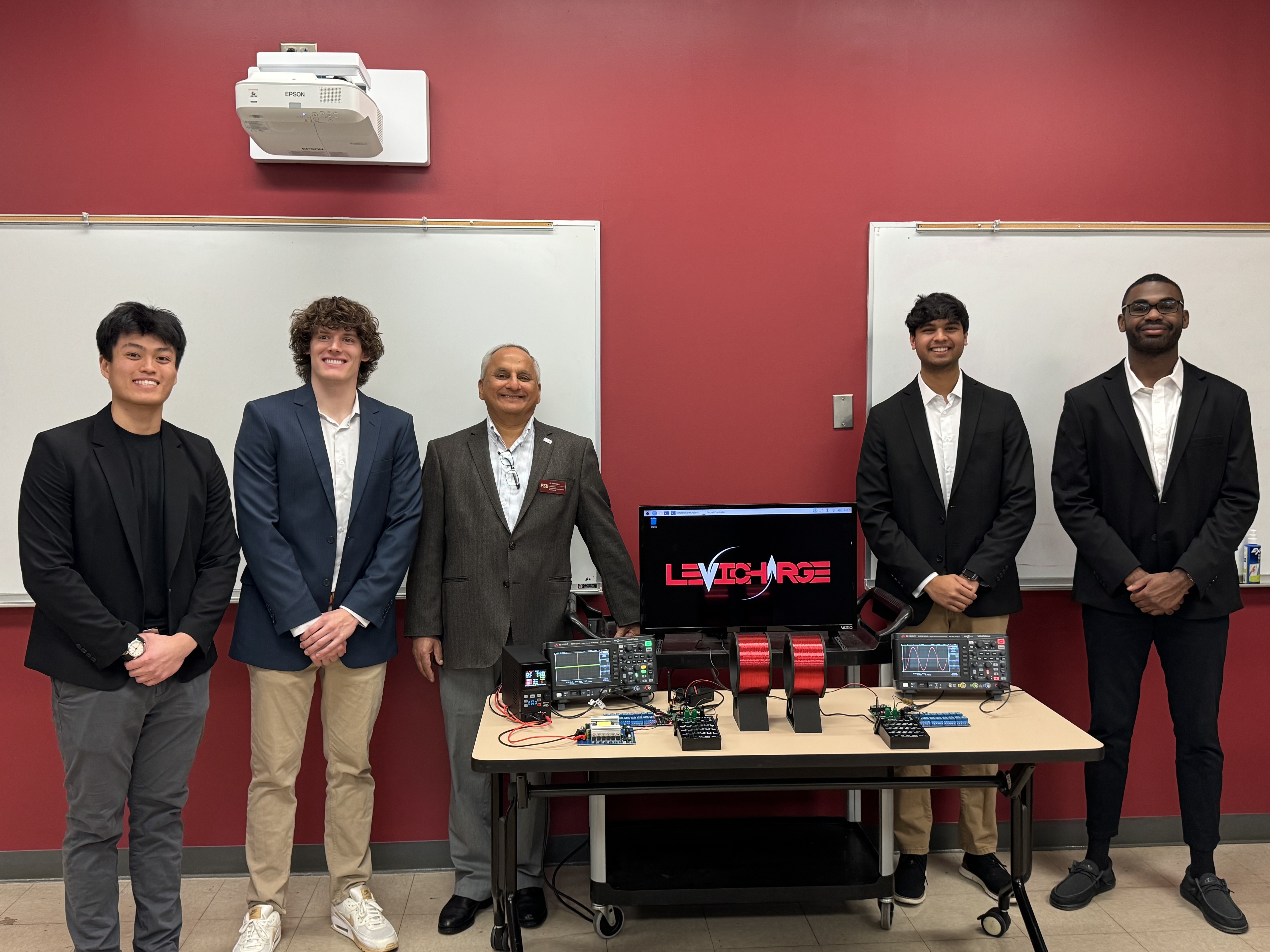
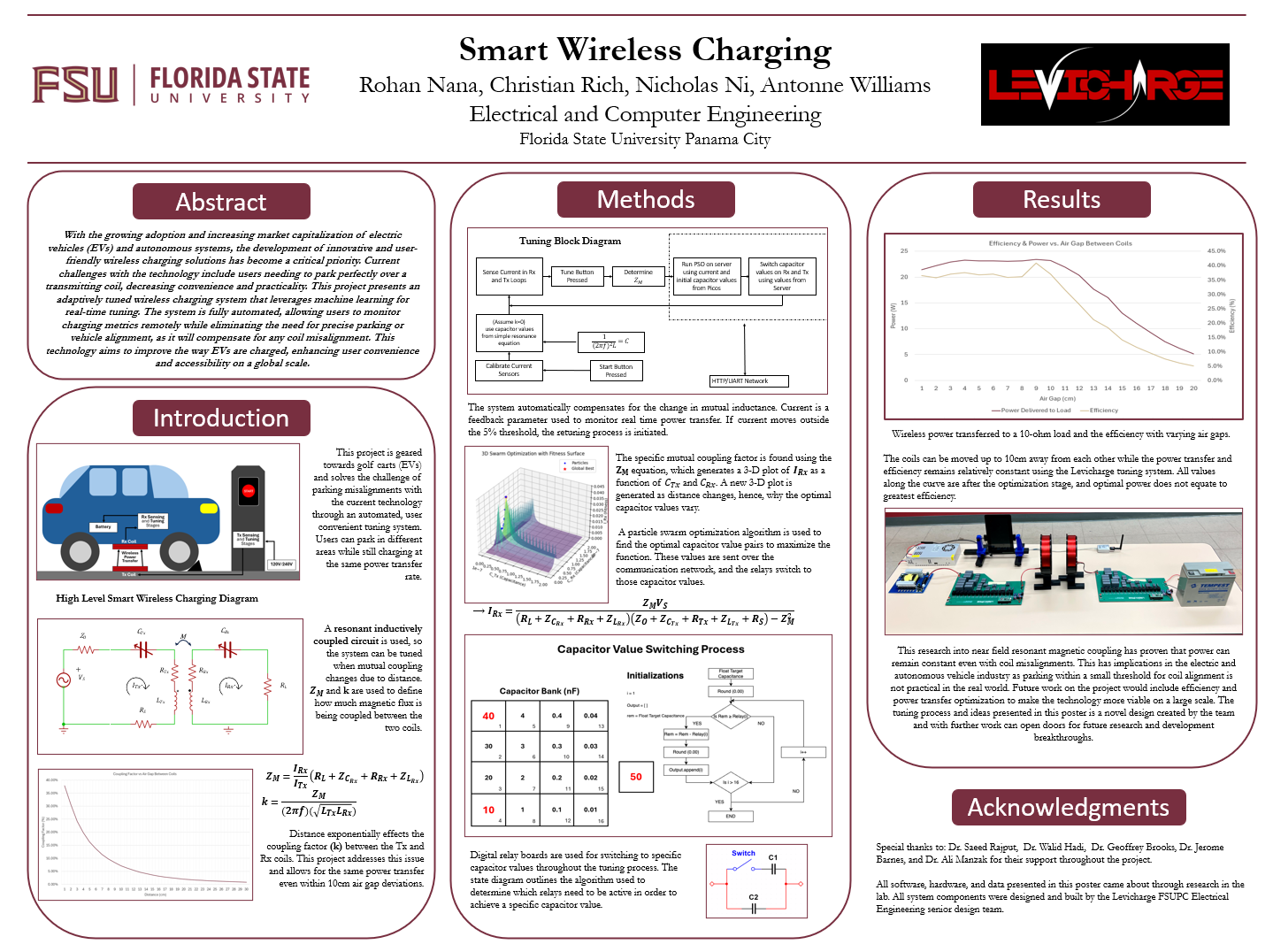
Electrical Engineering | This capstone project was undertaken by a team of senior electrical and computer engineering students dedicated to advancing wireless charging technology for the electric and autonomous vehicle industry. The FSUPC Levicharge senior design team—Rohan Nana, Christian Rich, Nicholas Ni, and Antonne Williams—is eager to showcase how wireless charging can transform the EV industry. | Smart Wireless Charging | With the growing adoption and increasing market capitalization of electric vehicles (EVs) and autonomous systems, the development of innovative and user-friendly wireless charging solutions has become a critical priority. Current challenges with the technology include users needing to park perfectly over a transmitting coil, decreasing convenience and practicality. This project proposes an adaptively tuned wireless charging system that leverages machine learning for real-time tuning. The system will be fully automated, allowing users to monitor charging metrics remotely while eliminating the need for precise parking or vehicle alignment, as it will compensate for any coil misalignment. This technology aims to improve the way EVs are charged, enhancing user convenience and accessibility on a global scale. | Dr. Saeed Rajput | Florida State University | Electrical and Computer Engineering | srajput@pc.fsu.edu | Dr. Walid Hadi | Wireless Charging, Electrical Engineering, Machine Learning | Complete |
|
No | 2025 | 5th annual Undergraduate Research Symposium, April 17, 2025 | https://pc.fsu.edu/student-research/symposium/research-symposium-program-portal?element_parents=elements/student_photo&ajax_form=1&_wrapper_format=drupal_ajax&token=oa9RwMKX4vSfKyRvv_56L5LQEqGdPzusCImzzim5aIQ | ||||
| 86 | 7961 | Face to Face Poster session | C-1 R - 9 | Student Research Symposium Program Portal: Submission #86 | 8c19a71f-721a-4033-8c02-50e76fc2583c | No | Star/flag Student Research Symposium Program Portal: Submission #86 | Lock Student Research Symposium Program Portal: Submission #86 | Add notes to Student Research Symposium Program Portal: Submission #86 | Thu, 02/06/2025 - 08:16 PM | Thu, 02/06/2025 - 08:17 PM | Mon, 04/14/2025 - 01:20 PM | Anonymous | 70.122.138.100 | Emily | Cloninger | emc23d@fsu.edu |
|
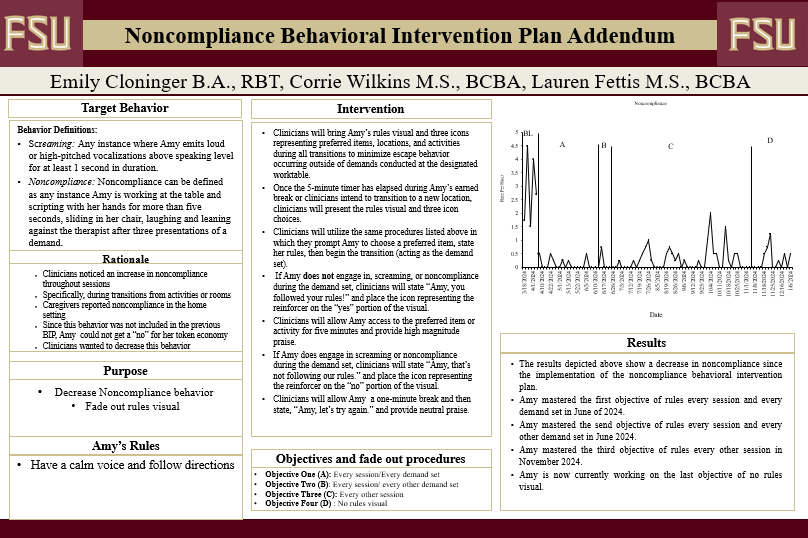
Applied Behavioral Analysis | My name is Emily Cloninger. I am currently in my second year in the Applied Behavior Analysis program. I work at the Early Childhood Autism Program (ECAP) and I am excited to share my work! | Noncompliance Behavioral Intervention Plan | An increase in noncompliance behavior was observed throughout sessions and in the home environment. Due to this, a Noncompliance Behavior Intervention Plan was implemented to decrease this maladaptive behavior in the clinic. Additionally, the clinical team wanted to generalize these procedures to the home environment to decrease non-compliance. Overall, since the implementation of the behavioral intervention, there has been a decrease in noncompliance. | Corrie Wilkins | n/a | n/a | wilkins@psy.fsu.edu | noncompliance behavioral intervention | Complete | EC poster for RS (5)_3.pdf185.06 KB
|
|
No | 2025 | 5th annual Undergraduate Research Symposium, April 17, 2025 | https://pc.fsu.edu/student-research/symposium/research-symposium-program-portal?element_parents=elements/student_photo&ajax_form=1&_wrapper_format=drupal_ajax&token=wNhFR3DFQamupN7VdpBbXoz2BSeRCju90_mO_myzMCM | ||||
| 82 | 7941 | Face to Face Poster session | C-1 R - 6 | Student Research Symposium Program Portal: Submission #82 | 1a29de2c-7d30-4c54-8ed5-909be376f77b | No | Star/flag Student Research Symposium Program Portal: Submission #82 | Lock Student Research Symposium Program Portal: Submission #82 | Add notes to Student Research Symposium Program Portal: Submission #82 | Thu, 02/06/2025 - 07:36 PM | Thu, 02/06/2025 - 07:46 PM | Mon, 04/14/2025 - 01:19 PM | Anonymous | 195.181.171.239 | Kinsey | Bigham | She/Her | kib23@fsu.edu |
|
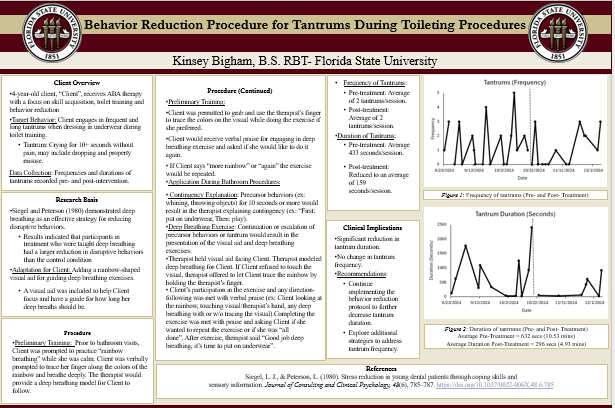
Applied Behavior Analysis (MS) | I am a graduate student in the Applied Behavior Analysis program at Florida State University. I have a strong passion for behavioral science and I am dedicated to using evidence-based interventions to improve the lives of individuals across various settings. I am working toward becoming a Board Certified Behavior Analyst (BCBA) and I am eager to contribute to the field through research and clinical practice. | Behavior Reduction Procedure for Tantrums During Toileting Procedures | Client receiving ABA therapy services for skill acquisition and behavior reduction. Client frequently engaged in tantrums during toileting procedures which reduced time spent on skill acquisition. Behavior reduction procedure was developed to reduce tantrums frequency and durations. Study concluded that tantrums did not decrease in frequency but were reduced significantly in duration. | Dr. Leah Koehler | Florida State University | School of Psychology/Applied Behavior Analysis | koehler@pc.fsu.edu | ABA, Tantrum, Behavior Reduction | Complete | Poster Project 2025_0.pdf240.51 KB
|
|
No | 2025 | 5th annual Undergraduate Research Symposium, April 17, 2025 | https://pc.fsu.edu/student-research/symposium/research-symposium-program-portal?element_parents=elements/student_photo&ajax_form=1&_wrapper_format=drupal_ajax&token=T2Mmc3Ik-p97UZog80O01H8OMZhPy7slM1vMbmQI3Ho | |||
| 83 | 7946 | Face to Face Poster session | C - 5 R - 7 | Student Research Symposium Program Portal: Submission #83 | eaa85e00-b3f2-47f2-849b-60101fa687d1 | No | Star/flag Student Research Symposium Program Portal: Submission #83 | Lock Student Research Symposium Program Portal: Submission #83 | Add notes to Student Research Symposium Program Portal: Submission #83 | Thu, 02/06/2025 - 07:03 PM | Thu, 02/06/2025 - 07:52 PM | Mon, 04/14/2025 - 01:20 PM | Anonymous | 99.146.115.139 | Deina | Escribano | de24c@fsu.edu |

|
Psychology--Applied Behavior Analysis | My name is Deina (Dee-na) and I am currently a first-year graduate student in the applied behavior analysis program. While in the program, I am working on various clinical applications of behavioral analytic principles at the Early Childhood Autism Program here in Panama City. In the future, I plan to explore the use of pairing procedures to promote more quality parent-child interactions. | Promoting Environmental Awareness; Out-of-Context Stimuli Receptive ID | This behavior intervention program aimed to improve environmental attending skills in an eight-year-old male diagnosed with Autism Spectrum Disorder (ASD) through Discrete Trial Training (DTT). The program targeted the identification of out-of-context stimuli within visual scenes to support the client’s engagement with-and-responding to his immediate environment. Using structured teaching methods, the client was presented with visual stimuli containing multiple distractors and prompted to identify the item that did not belong. Mastery was defined as 90% independent responding across three consecutive sessions with multiple clinicians. Over the course of implementation, the client demonstrated significant progress, probing out of two targets on the first day and mastering/probing out of seven additional targets by December 2024. These improvements were accompanied by increased engagement in social interactions related to environmental awareness. Despite temporary disruptions due to illness and holiday closures, the program demonstrated its effectiveness in enhancing the client’s attending skills, with potential for further generalization to naturalistic settings. However, as of January 2025, the client has demonstrated complete mastery of all 14-target scenes in this program. | Dakota Januchowski, M.S., BCBA | Florida State University | Psychology | djanuchowski@pc.fsu.edu | Madelynn Roberson, B.S., RBT | receptive identification, attending skills, discrimination skills | Complete | No | 2025 | 5th annual Undergraduate Research Symposium, April 17, 2025 | https://pc.fsu.edu/student-research/symposium/research-symposium-program-portal?element_parents=elements/student_photo&ajax_form=1&_wrapper_format=drupal_ajax&token=CRqL-96XXtkmAyg_hdsMycLIn53BWHfkcBpBnM9aEa0 | |||||
| 81 | 7936 | Face to Face Poster session | C - 5 R - 2 | Student Research Symposium Program Portal: Submission #81 | e7b57df2-0daa-4ea0-92e6-ce6abeb4bdbc | No | Star/flag Student Research Symposium Program Portal: Submission #81 | Lock Student Research Symposium Program Portal: Submission #81 | Add notes to Student Research Symposium Program Portal: Submission #81 | Thu, 02/06/2025 - 06:46 PM | Thu, 02/06/2025 - 07:14 PM | Mon, 04/14/2025 - 01:18 PM | Anonymous | 146.201.10.24 | Emileigh | Parda | She/Her | ecp21@fsu.edu |
|
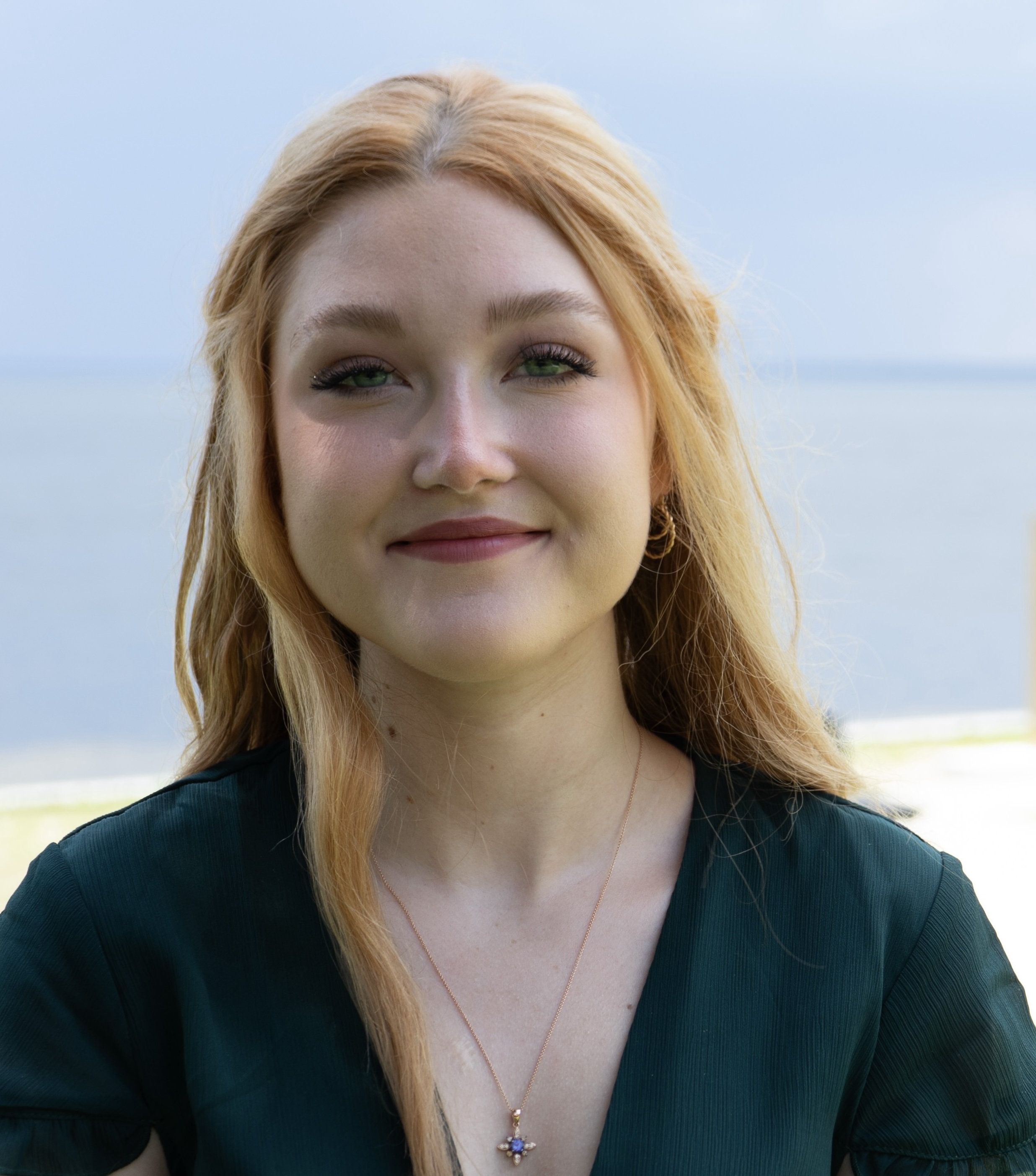
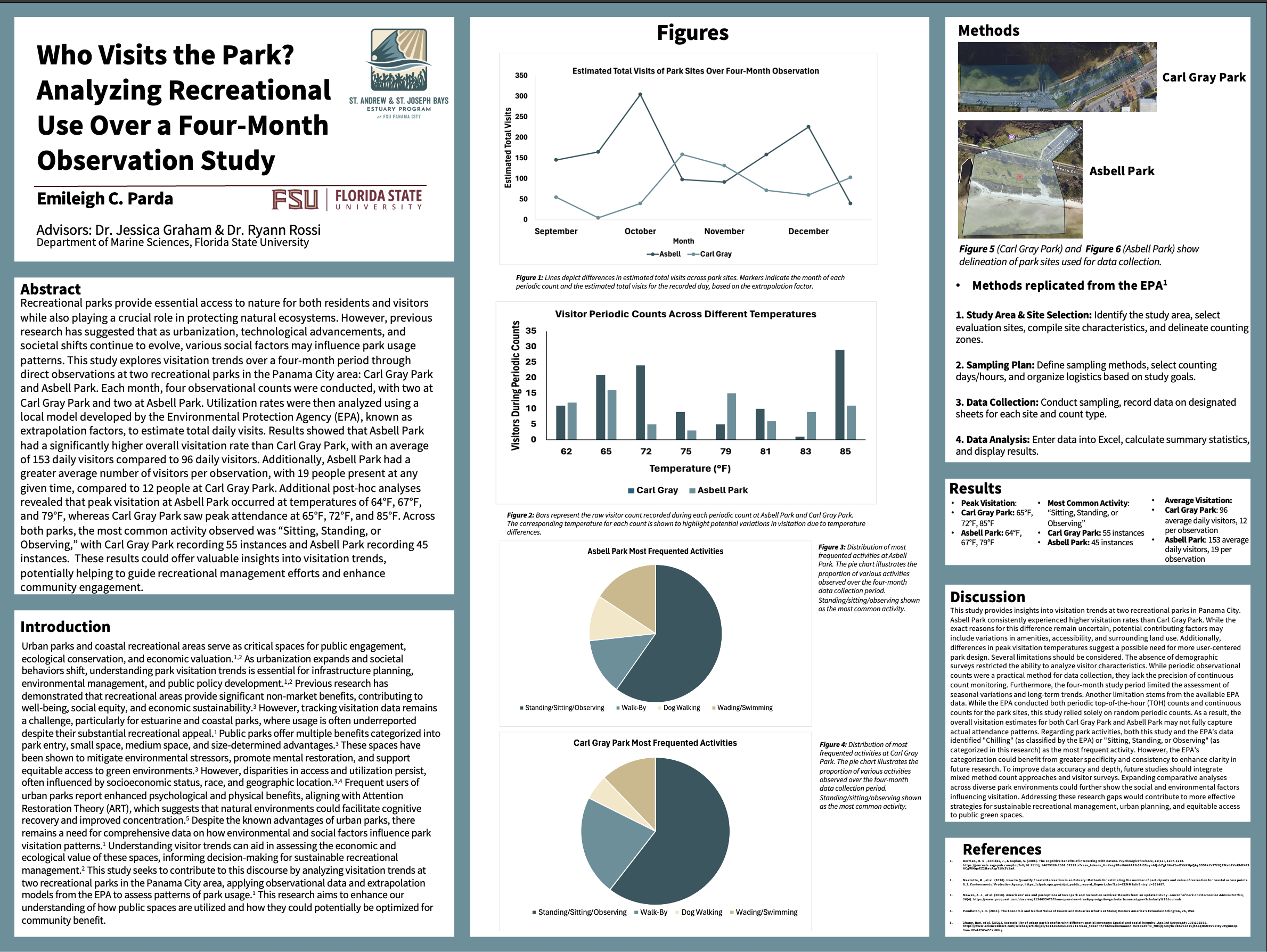
Psychology | My name is Emileigh Parda, and I am an undergraduate student majoring in psychology with minors in sociology and social work. My research spans multiple disciplines, including applied behavior analysis, social psychology, public health, and marine sciences. I aspire to become a neuropsychologist and pursue a Ph.D. in Clinical Psychology, with a research focus on preventative care for individuals at risk of psychopathology and the development of more effective, personalized rehabilitation plans for those with psychopathological conditions or traumatic brain injuries. As a senior, I will be graduating this May. During my gap year, I plan to work at an urgent care clinic, intern at a behavioral health hospital, and take on a post-baccalaureate research assistant position. | “Who Visits the Park? Analyzing Recreational Use Through a Four-Month Observation Study” | Recreational parks provide essential access to nature for both residents and visitors while also playing a crucial role in protecting natural ecosystems. However, previous research has suggested that as urbanization, technological advancements, and societal shifts continue to evolve, various social factors may influence park usage patterns. This study explores visitation trends over a four-month period through direct observations at two recreational parks in the Panama City area: Carl Gray Park and Asbell Park. Each month, four observational counts were conducted, with two at Carl Gray Park and two at Asbell Park. Utilization rates were then analyzed using a local model developed by the Environmental Protection Agency (EPA), known as extrapolation factors, to estimate total daily visits. Results showed that Asbell Park had a significantly higher overall visitation rate than Carl Gray Park, with an average of 153 daily visitors compared to 96 daily visitors. Additionally, Asbell Park had a greater average number of visitors per observation, with 19 people present at any given time, compared to 12 people at Carl Gray Park. Additional post-hoc analyses revealed that peak visitation at Asbell Park occurred at temperatures of 64°F, 67°F, and 79°F, whereas Carl Gray Park saw peak attendance at 65°F, 72°F, and 85°F. Across both parks, the most common activity observed was “Sitting, Standing, or Observing,” with Carl Gray Park recording 55 instances and Asbell Park recording 45 instances. These results could offer valuable insights into visitation trends, potentially helping to guide recreational management efforts and enhance community engagement. | Dr. Jessica Graham & Dr. Ryann Rossi | Florida State University Panama City | St. Andrews & St. Joseph Bays Estuary Program (Marine Biology) | jgraham6@pc.fsu.edu & rrossi@pc.fsu.edu | n/a | n/a | recreational parks, utilization, direct observation, periodic counts | Complete | Updated EPA Research Poster.pdf972.9 KB
|
|
No | 2025 | 5th annual Undergraduate Research Symposium, April 17, 2025 | https://pc.fsu.edu/student-research/symposium/research-symposium-program-portal?element_parents=elements/student_photo&ajax_form=1&_wrapper_format=drupal_ajax&token=kJ_gyhhYxDOOiu37G2hQ6E9V2QwTguv--Q-8cmzsnaI | |
| 80 | 7931 | Face to Face Poster session | C-1 R-1 | Student Research Symposium Program Portal: Submission #80 | 6c5bc967-29a8-4fff-9273-b2e0a0ce2e5c | No | Star/flag Student Research Symposium Program Portal: Submission #80 | Lock Student Research Symposium Program Portal: Submission #80 | Add notes to Student Research Symposium Program Portal: Submission #80 | Thu, 02/06/2025 - 06:04 PM | Thu, 02/06/2025 - 06:10 PM | Mon, 04/14/2025 - 12:24 PM | Anonymous | 50.4.49.203 | Lin Ai | Liao | LL23T@FSU.EDU |

|
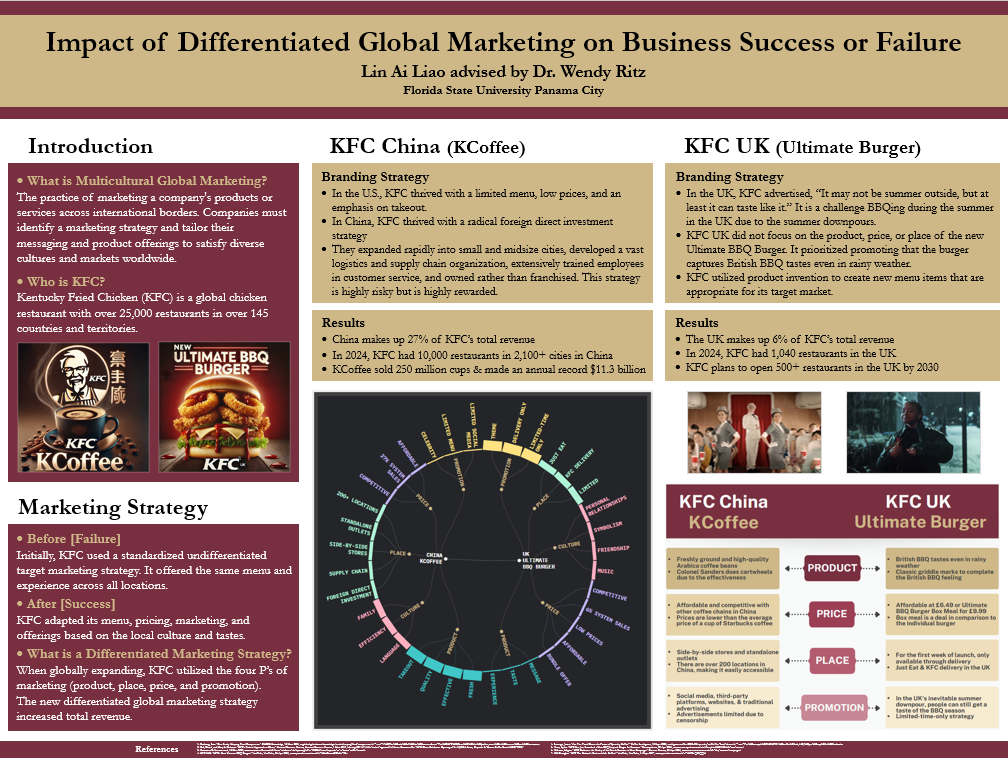
Accounting | I am an FSU Panama City sophomore majoring in accounting with a minor in business administration. I am from Tallahassee, Florida, and I enjoy gardening, pickleball, and beach volleyball. I am academically driven with a 4.0 GPA. This is my second year attending the student research symposium. My career goal is to be a certified public accountant (CPA). | Impact of Differentiated Global Marketing on Business Success or Failure | This study delves into the complexities of differentiated global marketing in the food industry, analyzing the usage of the fundamental marketing strategy of the marketing mix, in China and the United Kingdom (UK). It examines KFC’s usage of the marketing mix also known as the Four P’s (product, price, place, promotion), highlighting key areas that can lead to the branding success of a company. The study emphasizes the importance of companies in the food industry understanding that to expand globally, they must adapt their menu-products, pricing, and promotion based on the local culture and tastes. Through an examination of the differentiated global marketing strategy present in this real-world example, it offers insight into potential strategies for promotional success. By elucidating the intricacies of the global marketing process, this research aims to contribute to a deeper understanding of the importance of customer segmentation, behavioral targeting, and differentiated international marketing strategies. | Dr. Wendy Ritz | Kennesaw State University | Business Administration | writz@fsu.edu | Differentiated Global Marketing | Complete |
|
No | 2025 | 5th annual Undergraduate Research Symposium, April 17, 2025 | https://pc.fsu.edu/student-research/symposium/research-symposium-program-portal?element_parents=elements/poster_pdf&ajax_form=1&_wrapper_format=drupal_ajax&token=O6SvY-o4SnPJ4J8dYdQFZBhyWYoi9bvZIt-qIYTdcvk | |||||
| 79 | 7926 | Face to Face Poster session | C -4 R - 3 | Student Research Symposium Program Portal: Submission #79 | 31b20a25-da3f-47e5-8390-40b304738cd9 | No | Star/flag Student Research Symposium Program Portal: Submission #79 | Lock Student Research Symposium Program Portal: Submission #79 | Add notes to Student Research Symposium Program Portal: Submission #79 | Thu, 02/06/2025 - 05:33 PM | Thu, 02/06/2025 - 05:39 PM | Mon, 04/14/2025 - 01:18 PM | Anonymous | 73.19.145.120 | Alonso | Arcadia-Reynoso | ama22t@fsu.edu |
|
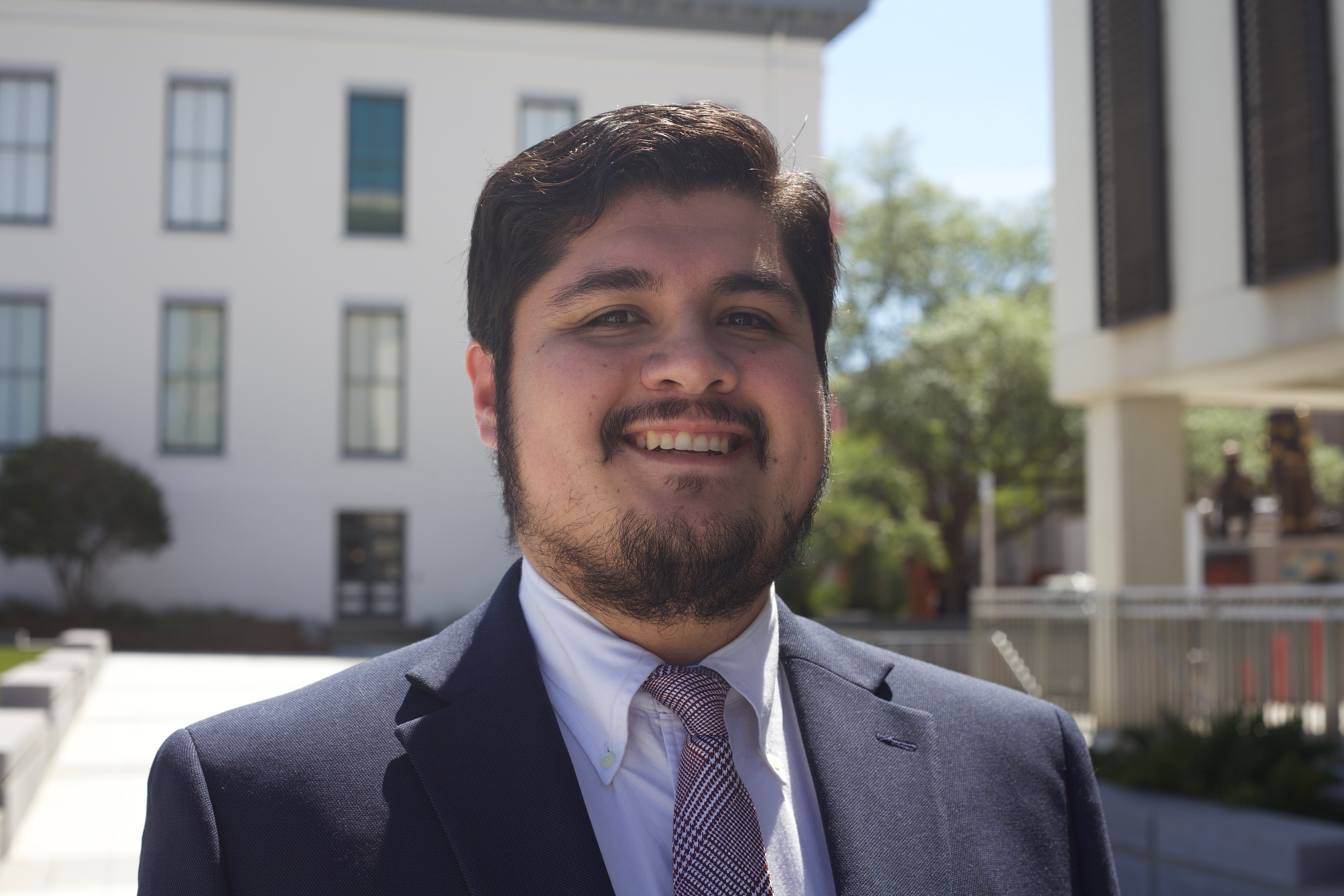
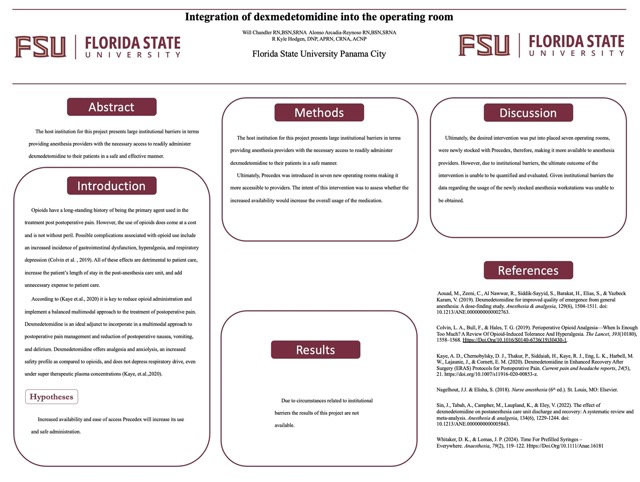
DNAP | ER and ICU nurse with nine years of experience seeking a rewarding career in nursing anesthesia. | Integration of dexmedetomidine into the operating room | Dexmedetomidine is an ideal adjunct to incorporate in a multimodal approach to postoperative pain management and reduction of postoperative nausea, vomiting, and delirium. Dexmedetomidine offers analgesia and anxiolysis, an increased safety profile as compared to opioids, and does not depress respiratory drive, even under super therapeutic plasma concentrations (Kaye, et.al.,2020). | R Kyle Hodgen, DNP, APRN, CRNA, ACNP | FSU | Nurse Anesthesia | RKH23A@FSU.EDU | Will Chandler,RN,BSN,SRNA | dexmedetomidine, Precedex, multimodal, anesthesia | Exploratory (the research question has been identified and design of approach is outlined) |
|
No | 2025 | 5th annual Undergraduate Research Symposium, April 17, 2025 | https://pc.fsu.edu/student-research/symposium/research-symposium-program-portal?element_parents=elements/poster_thumbnail&ajax_form=1&_wrapper_format=drupal_ajax&token=RYUIa-u27foFP50a0ji1EEhV_bK9_K2EihwHifHeVmI | ||||
| 77 | 7916 | Asynchronous Online Presentation | https://pc.fsu.edu/student-research/symposium/symposium-program-2025/systems-engineering | Student Research Symposium Program Portal: Submission #77 | ec2b746d-66c0-40da-9f87-c940b070731f | No | Star/flag Student Research Symposium Program Portal: Submission #77 | Lock Student Research Symposium Program Portal: Submission #77 | Add notes to Student Research Symposium Program Portal: Submission #77 | Thu, 02/06/2025 - 05:06 PM | Thu, 02/06/2025 - 05:06 PM | Tue, 04/01/2025 - 07:21 AM | Anonymous | 72.187.183.27 | Jon | Reischmann | jpr23b@fsu.edu |
|
Master of Science in Systems Engineering | Current Career : Currently working for L3Harris as a Systems Engineering Specializing in Obsolescence (Also Air Force Reservist, 14N Intelligence Officer) Hometown: Mount Dora Florida |
Robin Olds: Visionary Leader and Air Combat Icon | Robin Olds was a legendary leader and a decorated U.S. Air Force fighter pilot known for his exceptional combat skills and ability to inspire those under his command. His leadership transformed fighter operations during the Vietnam War, where he emphasized adaptability, tactical innovation, and a hands-on approach to command. This research analyzes Olds’ leadership style, examining his traits, behaviors, emotional intelligence, vision, and strengths. Despite his defiance of bureaucratic norms, his ability to optimize fighter tactics and mentor the next generation of pilots cemented his legacy. The goal of this research is to evaluate the impact of Olds’ leadership on military aviation and to extract lessons applicable to modern leadership and decision-making in high-stakes environments. | Dr. Daniel Georgiadis | Florida State University | Systems Engineering | dgeorgiadis@pc.fsu.edu | Robin Olds | Exploratory (the research question has been identified and design of approach is outlined) | 2025 | 5th annual Undergraduate Research Symposium, April 17, 2025 | https://pc.fsu.edu/student-research/symposium/research-symposium-program-portal?element_parents=elements/student_photo&ajax_form=1&_wrapper_format=drupal_ajax&token=BtsunMoR7oPJHGX21DTDS3Jdb-BTra6DhkaPXos38Ao | |||||||
| 76 | 7911 | Face to Face Poster session | C- 2 R - 9 | Student Research Symposium Program Portal: Submission #76 | 1cfda6a6-4a3e-4988-afe6-8ca487ba6188 | No | Star/flag Student Research Symposium Program Portal: Submission #76 | Lock Student Research Symposium Program Portal: Submission #76 | Add notes to Student Research Symposium Program Portal: Submission #76 | Thu, 02/06/2025 - 05:04 PM | Thu, 02/06/2025 - 05:05 PM | Tue, 07/22/2025 - 09:41 AM | Anonymous | 24.35.21.26 | Anneke | Bullock | She/Her | aab24@fsu.edu |
|
Public Health | Hello! My name is Anneke Bullock. I am originally from Zweibrucken, Germany and lived there for 8 years. I am bilingual in both German and English. I am currently in my junior year of university. I am attending FSU PC and will be majoring in Public Health. Along with that I will be completing a minor is business. Some things of the things I enjoy to do are traveling, doing outdoors activities, and spending time with family and friends. My future goal is to become an officer in the Air Force after I graduate from FSU. Then, I plan on completing my master's while in the USAF and potentially move up north. |
"Bridging the Divide: A Comprehensive Approach to Enhancing Patient Experience and Quality of Care in the U.S. Healthcare System" | The U.S. healthcare system faces critical challenges in aligning patient experience measures with effective implementation practices, resulting in widespread dissatisfaction among patients. This poster synthesizes findings from a comprehensive review of current literature alongside preliminary results from ongoing survey research examining patient experiences across various healthcare settings. While frameworks like the Patient Experience Surveys (PES) and HCAHPS aim to elevate care quality, their voluntary nature leads to inconsistent application and fragmented care experiences. By investigating these systemic shortcomings and contrasting the U.S. approach with successful models from other Western healthcare systems, we advocate for mandatory and standardized implementation protocols. Our presentation highlights the urgent need for policy reform that prioritizes patient-centered care, ensuring equitable access and improved outcomes for all populations. Ultimately, this work seeks to catalyze a national dialogue on actionable solutions that can transform the U.S. healthcare landscape into one that is more cohesive, responsive, and attuned to patient needs. | Dr. Bre` Minniefield | FSU PC | Biology | bminniefield@pc.fsu.edu | Public health, Patient Experience, U.S. Healthcare, Standardized Care, Patient Centered Care | Exploratory (the research question has been identified and design of approach is outlined) | No | 2025 | 5th annual Undergraduate Research Symposium, April 17, 2025 | https://pc.fsu.edu/student-research/symposium/research-symposium-program-portal?element_parents=elements/student_photo&ajax_form=1&_wrapper_format=drupal_ajax&token=AfZRQ5AjX4XHf2a4Jx3HbHMUwc-3p1kHiODGi7QPIas | |||||
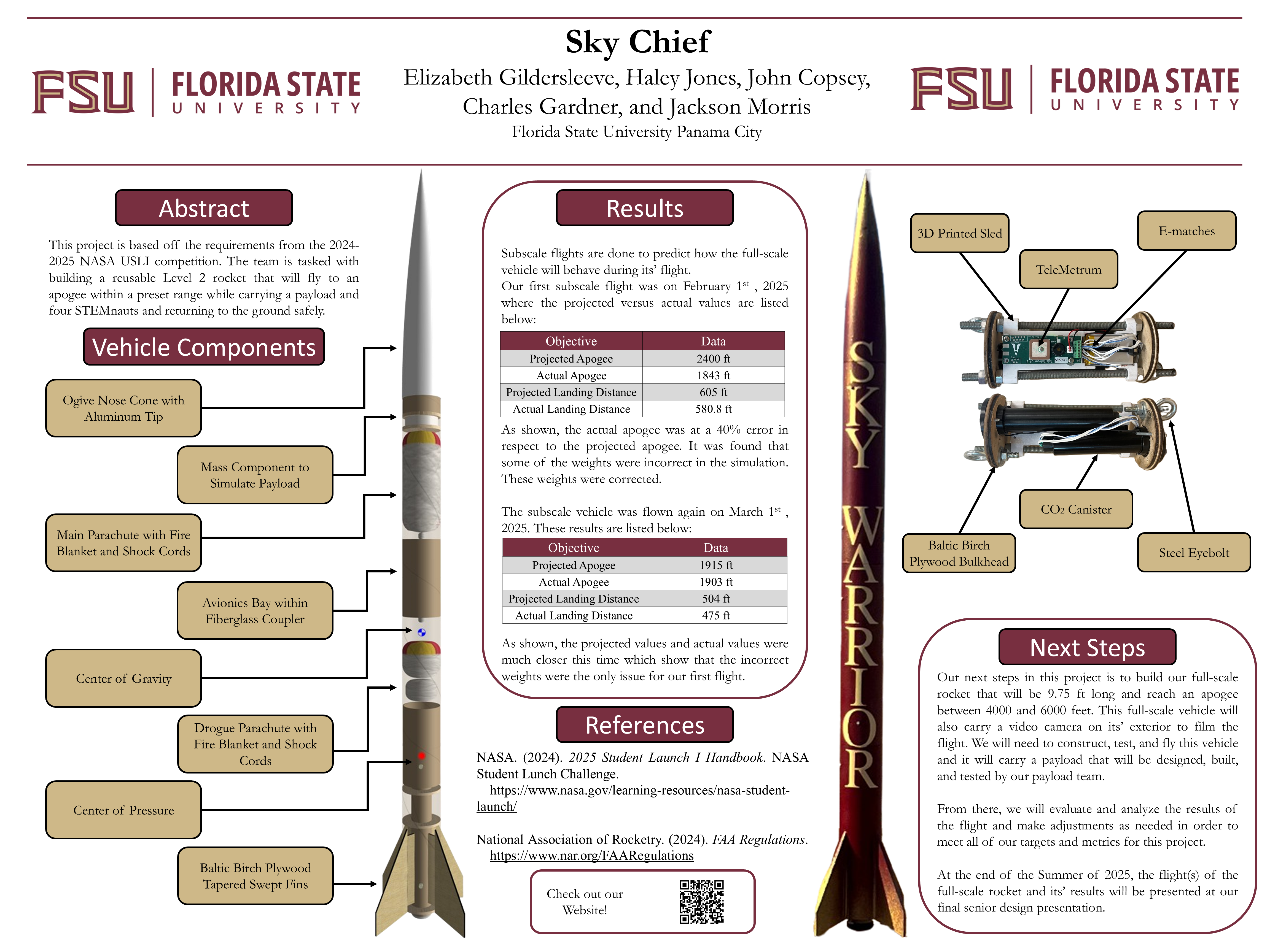
| 75 | 7906 | Face to Face Poster session | C -3 R- 11 | Student Research Symposium Program Portal: Submission #75 | 1bc2163b-53d5-4f6c-8984-6ee7c48db9ae | No | Star/flag Student Research Symposium Program Portal: Submission #75 | Lock Student Research Symposium Program Portal: Submission #75 | Add notes to Student Research Symposium Program Portal: Submission #75 | Thu, 02/06/2025 - 03:55 PM | Thu, 02/06/2025 - 03:55 PM | Mon, 04/14/2025 - 01:16 PM | Anonymous | 146.201.10.4 | Elizabeth Gildersleeve, Haley Jones, Charles Gardner, John Copsey, Jackson Morris | Steven-Thomas Dvorak, Seth Edwards, Dylan Bragg, and Hunter Popovich | eaf19@fsu.edu |
|
Mechanical Engineering | This research is conducted by a team of mechanical and electrical senior engineering students from FSU PC. Even though we are all from different places we have come together to design and produce something we have all dreamed of doing for years. We hope this project inspires future generations to follow their dreams and reach for the stars. | Sky Chief | The SKY CHIEF project follows the guidelines of the 2025 USCLI NASA competition in designing, constructing, and testing both subscale and full-scale rockets for flight and recovery. The rocket will achieve an altitude between 3,500 and 5,500 feet while carrying a payload to transmit between three and eight critical data points. These include temperature at the landing site, apogee reached, battery status, onboard STEMnaut orientation, time of landing, maximum velocity, landing velocity, and calculated STEMnaut survivability. In addition to meeting these requirements, the project incorporates an independent objective of integrating a camera into the rocket to capture in-flight and landing footage. The project emphasizes precise flight performance, payload data transmission, and reliable recovery, aligning with NASA's engineering and safety standards to validate mission success. |
Dr. Twan Capehart | Florida State University | Mechanical Engineering | tcapehart@pc.fsu.edu | Dr. Mauricio Chagas | Haley Jones, Charles Gardner, John Copsey, Jackson Morris, Steven-Thomas Dvorak, Hunter Popovich, Seth Edwards, Dylan Bragg | Rocket, Rocketry, Avionics, Payload, Launch | Exploratory (the research question has been identified and design of approach is outlined) | Senior Design 1 Poster.pdf370.91 KB
|
|
No | 2025 | 5th annual Undergraduate Research Symposium, April 17, 2025 | https://pc.fsu.edu/student-research/symposium/research-symposium-program-portal?element_parents=elements/student_photo&ajax_form=1&_wrapper_format=drupal_ajax&token=4AdD3rUNQNJtXz1qTGQ_ZwsX6n4RUCHLWVzq1B1Nesc | ||
| 73 | 7896 | Face to Face Poster session | C - 6 R - 2 | Student Research Symposium Program Portal: Submission #73 | aefc3082-a284-40fc-a1d1-998fe1c83aed | No | Star/flag Student Research Symposium Program Portal: Submission #73 | Lock Student Research Symposium Program Portal: Submission #73 | Add notes to Student Research Symposium Program Portal: Submission #73 | Thu, 02/06/2025 - 02:14 PM | Thu, 02/06/2025 - 02:15 PM | Mon, 04/14/2025 - 01:16 PM | Anonymous | 150.176.163.200 | Diego | Barragan | He Him | xbarrd@baystudent.org |
|
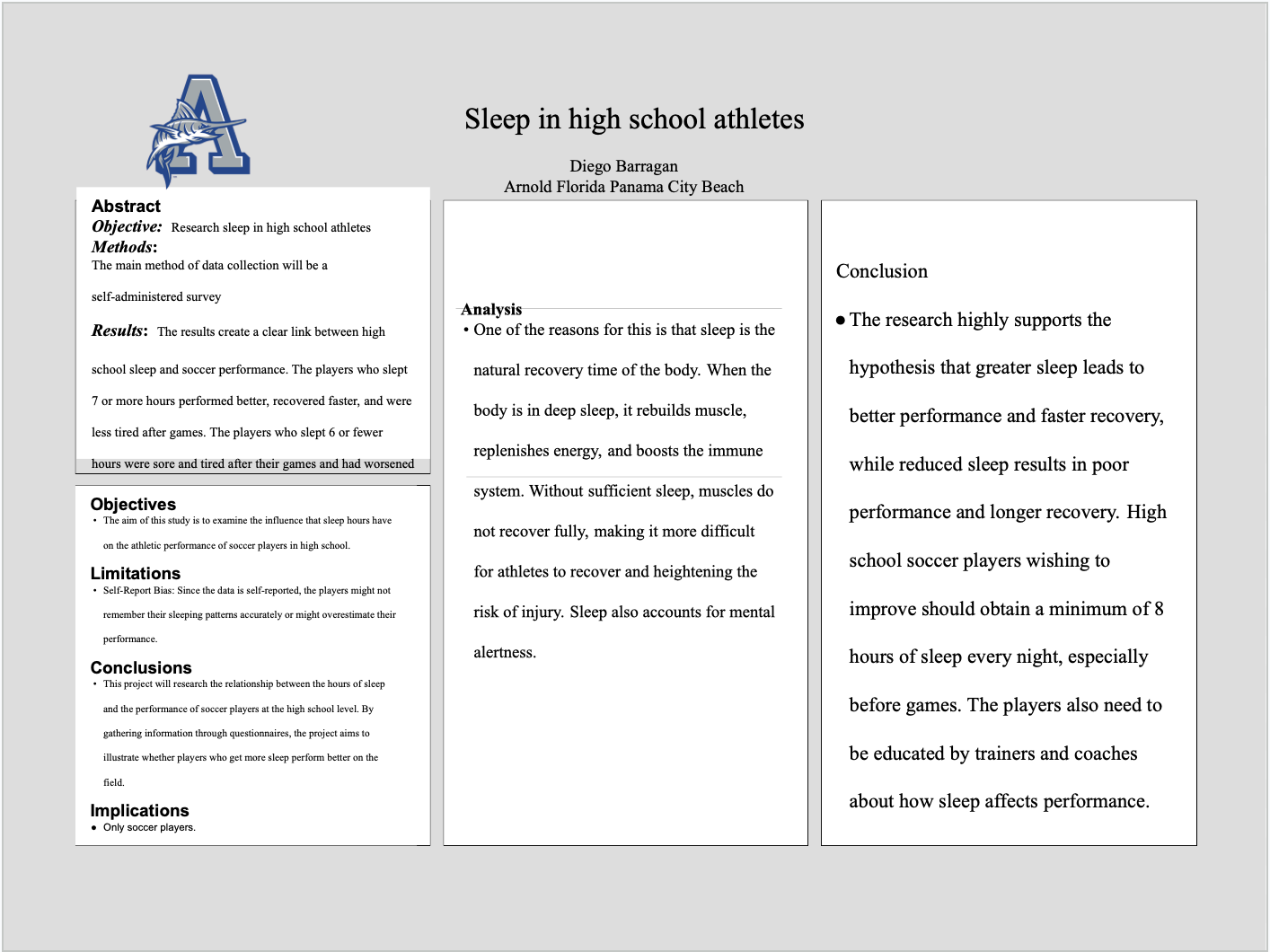
tbd | My research goal would be to see how athletes are affected by sleep. Some of my goals would be to graduate college as a civil engineer with a focus in construction. I was born and raised here in Panama City Beach Florida. | Sleep and its Correlational Effect on High School Athletes' Performances | Sleep is a crucial factor in athletic performance, yet many high school athletes do not get enough rest due to busy schedules, academic demands, and social obligations. This paper explores how sleep affects various aspects of athletic performance, including memory, focus, mood, motivation, injury risk, and recovery. Research has shown that sleep is essential for learning new motor skills, improving reaction time, and maintaining concentration during competition. Athletes who do not get enough sleep struggle with decision-making, slower reflexes, and decreased endurance, which can negatively impact their overall performance. Beyond cognitive effects, sleep deprivation increases the risk of injuries. Fatigue leads to poor coordination and slower muscle recovery, making athletes more susceptible to both acute and overuse injuries. Studies show that sleep also plays a key role in muscle repair and energy replenishment, making it an essential part of the recovery process. Furthermore, poor sleep quality has been linked to increased stress and anxiety, which can lower motivation and hinder performance. Despite the clear benefits of sleep, many high school athletes fail to meet the recommended 8–10 hours per night. This paper highlights the importance of prioritizing sleep for peak performance and injury prevention. By educating athletes, coaches, and parents on the effects of sleep, high school athletes can develop better habits that enhance both their performance and overall well-being. Encouraging consistent sleep routines, limiting screen time before bed, and managing schedules effectively can help young athletes maximize their potential on and off the field. |
Mrs Morgan | Arnold | Social Sciences | morgajp@bay.k12.fl.us | Sleep high school athlete | Exploratory (the research question has been identified and design of approach is outlined) | AHS_Template_0.pdf198.08 KB
|
|
No | 2025 | 5th annual Undergraduate Research Symposium, April 17, 2025 | https://pc.fsu.edu/student-research/symposium/research-symposium-program-portal?element_parents=elements/student_photo&ajax_form=1&_wrapper_format=drupal_ajax&token=leqgmeG1ar5wrTYoJspTzr1VaTvnhcpIdTvqw2qxrMA | |||
| 72 | 7891 | Face to Face Poster session | C -3 R- 10 | Student Research Symposium Program Portal: Submission #72 | 62ef3a21-9bbf-497e-9d6c-389f15b9c6ed | No | Star/flag Student Research Symposium Program Portal: Submission #72 | Lock Student Research Symposium Program Portal: Submission #72 | Add notes to Student Research Symposium Program Portal: Submission #72 | Thu, 02/06/2025 - 02:02 PM | Thu, 02/06/2025 - 02:08 PM | Fri, 02/27/2026 - 11:57 AM | Anonymous | 146.201.10.20 | Yasmin Buabssi, John Copsey, Charles Gardner, Janae Maxwell, | Chloe Tutunick, Allie Walters, and Robert Wilson | aew22m@fsu.edu |
|
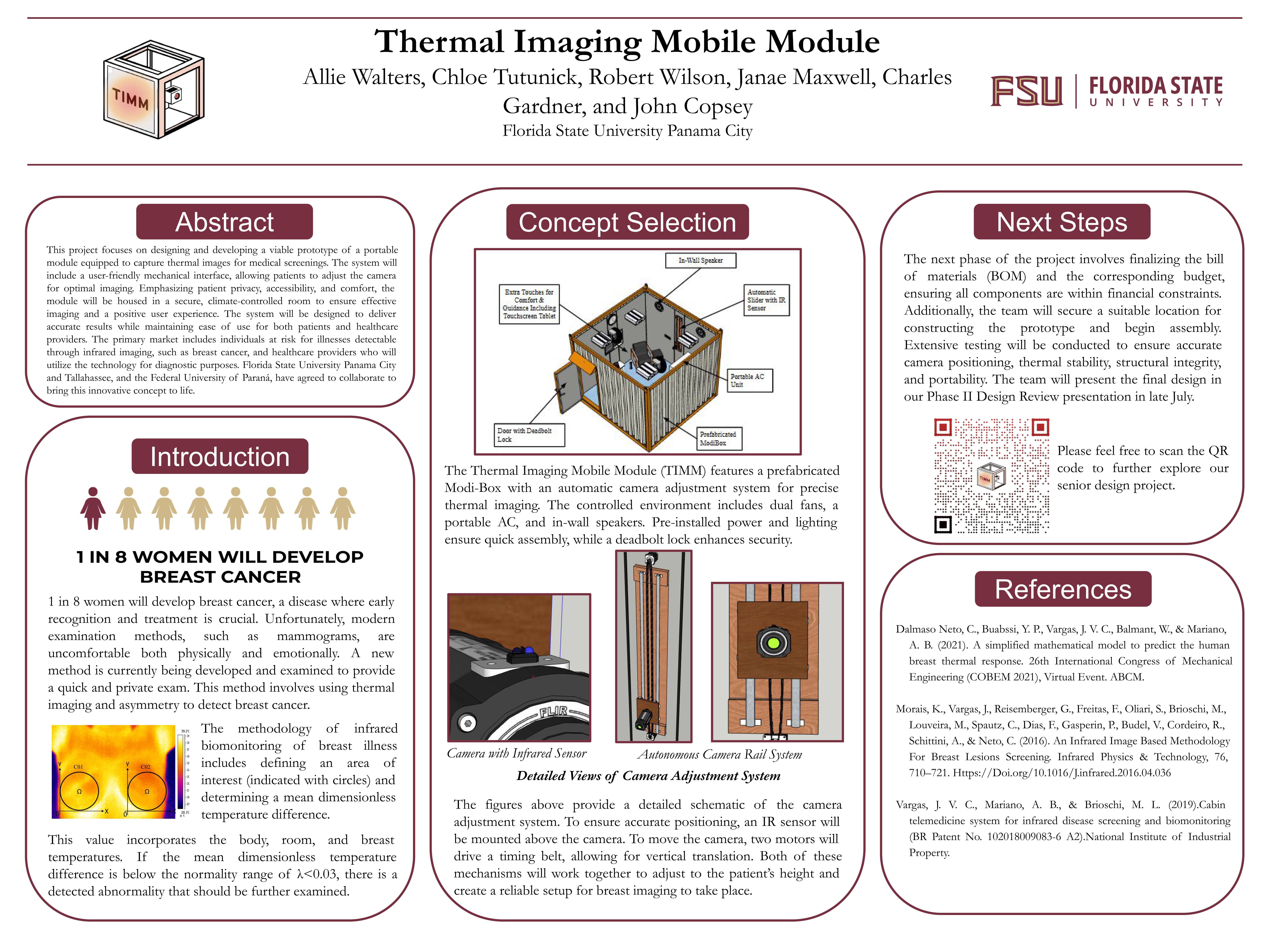
Mechanical Engineering | We are a team of senior mechanical engineering students from Panama City, Florida, dedicated to designing innovative solutions in the field of medical technology. Our team shares a passion for developing impactful products that improve healthcare and enhance patient outcomes. Our diverse backgrounds and technical expertise allow us to approach challenges with creativity and precision. Among us is Yasmin Buabssi, a foreign exchange student from Brazil, whose international perspective adds a unique dimension to our design process. Together, we strive to push the boundaries of engineering to make a meaningful difference in the medical field. | Thermal Imaging Mobile Module | This project focuses on designing and developing a viable prototype of a portable module equipped to capture thermal images for medical screenings. The system will include a user-friendly mechanical interface, allowing patients to adjust the camera for optimal imaging. Emphasizing patient privacy, accessibility, and comfort, the module will be housed in a secure, climate-controlled room to ensure effective imaging and a positive user experience. The system will be designed to deliver accurate results while maintaining ease of use for both patients and healthcare providers. The primary market includes individuals at risk for illnesses detectable through infrared imaging, such as breast cancer, and healthcare providers who will utilize the technology for diagnostic purposes. Florida State University Panama City and Tallahassee, and the Federal University of Paraná, have agreed to collaborate to bring this innovative concept to life. | Dr. Twan Capehart | Florida State University | Mechanical Engineering | tcapehart@pc.fsu.edu | Dr. José Vargas, Dr. Juan Ordonez, Dr. Mauricio Chagas | Chloe Tutunick, Robert Wilson, Janae Maxwell, Charles Gardner, John Copsey, Yasmin Buabssi | thermal imaging, breast cancer, mobile, module | Exploratory (the research question has been identified and design of approach is outlined) | TIMM Poster.pdf877.39 KB
|
|
No | 2025 | 5th annual Undergraduate Research Symposium, April 17, 2025 | https://pc.fsu.edu/student-research/symposium/research-symposium-program-portal?element_parents=elements/student_photo&ajax_form=1&_wrapper_format=drupal_ajax&token=Jfl1tyjUbamB3Au6cJ1h3fiL3oOBSVrRmSUhclHMOqc | ||
| 70 | 7881 | Face to Face Poster session | C - 7 R - 11 | Student Research Symposium Program Portal: Submission #70 | ef1ba550-50ed-4621-9ec6-687fce62b94d | No | Star/flag Student Research Symposium Program Portal: Submission #70 | Lock Student Research Symposium Program Portal: Submission #70 | Add notes to Student Research Symposium Program Portal: Submission #70 | Thu, 02/06/2025 - 01:37 PM | Thu, 02/06/2025 - 01:54 PM | Mon, 04/14/2025 - 01:15 PM | Anonymous | 96.27.64.86 | Natalie | Tout | xtoutnm@bayhaven.org |
|
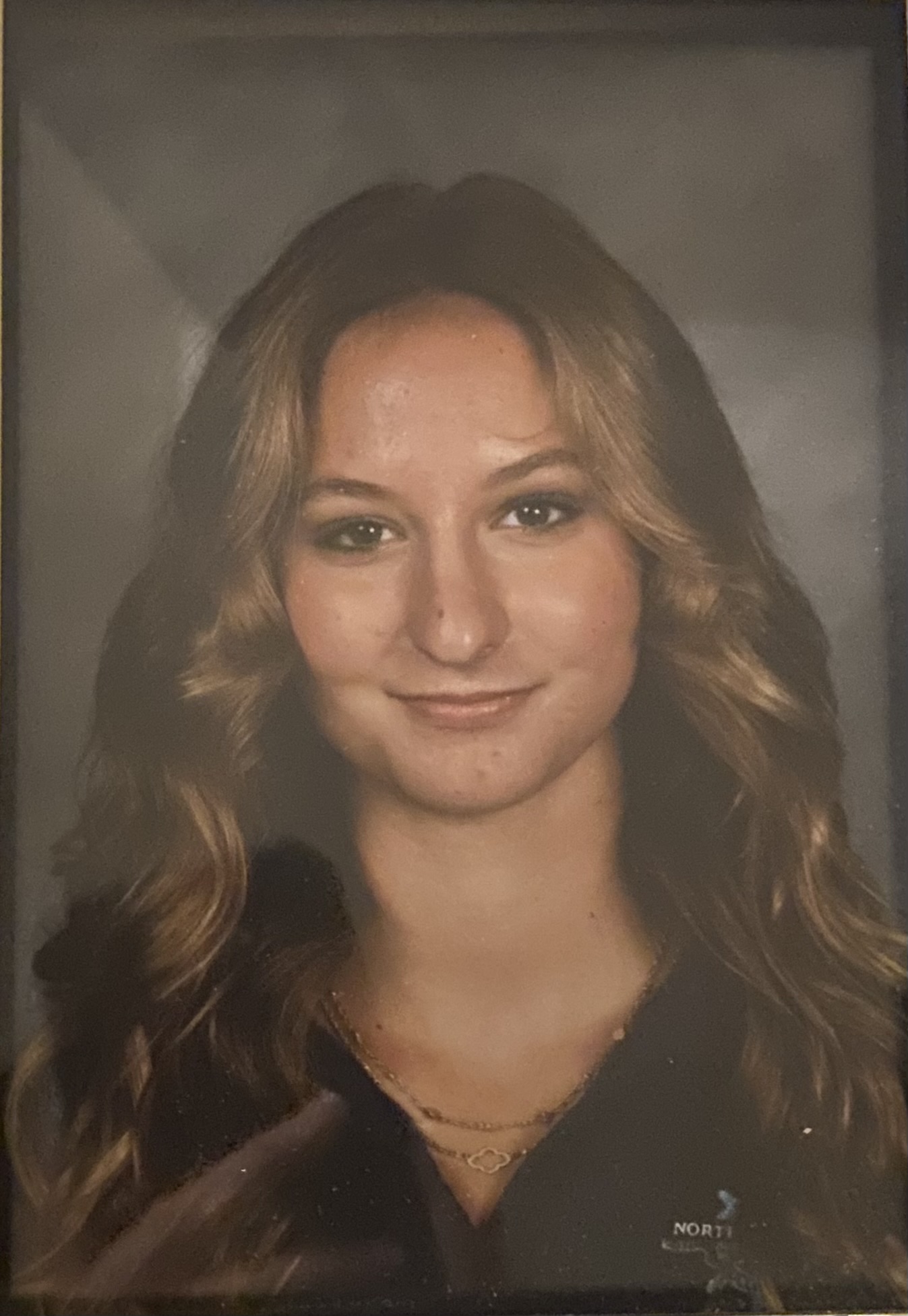
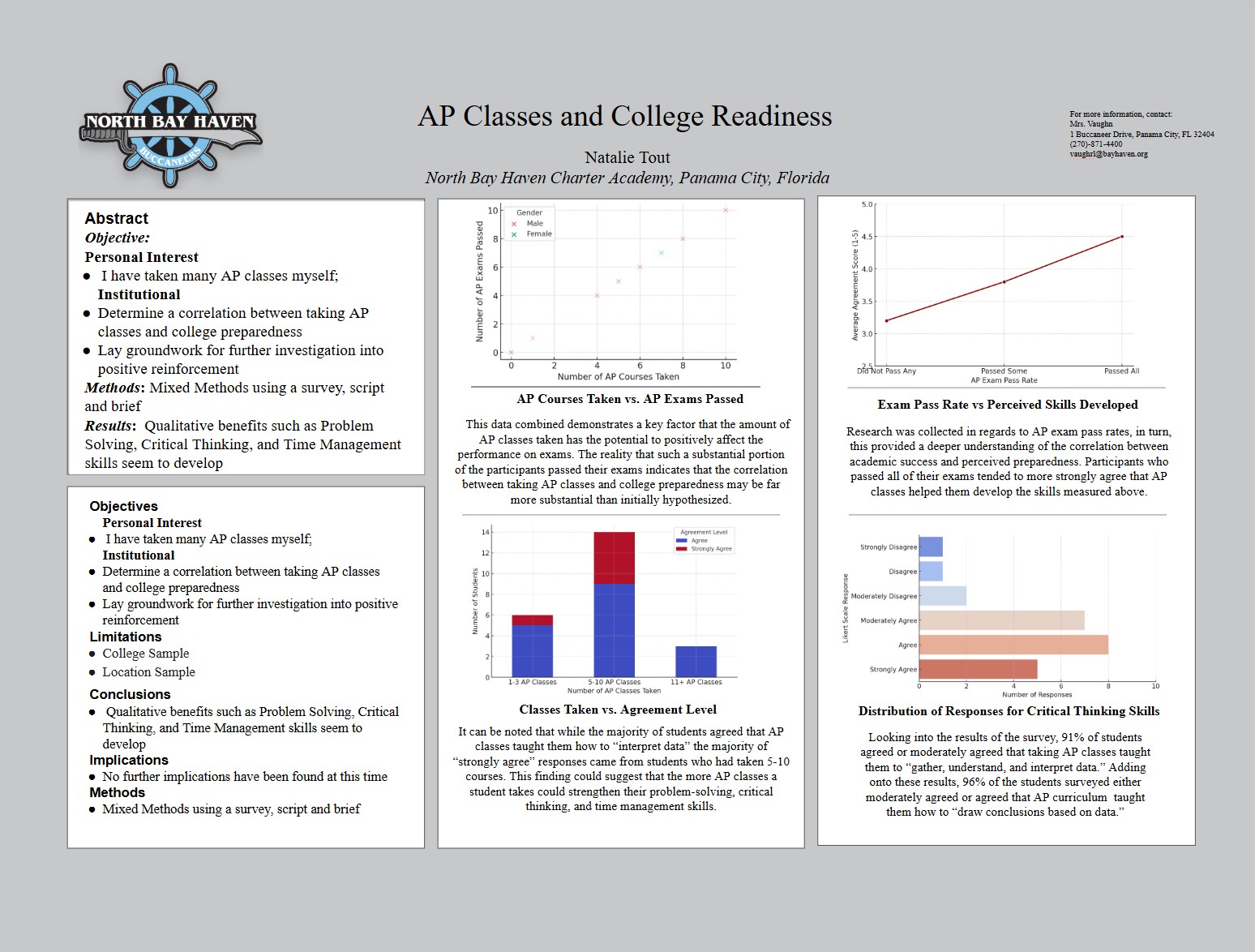
Undecided | My name is Natalie Tout and I am a researcher at North Bay Haven Charter Academy. I am in 11th grade and am currently studying to achieve my AP Capstone Diploma. | AP Classes and College Readiness | Despite the importance and prevalence of the subject matter, there are a limited number of studies that have been conducted on a qualitative level to identify the level of influence that taking AP classes in high school have on college readiness. Generally, these studies focus on quantitative relationships influencing college readiness itself. However, this study seeks to reveal the unresearched perspective pertaining to the qualitative ideas of taking AP classes and their effectiveness in preparing students for college classes. Unlike previous studies, this inquiry includes participation of college students to analyze differences in the data observed. Correspondingly, a survey was given to over 20 college participants. The respondents answered questions concerning demographics as well as additional questions specifically asking about the skills learned through taking AP courses. Consequently, qualitative aspects such as problem solving, time management, and critical thinking abilities were analyzed through the survey questions. The raw data was then analyzed, and conclusions were formed based on each participant's responses to the myriad of questions. The experiment's outcomes offer a variety of applications, especially in relation to teenagers and professionals involved in the education field which can be extremely advantageous for providing a comprehensive understanding of this crucial process for adolescents. Upon conclusion, accurate data and results culminated in cogent insight into the influence of taking AP courses and if they prepare students for the rigors of college. Nonetheless, extensive research beyond this study needs to be conducted in order to increase lucidity and eliminate any potential limitations. |
Robin Vaughn | North Bay Haven Charter Academy | AP Capstone Research | vaughrl@bayhaven.org> | AP Classes, College Board, Pedagogical | Complete |
|
No | 2025 | 5th annual Undergraduate Research Symposium, April 17, 2025 | https://pc.fsu.edu/student-research/symposium/research-symposium-program-portal?element_parents=elements/student_photo&ajax_form=1&_wrapper_format=drupal_ajax&token=SBGA4K-FWgySpRVsg5TllvMTOwjUQwbKcug_FFJ6hbo | |||||
| 69 | 7876 | Face to Face Poster session | C - 7 R - 4 | Student Research Symposium Program Portal: Submission #69 | 997ba604-b173-42e6-bdf4-a47bd4f6af34 | No | Star/flag Student Research Symposium Program Portal: Submission #69 | Lock Student Research Symposium Program Portal: Submission #69 | Add notes to Student Research Symposium Program Portal: Submission #69 | Thu, 02/06/2025 - 01:05 PM | Thu, 02/06/2025 - 01:09 PM | Tue, 04/22/2025 - 03:06 PM | Anonymous | 150.176.68.200 | Charlie Holmes, Truman Parsons, | and Kendall Sears | xparstj@baystudent.org |
|
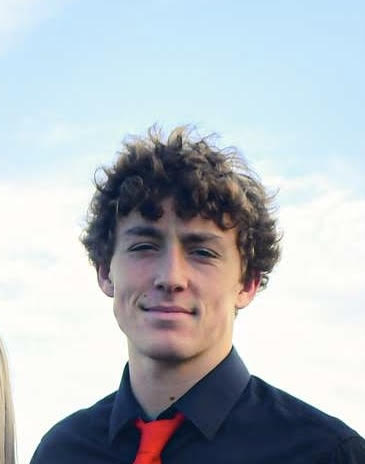
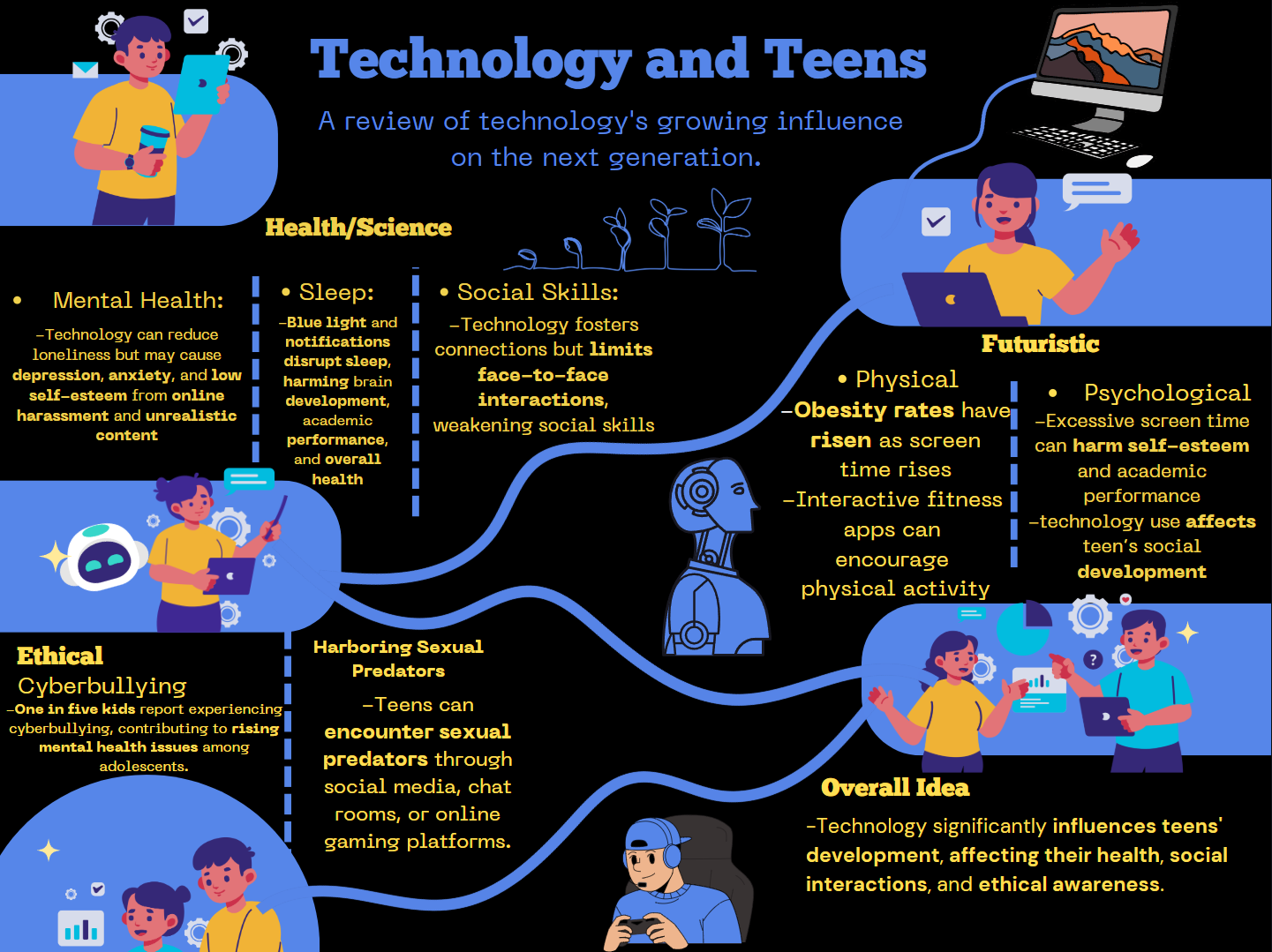
Engineering | My name is Truman Parsons, I was born and raised in Panama City Beach, FL. I am passionate about exploring the intersection of technology, health, science, and business. I am currently pursuing an undergraduate degree in engineering or business with plans to attend law school. My career aspirations include starting as a prosecutor and ultimately working up to a position at a private law firm. Outside of academics, I enjoy fishing, spearfishing, playing football, working out, golfing, and spending time with friends. I thrive on challenges and aim to combine my technical background with legal expertise to make a meaningful impact on the future of America. | Technology and Its Affects on Teenagers (ages 13-17) | Our research project explores the numerous ways technology impacts teenagers aged 13 to 17 through three key lenses: ethics, science, and future implications. The ethical lens examines whether it is appropriate for teenagers to use technology and social media, focusing on privacy, online behavior, and mental well-being. The scientific lens investigates the neurological and psychological effects of technology usage, including cognitive development and social interactions. The futuristic lens considers the long-term consequences of technological exposure on teenagers, such as career prospects, social dynamics, and mental health trends. All in all, these perspectives provide a comprehensive understanding of technology's growing influence on the next generation. | Doedy Deal | Arnold High School | AP Seminar | dealdm@bay.k12.fl.us | Technology, Youth, Health, Future | Complete | Tech and Teens poster.pdf241.92 KB
|
|
No | 2025 | 5th annual Undergraduate Research Symposium, April 17, 2025 | https://pc.fsu.edu/student-research/symposium/research-symposium-program-portal?element_parents=elements/student_photo&ajax_form=1&_wrapper_format=drupal_ajax&token=fn6isPgdD7FaQpJ_AB7475NUL5BbB1RHF61pQyydRv4 | ||||
| 68 | 7871 | Face to Face Poster session | C- 2 R - 8 | Student Research Symposium Program Portal: Submission #68 | 10e93431-d4d3-4d76-9a46-5ad8418f45b2 | No | Star/flag Student Research Symposium Program Portal: Submission #68 | Lock Student Research Symposium Program Portal: Submission #68 | Add notes to Student Research Symposium Program Portal: Submission #68 | Thu, 02/06/2025 - 12:50 PM | Thu, 02/06/2025 - 12:50 PM | Mon, 04/14/2025 - 01:50 PM | Anonymous | 146.201.10.22 | Gage | Proctor | He/Him | GP22O@fsu.edu |
|
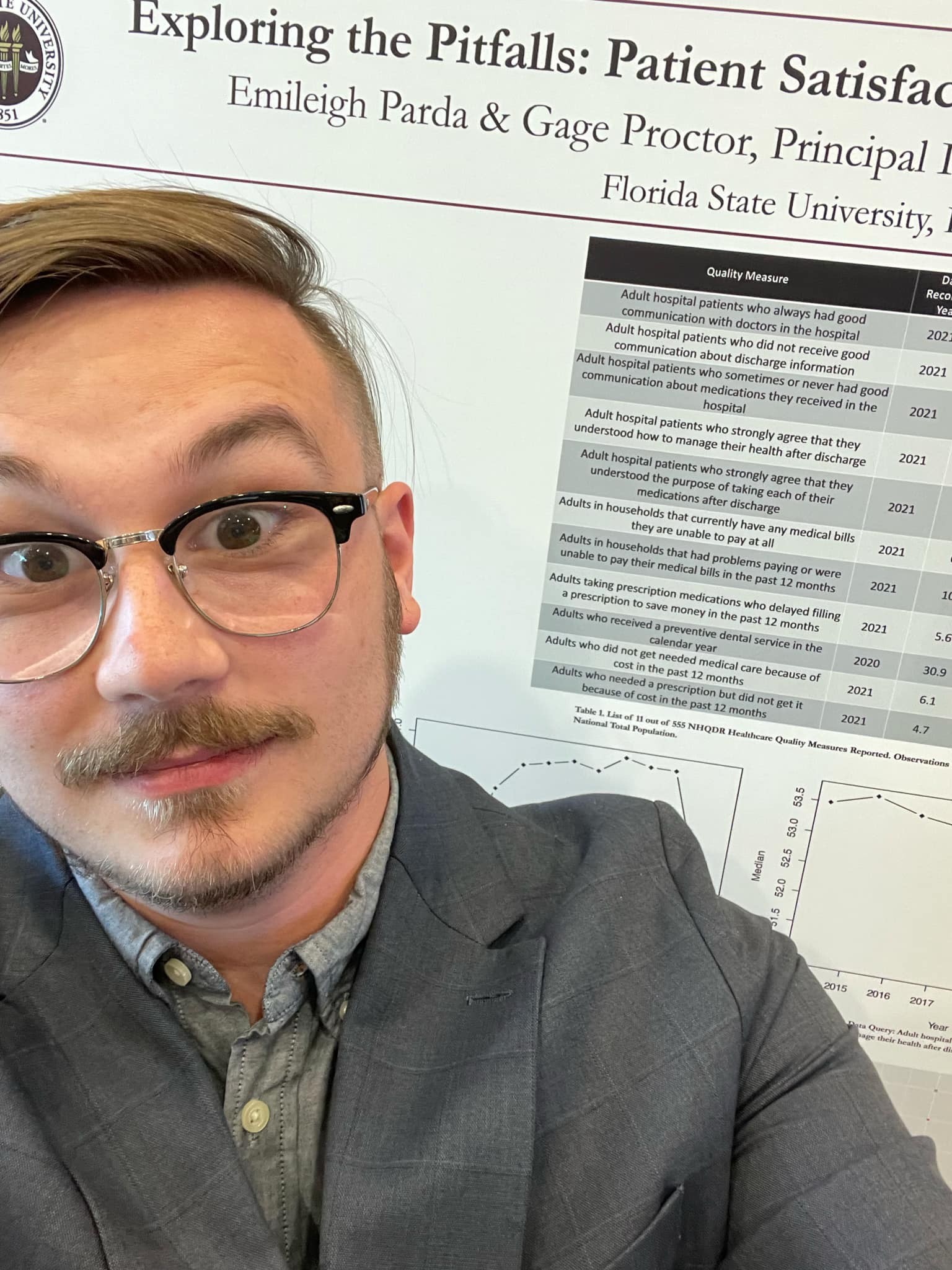
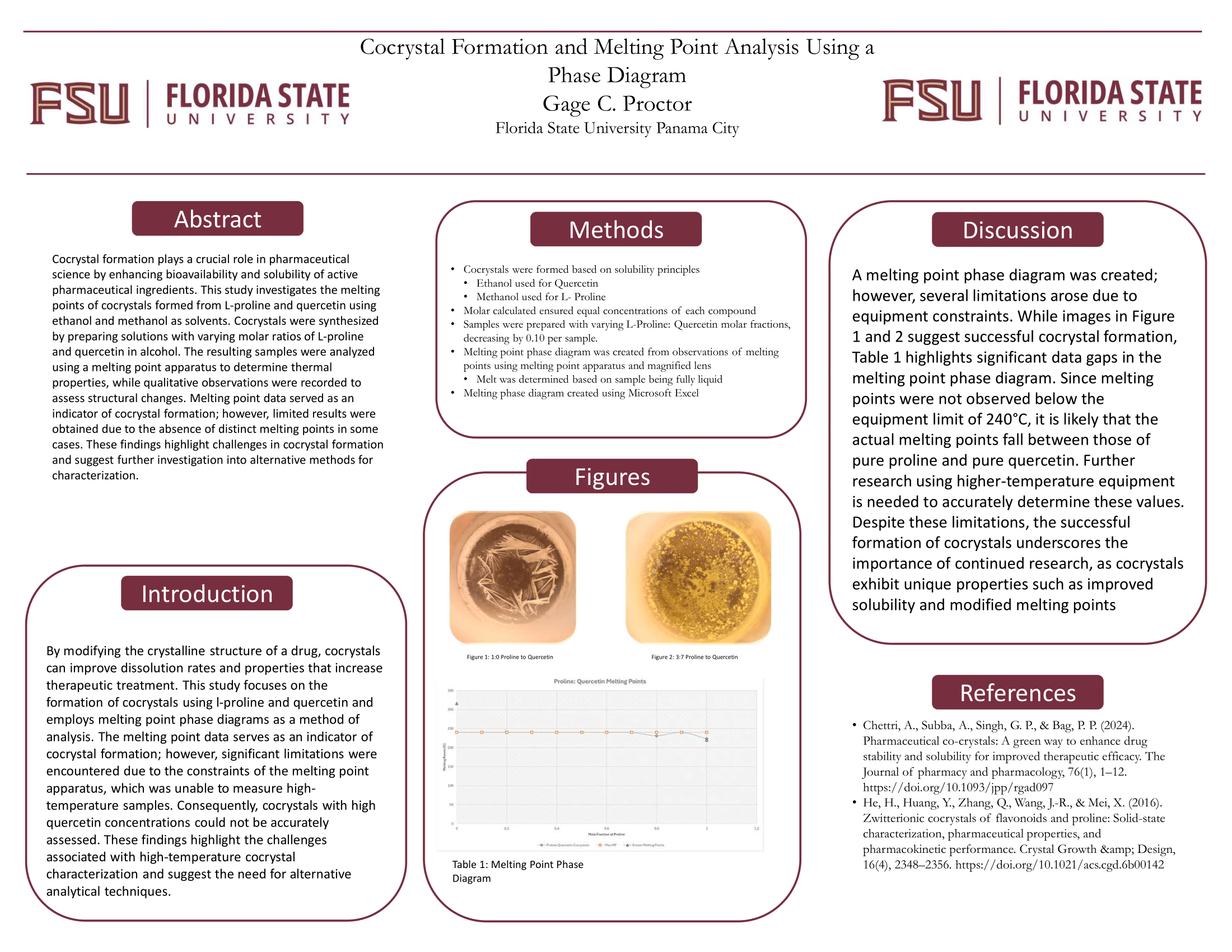
Public Health | I am a public health major, graduating in the spring of 2025. I plan to attend medical school in the future. I am originally from Morgantown, Kentucky. However, after serving 4 years in the United States Air Force at Tyndall Air Force Base I am attending Florida State University at the Panama City campus. | The melting point phase diagram of a cocrystal between Quercetin and L-proline. | Cocrystal formation plays a crucial role in pharmaceutical science by enhancing bioavailability and solubility of active pharmaceutical ingredients. This study investigates the melting points of cocrystals formed from L-proline and quercetin using ethanol and methanol as solvents. Cocrystals were synthesized by preparing solutions with varying molar ratios of L-proline and quercetin in alcohol. The resulting samples were analyzed using a melting point apparatus to determine thermal properties, while qualitative observations were recorded to assess structural changes. Melting point data served as an indicator of cocrystal formation; however, limited results were obtained due to the absence of distinct melting points in some cases. These findings highlight challenges in cocrystal formation and suggest further investigation into alternative methods for characterization |
Dr. Paul Baures | Florida State University-Panama City | Chemistry | pbaures@pc.fsu.edu | cocrystal, melting point, phase diagram | Complete | Cocrystal Complete.pdf678.25 KB
|
|
No | 2025 | 5th annual Undergraduate Research Symposium, April 17, 2025 | https://pc.fsu.edu/student-research/symposium/research-symposium-program-portal?element_parents=elements/student_photo&ajax_form=1&_wrapper_format=drupal_ajax&token=t1WhbDoLLC3DOvVZmgw68VYFtCxgrMM3SlQ_x3QX47U | |||
| 67 | 7866 | Face to Face Poster session | C - 6 R - 5 | Student Research Symposium Program Portal: Submission #67 | 527cebf0-9502-48de-9abd-89f8c14b59de | No | Star/flag Student Research Symposium Program Portal: Submission #67 | Lock Student Research Symposium Program Portal: Submission #67 | Add notes to Student Research Symposium Program Portal: Submission #67 | Thu, 02/06/2025 - 12:12 PM | Thu, 02/06/2025 - 12:19 PM | Tue, 04/15/2025 - 01:29 PM | Anonymous | 150.176.68.200 | Eden | Campbell | She/her | xcampem@baystudent.org |
|
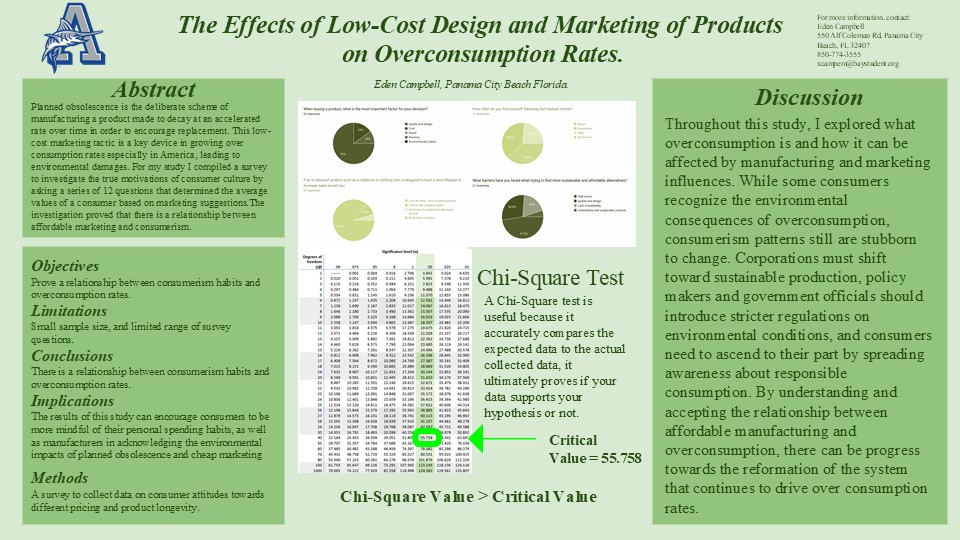
Undecided | I'm from Panama City Beach, FL and I am researching how the low-cost design and marketing of products affect over consumption and if there is a possible residual impact on climate change. | The Effects of Low-Cost Design and Marketing of Products on Overconsumption Rates. | Overcompensation rates have been on a massive incline since the beginning of 2000 and the introduction of fast-paced consumerism. The continuous process of constantly replacing and reproducing products created to deteriorate overtime leaves a trail of excessive production, waste, environmental degradation, and escalating in the current climate crisis. Planned obsolescence is the deliberate scheme of manufacturing a product made to decay at an accelerated rate over time in order to encourage replacement. This low-cost marketing tactic is a key device in growing over consumption rates especially in America, leading to environmental damages. | Doedy Deal | Arnold High School | AP Research | dealdm@bay.k12.fl.us | Climate change, Marketing, Low-cost design | Exploratory (the research question has been identified and design of approach is outlined) |
|
Yes | 2025 | 5th annual Undergraduate Research Symposium, April 17, 2025 | https://pc.fsu.edu/student-research/symposium/research-symposium-program-portal?element_parents=elements/student_photo&ajax_form=1&_wrapper_format=drupal_ajax&token=aZVmH9SvtFweAliwPIJHEnqn3kmJti3Gi__8TSyXCi0 | ||||
| 66 | 7861 | Face to Face Poster session | C-1 R - 7 | Student Research Symposium Program Portal: Submission #66 | e49e85fe-3910-4092-b080-9bb8fe6bd2a6 | No | Star/flag Student Research Symposium Program Portal: Submission #66 | Lock Student Research Symposium Program Portal: Submission #66 | Add notes to Student Research Symposium Program Portal: Submission #66 | Thu, 02/06/2025 - 11:07 AM | Thu, 02/06/2025 - 11:12 AM | Mon, 04/14/2025 - 01:49 PM | Anonymous | 146.201.10.30 | Elizabeth | Peeples | egp20u@fsu.edu |
|
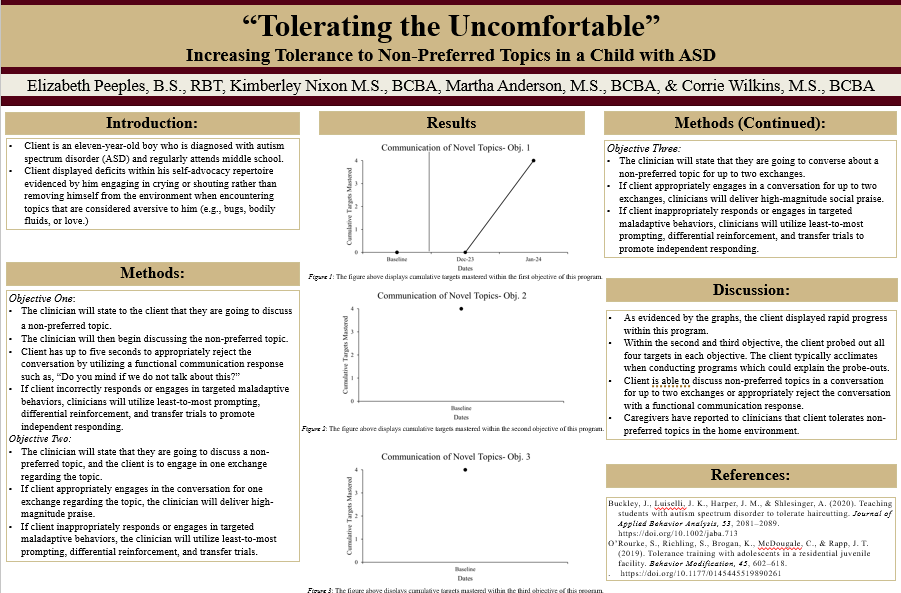
Applied Behavior Analysis, Psychology | I grew up in Panama City, Florida. I enjoy watching movies, especially Wicked. My career goals include graduating with my masters degree and becoming a BCBA. In the future, I hope to become clinical director of a clinic. | Tolerating the Uncomfortable | The client in the procedure is a ten-year-old boy who is diagnosed with autism spectrum disorder. He began services at the Early Childhood Autism Program in April of 2022. Throughout his clinical and home environments, it has been reported that the client displayed a deficit in his ability to tolerate non-preferred topics, such as bugs, blood, throw up etc. When encountering non-preferred topics throughout his environment, the client would engage in maladaptive behaviors including screaming, crying, and elopement. To remediate these deficits, the clinical team opted to implement a Communicating Novel Topics program. The procedure implemented denial and tolerance training to non-preferred topics, before fading in conversations regarding the non-preferred topics. Differential reinforcement and escape extinction from the nonpreferred topic were implemented to aid in the acquisition of the procedure. Research conducted by O’Rourke et al. (2019) demonstrated that the utilization of tolerance training increased the subject’s ability to tolerate a non-preferred stimulus event. Within the individual steps of the program, the client appropriately and independently rejected a conversation involving a non-preferred topic. Once the client was appropriately rejecting a conversation, the client was then required to engage in conversations with up to two exchanges involving the non-preferred conversation. This program was implemented within the month of February 2024 and was mastered in March 2024. Parental reports have shown that the procedure has generalized across environments including his school, the community with friends, and at his home. |
Kolton Sellers | Florida State University Panama City | Applied Behavior Analysis, Psychology | sellers@pc.fsu.edu | Tolerance training | Complete | Research Symposium Poster.pdf244.1 KB
|
|
No | 2025 | 5th annual Undergraduate Research Symposium, April 17, 2025 | https://pc.fsu.edu/student-research/symposium/research-symposium-program-portal?element_parents=elements/student_photo&ajax_form=1&_wrapper_format=drupal_ajax&token=xAB2ji0pug8u5rnU5izezyUhriOpckPL8QpVbmlIsnA | ||||
| 65 | 7856 | Face to Face Poster session | C -4 R - 2 | Student Research Symposium Program Portal: Submission #65 | d34d5157-bc26-4cce-a3e5-04df42c6b5f0 | No | Star/flag Student Research Symposium Program Portal: Submission #65 | Lock Student Research Symposium Program Portal: Submission #65 | Add notes to Student Research Symposium Program Portal: Submission #65 | Wed, 02/05/2025 - 11:57 PM | Thu, 02/06/2025 - 12:00 AM | Mon, 04/14/2025 - 01:49 PM | Anonymous | 68.202.136.208 | Brenda | Dierestil | bqd22@fsu.edu |
|
Nurse Anesthesia DNAP | Brenda Dierestil A Doctor of Nurse Anesthesia student at FSU Panama City. Her current research investigates the impact of weight-based lidocaine dosing in propofol-based sedation for esophagogastroduodenoscopy (EGD) procedures, aiming to optimize sedation outcomes and reduce adverse events such as apnea and hemodynamic instability. With a strong commitment to improving patient safety and clinical practices, Brenda strives to bridge the gap between research and real-world application, contributing to the evolution of anesthesia care in procedural sedation. |
Lidocaine Dosage for EGD Sedation | Propofol-based sedation for esophagogastroduodenoscopy (EGD) often requires careful anesthetic management to minimize adverse events. Lidocaine, an adjuvant to propofol, can reduce propofol requirements and improve patient outcomes. This study aimed to evaluate the impact of a weight-based lidocaine dosing regimen (1.5 mg/kg) on apneic events compared to a fixed low dose (50 mg) in adult patients undergoing EGD. A pre- and post-intervention survey design was employed to assess clinical practice changes among anesthesia providers within a U.S. hospital in the eastern region. Post-intervention, adherence to the recommended lidocaine dosing increased significantly, leading to a reduction in propofol requirements and fewer adverse events like apnea and hemodynamic instability. Adherence to the recommended dosage of 1.5 mg/kg of lidocaine 2% increased notably, with the number of practitioners adhering to this guideline doubling from 10 to 20 out of 25 respondents. Additionally, 18 practitioners reported notable improvements, including reduced propofol requirements and a lower incidence of adverse events such as apnea and hemodynamic instability. These findings highlight the importance of targeted education and evidence-based dosing practices in improving patient safety and optimizing anesthesia care for EGD procedures, illustrating how a well-structured educational initiative can bridge the gap between evidence-based recommendations and real-world clinical practice. |
Gerard Hogan | College of Applied Sciences | Nurse Anesthesia | ghogan@fsu.edu | Lidocaine, propofol, esophagogastroduodenoscopy, apneic events, sedation optimization | Complete | Symposium Poster.pdf776.43 KB
|

|
No | 2025 | 5th annual Undergraduate Research Symposium, April 17, 2025 | https://pc.fsu.edu/student-research/symposium/research-symposium-program-portal?element_parents=elements/student_photo&ajax_form=1&_wrapper_format=drupal_ajax&token=bS4Wy-mV6381brEq9J1GstcDScXvaIVgSbllpth6LAI |