
Student Research Symposium Program Portal
220 submissions
| # | SID | Presentation Modality | Poster Session/Number | Submission title | UUID | In draft | Starred | Locked | Notes | Created | Completed | Changed | User | IP address | Primary Student Contact First Name | Primary Student Contact Last Name | Pronouns | Primary Student Contact FSU Student Email | Photo of all individuals presenting this work | Major(s) of all individuals presenting this work | Bio of all individuals presenting this work | Poster Title | Abstract | Research Mentor Name | Research Mentor's College (or High School) | Research Mentor's Department (or Subject) | Research Mentor's Email | Additional Research Mentor(s) | Co-presenter(s) | Keywords | Work | Poster PDF or Powerpoint | Poster Thumbnail | I will be printing my poster | Year | Annual description | Update URL | Operations |
|---|---|---|---|---|---|---|---|---|---|---|---|---|---|---|---|---|---|---|---|---|---|---|---|---|---|---|---|---|---|---|---|---|---|---|---|---|---|---|
| 164 | 9012 | Asynchronous Online Presentation | https://drive.google.com/file/d/1Sq-faCsh3WHwu3b4UVUEHWLFV1eLoiCv/view?usp=sharing | Student Research Symposium Program Portal: Submission #164 | dc3a7b13-1e5e-4ef5-b6ce-b1476f095b97 | No | Star/flag Student Research Symposium Program Portal: Submission #164 | Lock Student Research Symposium Program Portal: Submission #164 | Add notes to Student Research Symposium Program Portal: Submission #164 | Thu, 01/22/2026 - 10:28 PM | Thu, 01/22/2026 - 10:42 PM | Fri, 04/10/2026 - 03:46 PM | Anonymous | 69.162.242.46 | Nathan | Cerletty | njc24e@fsu.edu |
|
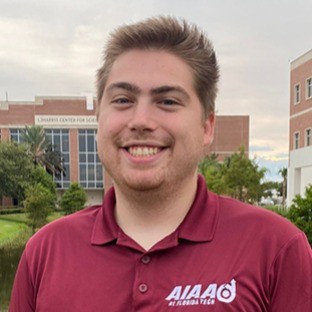
MS Systems Engineering | I am an aerospace engineering professional focused on systems integration, verification and validation along with cross-functional leadership within defense programs. I earned my BS in Aerospace Engineering, Cum Laude, from the Florida Institute of Technology in 2023, with concentrations in astronautics, propulsion, aerodynamics, and orbital mechanics. During my undergraduate studies, I developed a strong interest in space operations and the ground support infrastructure that enables launch and missile systems. Since August 2023, I have served as a Systems Engineer at Northrop Grumman, where I support the definition, integration, and documentation of special test equipment for high-value aerospace programs. In this role, I have led a three-engineer team developing system architecture and test plans exceeding 20 million dollars, collaborated closely with the Office of the Chief Engineer, and helped align technical execution with evolving customer and contractual requirements while reducing program risk. In parallel, I am completing a Master of Science in Systems Engineering at Florida State University, expected in May 2026, along with a Graduate Certificate in Systems Engineering Leadership. My prior experience includes internships at Lockheed Martin supporting multiple fixed- and rotary-wing platforms. My career goal is to combine technical rigor and leadership to deliver reliable, mission-critical aerospace systems. |
Quiet Authority in Extreme Environments: The Leadership Legacy of Neil Armstrong | This paper examines the leadership legacy of Neil Armstrong through the lens of contemporary leadership theory and motivational research. Although widely recognized for commanding the Apollo Eleven mission, Armstrong’s influence extended far beyond a single historic event. His leadership was grounded in disciplined judgment, ethical responsibility, and technical mastery developed through naval aviation, experimental flight testing, and human spaceflight. Using frameworks related to visionary, learner, team oriented, achiever, optimizer, and key contributor motivations, this analysis demonstrates how Armstrong consistently aligned internal motivation with observable behavior. His calm decision-making during Gemini Eight and Apollo Eleven illustrates ethical climate reinforcement, emotional intelligence, and values-based courage under pressure. Additionally, his emphasis on collective achievement and openness to technical input contributed to a culture of trust, accountability, and constructive dialogue. By integrating motivation theory, ethical leadership research, and systems-based leadership principles, this paper argues that Armstrong exemplified quiet authority in extreme environments. His leadership model offers a durable framework for ethical, disciplined, and purpose driven influence in modern high risk and technically complex organizations. |
Dr. Georgiadis | College of Engineering | IME | dgeorgiadis@eng.famu.fsu.edu | Leadership, Teamwork, Discipline, Moon Landing, Mission Focus | Complete | 2026 | 5th annual Undergraduate Research Symposium, April 17, 2025 | https://pc.fsu.edu/student-research/symposium/research-symposium-program-portal?element_parents=elements/student_photo&ajax_form=1&_wrapper_format=drupal_ajax&token=x7b6u5VEXDDjs28LANLkYbqZ56MmLlW7x6rkPeg5tkg | |||||||
| 163 | 9011 | Synchronous Online Presentation | https://pc.fsu.edu/2026-synchronous-online-research-presentations | Student Research Symposium Program Portal: Submission #163 | cf8e0a3e-2bbf-4644-a927-66e29bda3922 | No | Star/flag Student Research Symposium Program Portal: Submission #163 | Lock Student Research Symposium Program Portal: Submission #163 | Add notes to Student Research Symposium Program Portal: Submission #163 | Thu, 01/22/2026 - 08:12 PM | Thu, 01/22/2026 - 08:41 PM | Fri, 04/10/2026 - 03:47 PM | Anonymous | 2601:b031:ff00:ed05:cdb1:b66f:27d1:5010 | Dalton | Bradley, and David Ertle | dgb23a@fsu.edu |
|
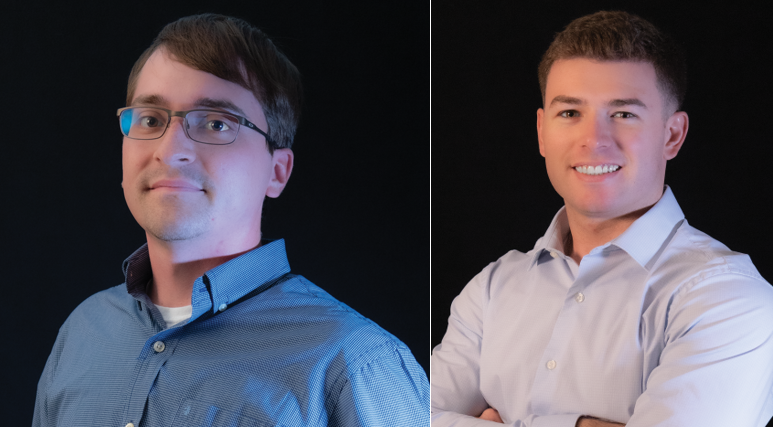
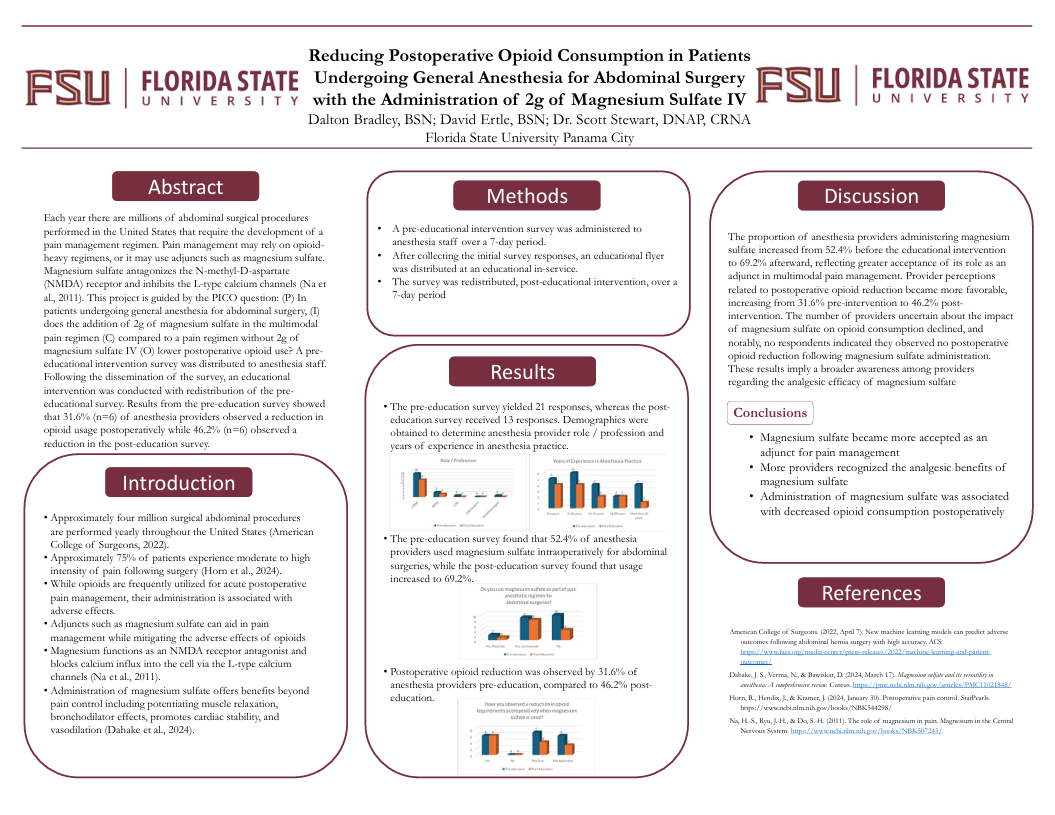
Doctor of Nurse Anesthesia Practice | Dalton Bradley, from Jay, Florida, is a Doctor of Nurse Anesthesia Practice student with a background that includes one year in a medical / surgical nursing department and one and a half years in a medical intensive care unit. David Ertle, from Pensacola, Florida, is a Doctor of Nurse Anesthesia Practice student with a background that includes one year in the emergency department, one year in a Level I trauma intensive care unit, and one year in a cardiovascular intensive care unit. As they complete their training at Florida State University, they are interested in pursuing CRNA positions that emphasize clinical excellence, autonomy, and professional growth. | Reducing Postoperative Opioid Consumption in Patients Undergoing General Anesthesia for Abdominal Surgery with the Administration of 2g of Magnesium Sulfate IV | Each year there are millions of abdominal surgical procedures performed in the United States that require the development of a pain management regimen. Pain management may rely on opioid-heavy regimens, or it may use adjuncts such as magnesium sulfate. Magnesium sulfate antagonizes the N-methyl-D-aspartate (NMDA) receptor and inhibits the L-type calcium channels (Na et al., 2011). This project is guided by the PICO question: (P) In patients undergoing general anesthesia for abdominal surgery, (I) does the addition of 2g of magnesium sulfate in the multimodal pain regimen (C) compared to a pain regimen without 2g of magnesium sulfate IV (O) lower postoperative opioid use? A pre-educational intervention survey was distributed to anesthesia staff. Following the dissemination of the survey, an educational intervention was conducted with redistribution of the pre-educational survey. Results from the pre-education survey showed that 31.6% (n=6) of anesthesia providers observed a reduction in opioid usage postoperatively while 46.2% (n=6) observed a reduction in the post-education survey. | Scott Stewart, DNAP, CRNA | College of Applied Studies | Nurse Anesthesia | sstewart3@fsu.edu | Analgesia, Analgesic Adjuncts, Magnesium Sulfate | Complete | Bradley and Ertle Poster_0.pdf404.79 KB
|
|
No | 2026 | 5th annual Undergraduate Research Symposium, April 17, 2025 | https://pc.fsu.edu/student-research/symposium/research-symposium-program-portal?element_parents=elements/student_photo&ajax_form=1&_wrapper_format=drupal_ajax&token=9fbJE4DeY4SEMnrfoMlUEA7K5DiTp9PS_lK1OiPtE5o | ||||
| 161 | 9009 | Asynchronous Online Presentation | https://drive.google.com/file/d/13D6tV44VaOSwRJT5lom4nhUNoMADIPaT/view?usp=sharing | Student Research Symposium Program Portal: Submission #161 | 02e04a59-6abb-464d-beda-1dac9f394e33 | No | Star/flag Student Research Symposium Program Portal: Submission #161 | Lock Student Research Symposium Program Portal: Submission #161 | Add notes to Student Research Symposium Program Portal: Submission #161 | Wed, 01/21/2026 - 10:58 PM | Wed, 01/21/2026 - 11:24 PM | Fri, 04/10/2026 - 03:48 PM | Anonymous | 98.19.0.68 | Michael | Finley | mlf24h@fsu.edu |
|
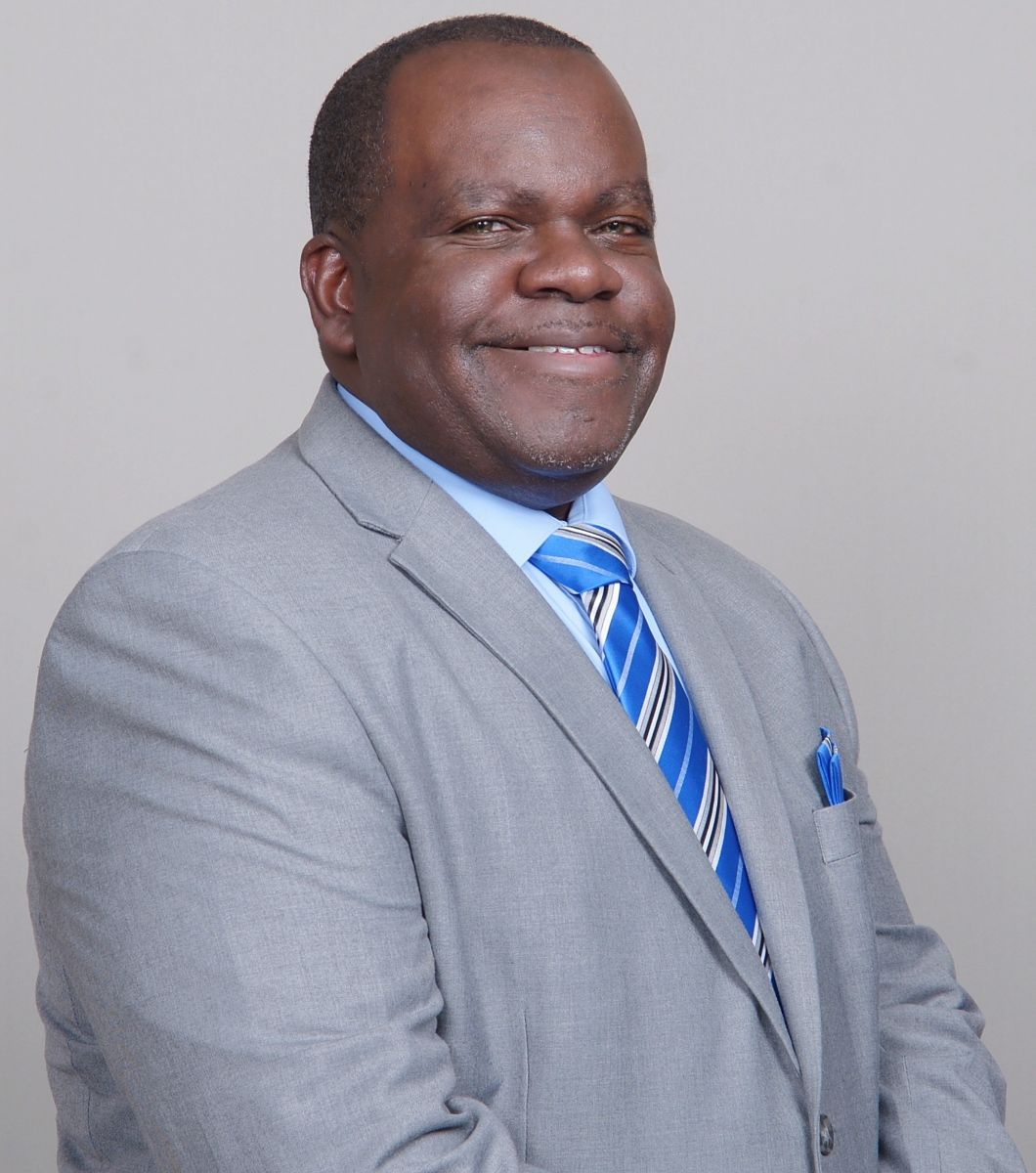
MS Systems Engineering | Michael Finley is an experienced Technology and Systems Engineering leader with over a decade of success delivering mission-critical solutions across complex engineering and business environments. He currently serves as a Staff Systems Engineer at Lockheed Martin in Fort Worth, Texas, where he leads high-performing teams supporting F-35 integration, test, and simulation labs. Michael is known for aligning technical execution with strategic objectives, driving operational excellence, and improving system performance in high-stakes, security-focused environments. Throughout his career, Michael has progressed through increasing levels of technical and leadership responsibility, contributing to major defense programs including the F-35, F-22, and F-16. His work spans system requirements development, verification and validation, integration and test leadership, lab operations, and cross-functional coordination with customers, vendors, and program stakeholders. He has led and mentored engineers, reduced certification timelines, improved onboarding efficiency, and strengthened communication across multidisciplinary teams. Michael holds an MBA in Security Management, a Bachelor’s degree in Technical Management, and is currently pursuing a Master of Science in Systems Engineering. His strengths include analytical thinking, leadership, and problem solving, along with a strong commitment to continuous learning and sharing knowledge to develop others and strengthen the organization. | Colin Powell: From the Battlefield to the Boardroom | Colin Powell was a renowned military and political leader who rose from being poor to becoming a four-star General in the U.S. Army and then U.S. Secretary of State. Powell's leadership skills and actions were examined throughout his life, from when he was a child to when he was a top military and diplomatic leader. It examines Powell's leadership through the lens of various leadership theories, employing significant events from his career as a timeline to illustrate the evolution of his character, decision-making, and people-oriented approach over time. He puts a lot of emphasis on being honest, responsible, working as a team, thinking strategically, and staying calm as a leader when things get tough. This research seeks to identify the characteristics that contributed to Powell's effectiveness across various contexts by comparing his actual behaviors with established leadership concepts. The results reveal leadership practices that consistently yielded positive outcomes, alongside aspects requiring additional consideration. In the end, this study is a personal commitment to becoming a better leader through gaining knowledge from Powell's experiences to find qualities that are good and those that require caution. The goal is to make a leader who is more self-aware, moral, and effective. | Dr. Georgiadis | College of Engineering | IME | dgeorgiadis@eng.famu.fsu.edu | Leadership, theory, attributes, practice, United States, Army, Colin Powell, General, Secretary of State | Complete | 2026 | 5th annual Undergraduate Research Symposium, April 17, 2025 | https://pc.fsu.edu/student-research/symposium/research-symposium-program-portal?element_parents=elements/student_photo&ajax_form=1&_wrapper_format=drupal_ajax&token=flXr9pvEVfjWswphOx0FwukLkaSyk0m1F07FoIR_eCw | |||||||
| 162 | 9010 | Asynchronous Online Presentation | https://drive.google.com/file/d/163LC0adalFxQzBGFadLIMUST_sGB59Nq/view?usp=sharing | Student Research Symposium Program Portal: Submission #162 | 9f7e8b47-7c97-46cb-9959-2ef64fb23b9f | No | Star/flag Student Research Symposium Program Portal: Submission #162 | Lock Student Research Symposium Program Portal: Submission #162 | Add notes to Student Research Symposium Program Portal: Submission #162 | Wed, 01/21/2026 - 10:44 PM | Wed, 01/21/2026 - 11:28 PM | Fri, 04/10/2026 - 03:47 PM | Anonymous | 2607:3c40:1104:d7e0:8df9:1b96:701a:4696 | Valentina | Hatfield | Vbh25@fsu.edu |

|
Mechanical Engineering (Bachelors) & Systems Engineering (Masters) | Valentina Hatfield is a graduate of the University of West Florida, where she earned a Bachelor of Science degree in Mechanical Engineering. She currently works as an engineer at Eglin Air Force Base, contributing to the development and sustainment of the Massive Ordnance Penetrator (MOP) program. Valentina is presently pursuing a graduate degree in Systems Engineering at Florida State University, with academic interests focused on complex systems, integration, and decision-making. Originally from Niceville, Florida, Valentina has lived in the city for over 22 years and recently purchased her first home there. Outside of her professional and academic pursuits, she enjoys spending time with her family, including her seven-month-old baby, and relaxing through thrifting when time allows. | The Great Communicator | This work focuses on studying the leadership traits and practices of Ronald Reagan. The paper examines how Reagan used integrity, communication, and influence to build trust and unite the nation during times of economic, political, and international challenge. Using leadership theories such as trait-based leadership, behavioral leadership, and Leader Member Exchange (LMX) theory, this study explains why Reagan was an effective leader beyond his formal position as president. This study highlights Reagan’s role as “The Great Communicator” and how his optimism, clear messaging, and confidence helped restore public trust in American leadership. Overall, this work shows that Reagan’s leadership success came from a combination of strong personal character and effective leadership behaviors, demonstrating that leadership is developed through actions and relationships rather than authority alone. | Dr. Georgiadis | College of Engineering | IME | dgeorgiadis@eng.famu.fsu.edu | Leadership, Theory, Ronald Reagan, Communication, Trust, Influence | Exploratory (the research question has been identified and design of approach is outlined) | 2026 | 5th annual Undergraduate Research Symposium, April 17, 2025 | https://pc.fsu.edu/student-research/symposium/research-symposium-program-portal?element_parents=elements/student_photo&ajax_form=1&_wrapper_format=drupal_ajax&token=jaW1LTJsCZbZD80iUSYmDw5pZt4sA6_qaU2gmDOsFG4 | |||||||
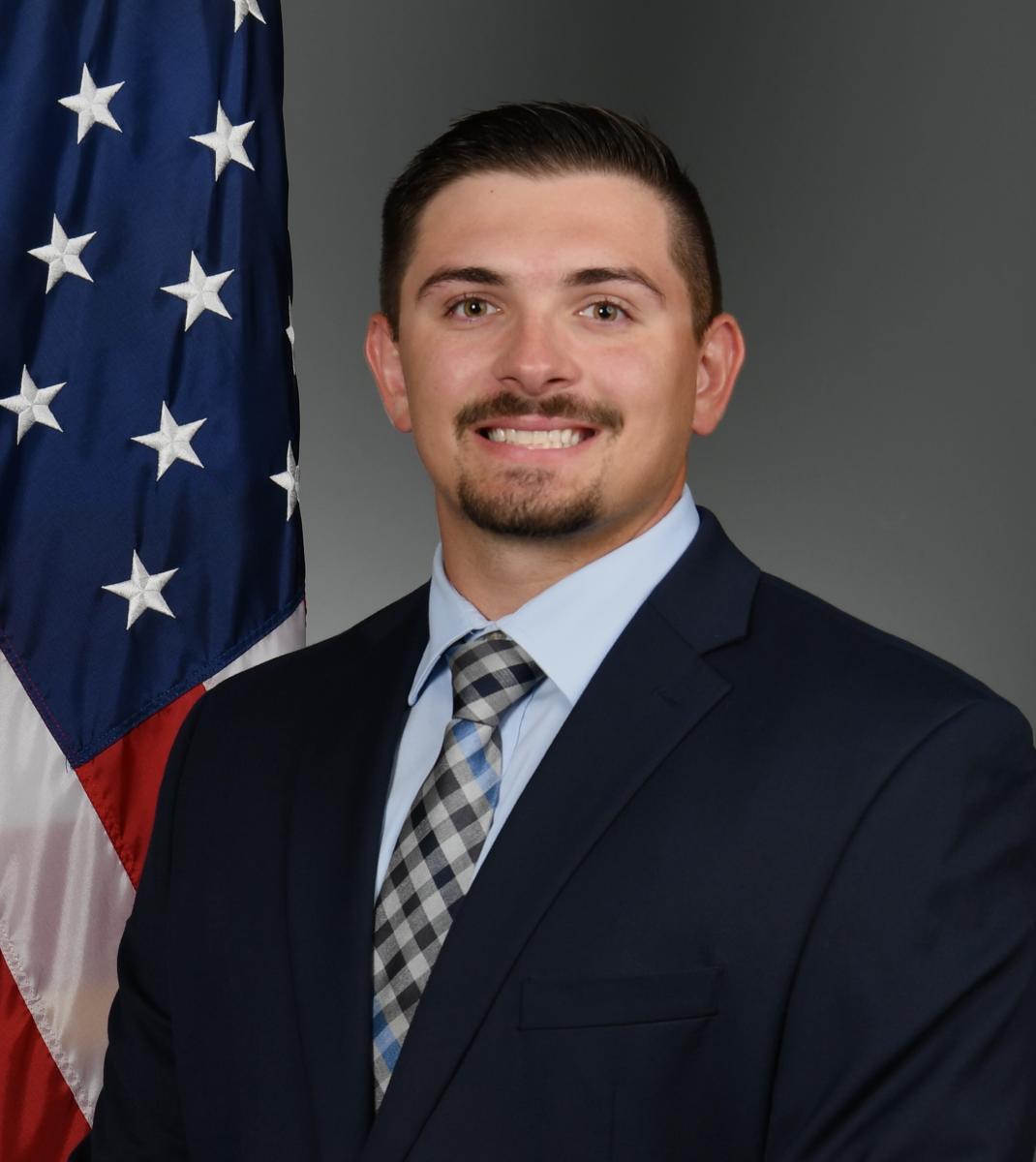
| 160 | 9008 | Asynchronous Online Presentation | https://drive.google.com/file/d/1vrM-Yjez6XRvn6iBTwh0PMPjthmy67hD/view?usp=sharing | Student Research Symposium Program Portal: Submission #160 | abfa8208-55f9-422b-aed6-9e72a3860d1e | No | Star/flag Student Research Symposium Program Portal: Submission #160 | Lock Student Research Symposium Program Portal: Submission #160 | Add notes to Student Research Symposium Program Portal: Submission #160 | Wed, 01/21/2026 - 08:33 PM | Wed, 01/21/2026 - 10:06 PM | Fri, 04/10/2026 - 03:48 PM | Anonymous | 2600:8807:a740:d700:fc7a:9c30:f7:9f08 | Chase | Mathias | cmm25b@fsu.edu |
|
MS Systems Engineering | I am from Lancaster, Pennsylvania, and I am currently a graduate student in the systems engineering program. I earned my undergraduate degrees from West Virginia University, completing one in aerospace engineering and one in mechanical engineering. I am pursuing a graduate degree in systems engineering to strengthen my understanding of systems thinking and engineering and to apply this knowledge in my professional role. I work as a civilian for the U.S. Air Force, and my goal in this program is to enhance my career opportunities while contributing to the protection of the warfighter. | George Washington: Leadership Biography Paper & Poster | George Washington was a visionary leader who is known as a decorated commander of the Revolutionary Army as well as the first president of the United States of America. This paper analyzes Washington’s characteristics, behavior, motivation, emotional intelligence, ethics, courage, and approach to followership collectively shaped his effectiveness as a leader. This will be based on historical context that shows his true traits and behaviors that he has demonstrated as the Commander in Chief of the Continental Army as well as the President. In the study, discussion will also show evidence of how Washington was able to operate within complex systems, with ample amounts of uncertainty and risk. The study shows that Washington was able to balance his authority and manage the situation around him. This paper will also incorporate concepts from The Motivational Code to examine Washington’s visionary motivation and emotional intelligence. These feed into his moral authority that established a long lasting ethical and prosperous culture. Overall, this paper will illustrate how Washington’s leadership encompasses his followers’ needs, systems thinking, discipline, and long-term vision. A study into Washington’s leadership is a study into endless lessons for leadership in complex organizations. | Dr. Daniel R. Georgiadis | College of Engineering | IME | dgeorgiadis@eng.famu.fsu.edu | Leadership, Theory, Revolutionary War, Ethics, Attributes, George Washington | Complete | 2026 | 5th annual Undergraduate Research Symposium, April 17, 2025 | https://pc.fsu.edu/student-research/symposium/research-symposium-program-portal?element_parents=elements/student_photo&ajax_form=1&_wrapper_format=drupal_ajax&token=a25UNzoUJtyos1tOLZz1F8etbHkmOWxPPInvt2QWBgY | |||||||
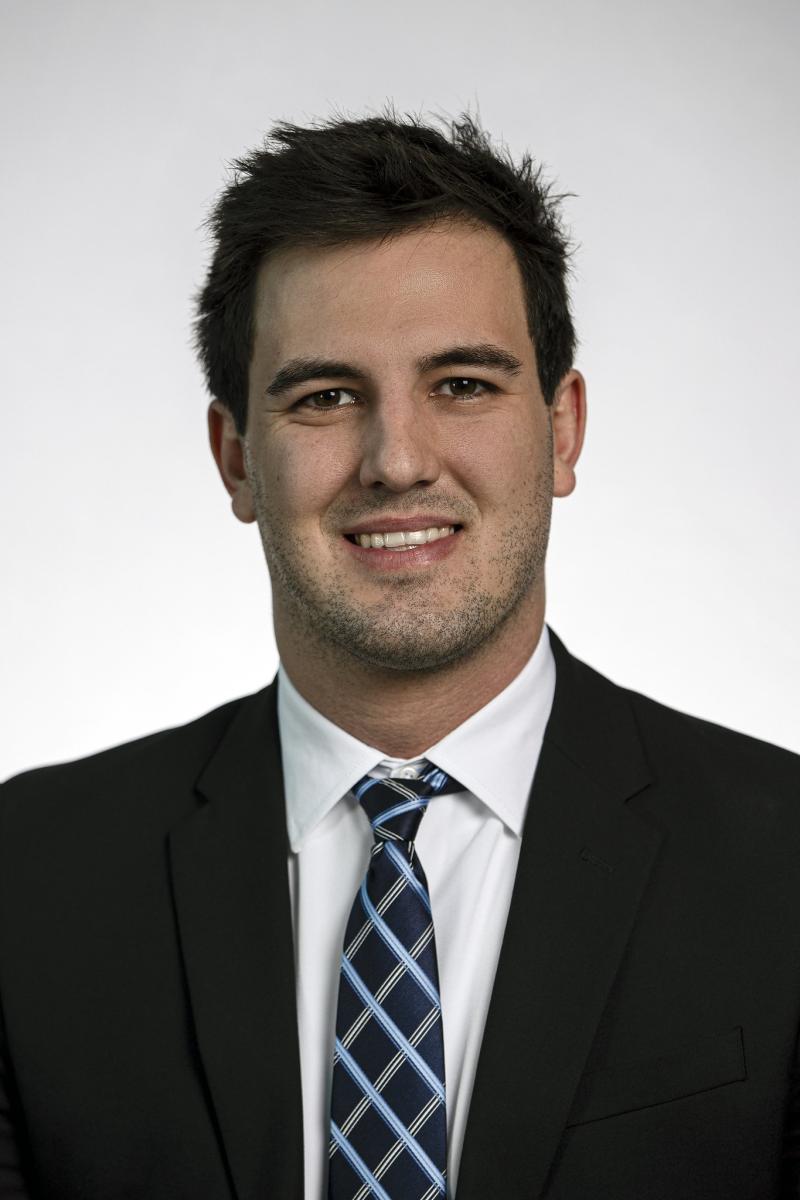
| 159 | 9007 | Asynchronous Online Presentation | https://drive.google.com/file/d/1cr9-qMqnPx-H-pj_YjGayFJvEYR4FkjT/view?usp=sharing | Student Research Symposium Program Portal: Submission #159 | 389b4dec-da09-484b-b941-807c682fb6b1 | No | Star/flag Student Research Symposium Program Portal: Submission #159 | Lock Student Research Symposium Program Portal: Submission #159 | Add notes to Student Research Symposium Program Portal: Submission #159 | Wed, 01/21/2026 - 02:27 PM | Wed, 01/21/2026 - 02:43 PM | Fri, 04/10/2026 - 03:49 PM | Anonymous | 2600:8807:8501:b300:e1cb:b0ae:bed9:db1b | Evan | Gonzalez | ecg18b@fsu.edu |
|
M.S Systems Engineering | I graduated from Florida State University with a mechanical engineering undergraduate degree and am currently a graduate student studying systems engineering. The connection of technical systems, leadership, and human decision-making captured my curiosity throughout my academic career and work experience. As a Mission Data Engineer supporting the Joint Strike Fighter F-35 program, I presently work for the US Department of Defense, where I help analyze complex operational systems and mission effectiveness. My scholarly pursuits center on decision-making, systems thinking, and leadership in expansive, high-risk engineering settings. In order to contribute to resilient, adaptable technologies that support mission success and national security, I intend to continue my career in defense and systems engineering. I am especially interested in how leadership motivation and behavior affect organizational performance and long-term system outcomes. | The Making of an Industrial Leader Through Henry Ford | Henry Ford's leadership is examined in this study by looking at the structural, behavioral, and motivational elements that influenced his long-term influence on society and business. The paper emphasizes how Ford's visionary perspective fueled revolutionary advancements in manufacturing, labor practices, and organizational design by drawing on leadership theory, motivational frameworks, and historical analysis. Important programs like the five-dollar workday and mass manufacturing are examined as manifestations of a leadership style that is future-oriented and focused on building sustainable industrial systems. The study also looks at Ford's leadership shortcomings, such as control, inflexibility, and refusal to adapt when circumstances changed. All things considered, this study shows how deeply held motivation affects leadership performance in complex systems, providing guidance for modern leaders working in huge, dynamic companies. | Dr. Georgiadis | College of Engineering | IME | dgeorgiadis@eng.famu.fsu.edu | Leadership, Motivation, Systems Engineering, Visionary Leadership, Industrial Innovation | Complete | 2026 | 5th annual Undergraduate Research Symposium, April 17, 2025 | https://pc.fsu.edu/student-research/symposium/research-symposium-program-portal?element_parents=elements/student_photo&ajax_form=1&_wrapper_format=drupal_ajax&token=dLr6wFe-SijMayMS_Dtd19Cx0pYg4qhhrOcGme8UCJ0 | |||||||
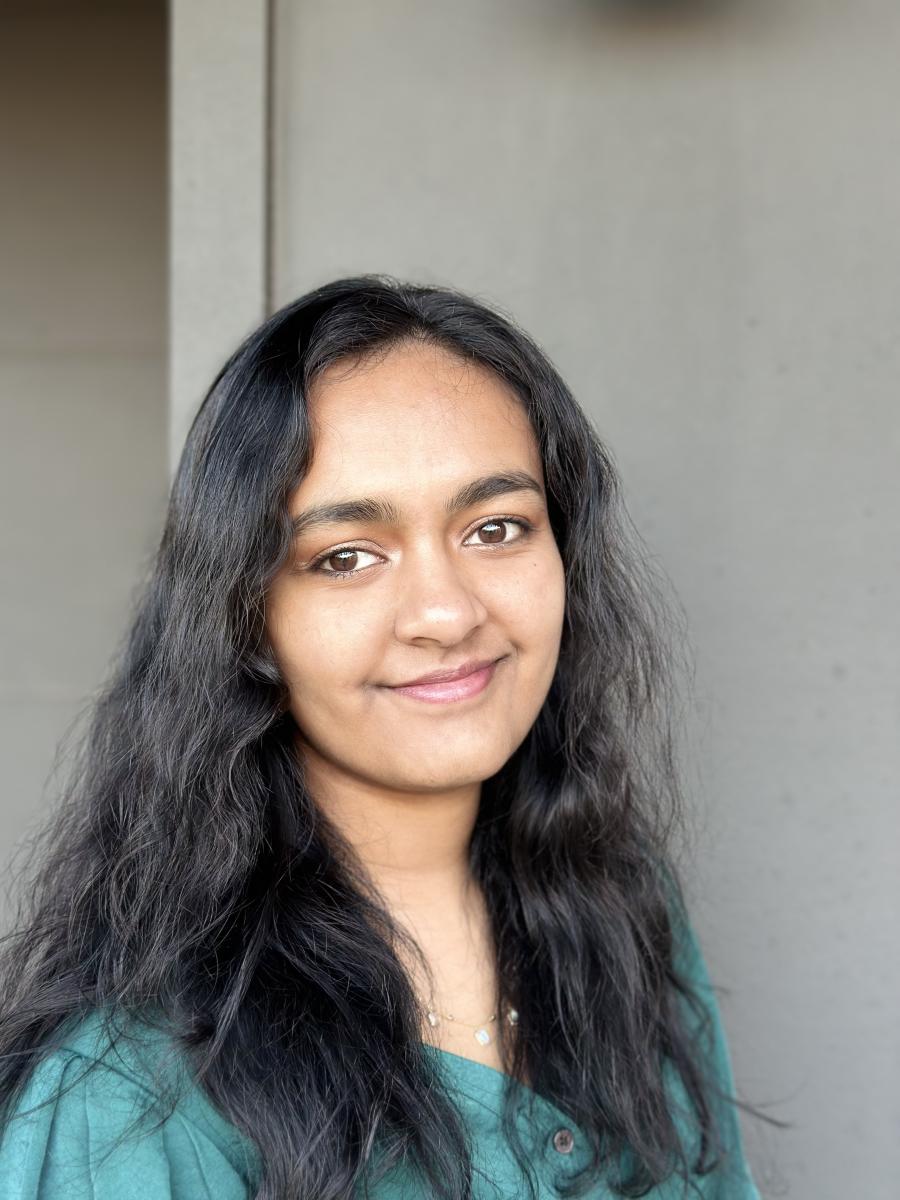
| 158 | 9006 | Asynchronous Online Presentation | https://drive.google.com/file/d/1QXGEfm1_kBN4o9jy7BGB9E2jkLuoAMrc/view?usp=sharing | Student Research Symposium Program Portal: Submission #158 | f1461e9f-d86f-481d-8a48-3870e4150387 | No | Star/flag Student Research Symposium Program Portal: Submission #158 | Lock Student Research Symposium Program Portal: Submission #158 | Add notes to Student Research Symposium Program Portal: Submission #158 | Wed, 01/21/2026 - 01:44 PM | Wed, 01/21/2026 - 02:02 PM | Fri, 04/10/2026 - 03:49 PM | Anonymous | 2600:8807:8309:9200:a5ee:5f60:88ff:820d | Maansi | Verma | mv25e@fsu.edu |
|
Masters of System Engineering | My name is Maansi Verma and I am from Suwanee, Georgia. I hold a bachelor’s degree in mechanical engineering from Mercer University, where I developed a strong foundation in engineering design, analysis, and mathematics. I am currently a graduate student pursuing Systems Engineering. Currently work as a civilian Electronics Engineer with the United States Air Force. Professionally, my career goal is to work in systems engineering roles that focus on integrating complex systems, managing risk, and supporting decision-making in defense and large-scale technical organizations. In the future, I would like to manage and work with other engineers to simplify the process. My research interests include systems, risk and reliability analysis, and improving the connection between technical design and operational outcomes. |
Sally Ride | Dr. Sally Ride was the first American woman to travel into space and paved the way for young people, especially women, across the world. She demonstrated strong technical expertise, ethical integrity, and a collaborative leadership style throughout her career at NASA, including during her historic space missions and her role in the Challenger investigation. Ride exemplified effective leadership behaviors described in The Leadership Experience and demonstrated the Visionary Family motivation outlined in The Motivation Code through her long-term commitment to science education, safety, and inclusion. Overall, her career illustrates how competence, integrity, and a focus on future impact can create lasting leadership influence in high-risk environments. | Dr. Daniel R. Georgiadis | George Washington University | Systems Engineering, MSSE Program Coordinator | dgeorgiadis@eng.famu.fsu.edu | Leadership, Engineering | Complete | 2026 | 5th annual Undergraduate Research Symposium, April 17, 2025 | https://pc.fsu.edu/student-research/symposium/research-symposium-program-portal?element_parents=elements/student_photo&ajax_form=1&_wrapper_format=drupal_ajax&token=tRwPX3SSr2exgNpKxcDxfMYkyDRDp4ZqtPN_9sSO9yw | |||||||
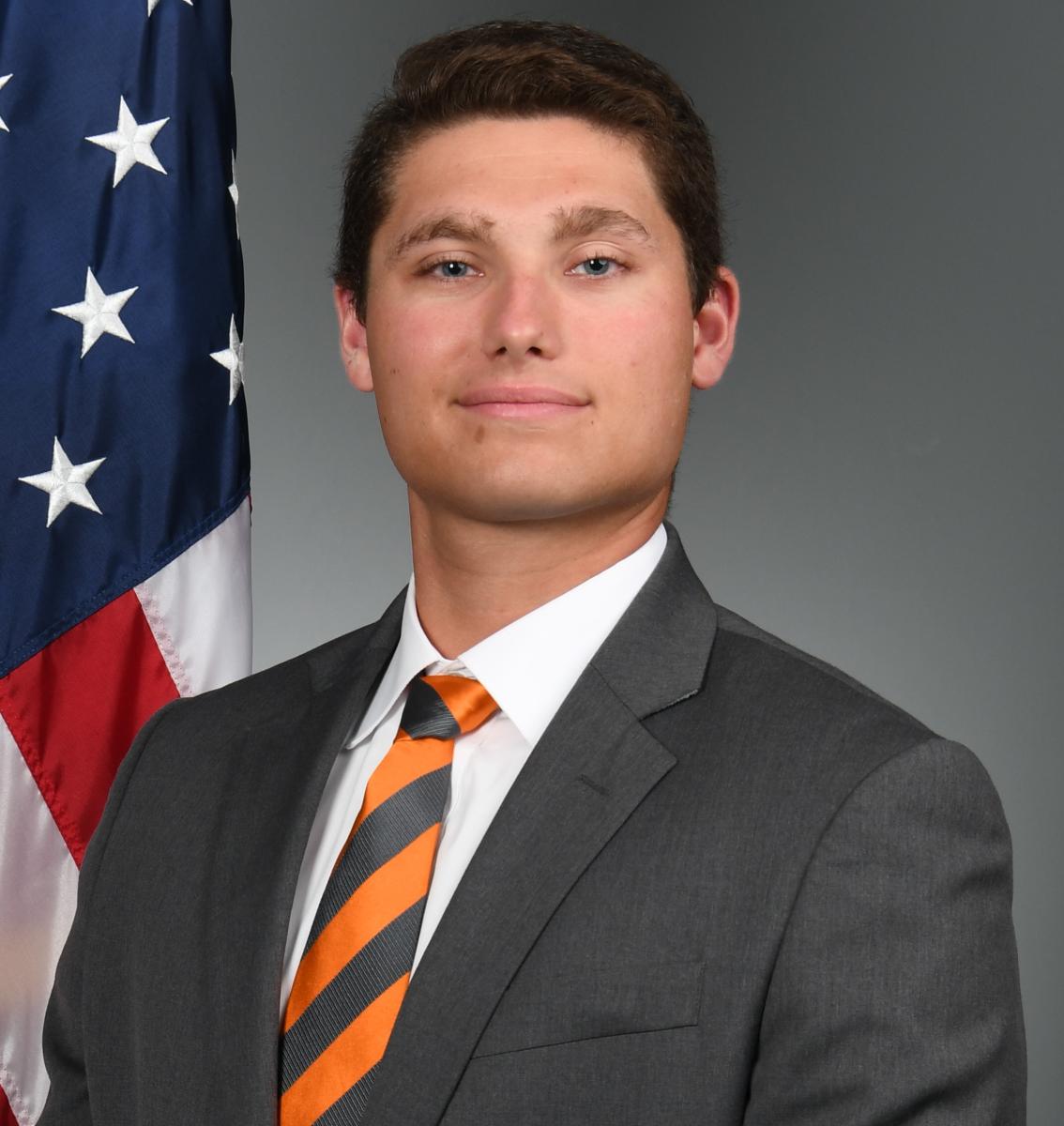
| 157 | 9005 | Asynchronous Online Presentation | https://drive.google.com/file/d/1OVakTlpk1P-BlqNtpFu7NZfxpcpa3Dci/view?usp=sharing | Student Research Symposium Program Portal: Submission #157 | 1d1231e8-cde6-4fdb-a33f-7b400bf2f577 | No | Star/flag Student Research Symposium Program Portal: Submission #157 | Lock Student Research Symposium Program Portal: Submission #157 | Add notes to Student Research Symposium Program Portal: Submission #157 | Wed, 01/21/2026 - 11:54 AM | Wed, 01/21/2026 - 12:35 PM | Fri, 04/10/2026 - 03:50 PM | Anonymous | 216.169.140.175 | Patrick | Jones | pj25@fsu.edu |
|
MS Systems Engineering | I am Patrick Jones, and I am a recent graduate of the University of Tennessee Knoxville. I received my Bachelor’s in Aerospace Engineering with a minor in Honors Leadership Studies. My primary involvements at Tennessee included: Beta Upsilon Chi, the Honors Leadership Program, and the American Institute of Aeronautics and Astronautics. Within Beta Upsilon Chi specifically, I served as Community Service Coordinator, House Manager, All Campus Events Coordinator, and most notably, Treasurer. Using my experience and degree, I am currently employed as an Aerospace Engineer at the Department of the Air Force. As a part of the Air Force’s PAQ program, I am also pursuing a Masters in Systems Engineering at Florida State University. My leadership vision is to propel the engineering industry forward through the optimization of current products and the creation of new ones in order to best serve clientele. To fulfill this leadership vision, my personal mission is to become an engineer and work my way up to one day become a leader of leaders within an engineering firm. |
Leading the Paradigm Shift: Satya Nadella’s Transformational Leadership | This paper explores the concept of transformational leadership as it is embodied by the qualities and actions of Satya Nadella, the current CEO of Microsoft. After his takeover in 2014, Nadella revitalized the company following a period of strategic stagnation and declining relevance by emphasizing modern leadership principles such as empathy, curiosity, collaboration, and adaptability. These principles generated a cultural transformation within Microsoft and enabled the company’s return as a global leader in computing. The paper analyzes how Nadella’s leadership qualities and behaviors correlate to established leadership theories and practices to better understand how transformational leadership can be applied effectively. The goal of this analysis is to highlight key qualities and practices that myself and other prospective leaders can employ within our own organizations. | Daniel Georgiadis | College of Engineering | IME | dgeorgiadis@eng.famu.fsu.edu | Leadership, Transformation, CEO, Satya Nadella | Complete | 2026 | 5th annual Undergraduate Research Symposium, April 17, 2025 | https://pc.fsu.edu/student-research/symposium/research-symposium-program-portal?element_parents=elements/student_photo&ajax_form=1&_wrapper_format=drupal_ajax&token=hV3tBhjTFaTinNxHe7cMEteVDK1ZgMOOi9EjkC2638k | |||||||
| 156 | 9004 | Face to Face Poster session | 10:00 Graduate and Undergraduate presentations | Student Research Symposium Program Portal: Submission #156 | 7e287ae0-41a1-4e58-a16e-a28e1b91e0c5 | No | Star/flag Student Research Symposium Program Portal: Submission #156 | Lock Student Research Symposium Program Portal: Submission #156 | Add notes to Student Research Symposium Program Portal: Submission #156 | Tue, 01/20/2026 - 01:00 PM | Tue, 01/20/2026 - 01:02 PM | Mon, 04/06/2026 - 02:47 PM | Anonymous | 146.201.13.22 | Dixie | Collins | She/Her/Hers | dcw09d@fsu.edu |
|
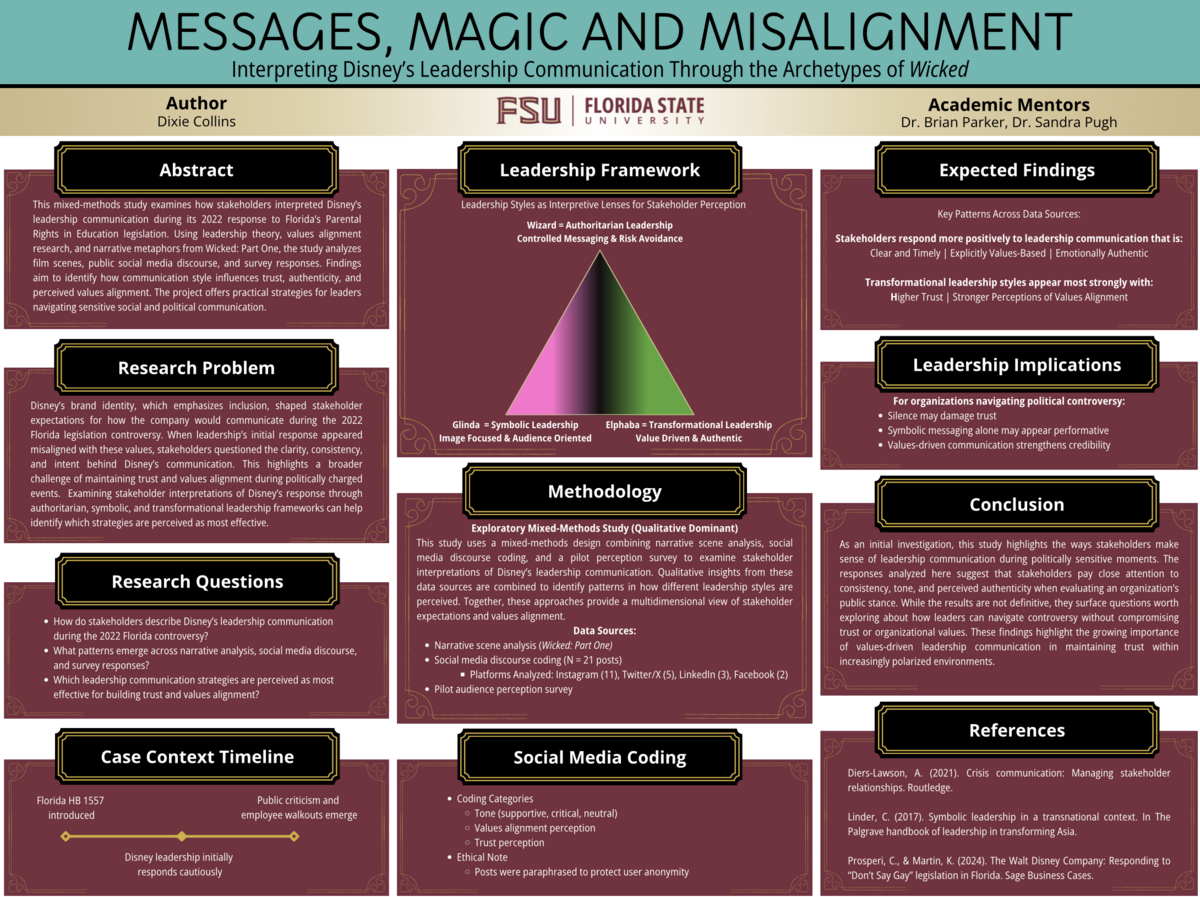
Corporate & Public Communications (M.S.) | Building on my undergraduate work at Florida State University, I am currently pursuing an M.S. in Corporate & Public Communication at the Panama City campus. My academic interests focus on rhetoric and media studies, particularly media and rhetorical approaches that challenge conventional analysis and encourage new ways of thinking about communication. I enjoy blending pop culture, narrative, and various media to help make complex ideas clearer and more engaging. My current research examines The Walt Disney Company’s response to Florida’s “Don’t Say Gay” bill, using characters from Wicked as an interpretive lens to explore rhetorical positioning and meaning‑making. With a professional background in hospitality, I place a strong value on audience perspective, lived experience, and relational communication, all of which shape my approach to research. I plan to pursue a Ph.D. and a career as a professor and researcher. | Messages, Magic, and Misalignment: Interpreting Disney’s Leadership Communication Through the Leadership Archetypes of Wicked | In 2022, The Walt Disney Company faced widespread criticism for its initially cautious response to Florida’s Parental Rights in Education law, commonly known as the “Don’t Say Gay” bill. As a brand known for storytelling which features inclusion, Disney’s measured communication prompted questions regarding leadership authenticity, values alignment, and stakeholder trust. This research examines audience interpretations of Disney’s leadership communication during the controversy using a narrative leadership framework inspired by Wicked. The study maps three leadership archetypes to the Disney case: transformational leadership (Elphaba), symbolic leadership (Glinda), and authoritarian leadership (the Wizard). These archetypes offer a clear interpretive lens for analyzing perceptions of leadership communication strategies during the crisis. Using a mixed methods exploratory sequential design, the study combines qualitative coding of public social media discourse across platforms, including Facebook, Instagram, and LinkedIn, with narrative analysis of key scenes from the Wicked films. These data sources enable examination of stakeholder interpretations of Disney’s communication and alignment with various leadership communication styles. Additionally, a pilot survey was developed to explore stakeholder perceptions of leadership authenticity, communication timing, and values alignment. Despite limited early responses, the survey provides an exploratory foundation for future research. By integrating leadership theory with cultural narrative analysis, this research demonstrates how storytelling frameworks can illuminate complex organizational communication challenges and provides insights for leaders navigating politically sensitive issues while maintaining credibility and stakeholder trust. |
Dr. Brian Parker | Florida State University | Professional Communication | bparker@fsu.edu | Dr. Sandra Pugh | Leadership Communication, Organizational Values & Trust, Crisis Communication, Popular Culture in Research, Corporate Political Engagement | Exploratory (the research question has been identified and design of approach is outlined) |
|
Yes | 2026 | 5th annual Undergraduate Research Symposium, April 17, 2025 | https://pc.fsu.edu/student-research/symposium/research-symposium-program-portal?element_parents=elements/student_photo&ajax_form=1&_wrapper_format=drupal_ajax&token=qi9uexuJG4lgNqMCztsw3Opa-OXuTLu1z7o55cOVM2w | |||
| 155 | 9003 | Asynchronous Online Presentation | https://drive.google.com/file/d/14xwXOuzWIz_xo5wgLwwsuitZe33xrpW_/view?usp=sharing | Student Research Symposium Program Portal: Submission #155 | 6fb22ce0-6170-4bbc-8bf7-41ef1d54086b | No | Star/flag Student Research Symposium Program Portal: Submission #155 | Lock Student Research Symposium Program Portal: Submission #155 | Add notes to Student Research Symposium Program Portal: Submission #155 | Tue, 01/20/2026 - 09:48 AM | Tue, 01/20/2026 - 10:16 AM | Fri, 04/10/2026 - 03:50 PM | Anonymous | 81.145.210.42 | James | Brown | JDB23h@fsu.edu |
|
Masters of Systems Engineering | Served 26 years as Electronics Engineer in the United States Navy. Retired in 2019 and employed as a Systems Engineer from 2019 to 2022 for Huntington Ingalls Technical Solution Division and BAE systems located in United kingdom. Assumed position as government civilian as Director of Joint Maritime Forces in the United kingdom from 2022 to present. | Dwight D. Eisenhower: A Life of Leadership and Responsibility | This research will focus on the life and leadership of Dwight D. Eisenhower and how it demonstrates that effective leadership is built on responsibility, cooperation, and careful decision making. During World War II, he led Allied forces by staying calm under pressure, working well with leaders from other nations, and taking responsibility for major decisions. His leadership focused on teamwork, clear communication, and keeping everyone focused on a shared goal. As president, Eisenhower used the same leadership approach by maintaining a strong defense while avoiding unnecessary conflict during the Cold War. | Dr. Georgiadis | Floridas State University | IME | dgeorgiadis@eng.famu.fsu.edu | Leadership, responsibility, cooperation, teamwork, communication, focused, calm, military, General, President | Complete | 2026 | 5th annual Undergraduate Research Symposium, April 17, 2025 | https://pc.fsu.edu/student-research/symposium/research-symposium-program-portal?element_parents=elements/student_photo&ajax_form=1&_wrapper_format=drupal_ajax&token=QtKLTiJtnl3i_yogrCUh1fueKDBUr9wy0HepKZX2I2M | |||||||
| 154 | 9002 | Synchronous Online Presentation | https://pc.fsu.edu/2026-synchronous-online-research-presentations | Student Research Symposium Program Portal: Submission #154 | 7bb656e0-4dd9-4252-a550-e5314b473340 | No | Star/flag Student Research Symposium Program Portal: Submission #154 | Lock Student Research Symposium Program Portal: Submission #154 | Add notes to Student Research Symposium Program Portal: Submission #154 | Mon, 01/19/2026 - 09:30 AM | Mon, 01/19/2026 - 10:23 AM | Fri, 04/10/2026 - 03:51 PM | Anonymous | 67.235.200.51 | Garrett | Verkaik, and James Sparks | gvv23@fsu.edu |

|
DNAP | James Sparks - Born and raised in Paris, TX. James Graduated nursing school in 2021 and went directly into an ICU working through the COVID pandemic. It was in the ICU that James found his passion for critical care, and opened the possibility of pursuing nurse anesthesia. Garrett Verkaik - Garrett was born and raised in central Florida and also graduated nursing school in 2021. Garrett also went directly into the ICU where he developed a desire for individualized care and critical patients, and thus the pursuit of nurse anesthesia. |
Ideal Body Weight Dosing of Dexmedetomidine | Dexmedetomidine is an α₂-adrenergic agonist used widely in anesthesia for its analgesic, sympatholytic, and recovery-enhancing properties. Despite its benefits, considerable variation exists in provider dosing practices, limiting consistency in patient outcomes. Current evidence suggests that ideal body weight (IBW)–based bolus dosing provides a more standardized and clinically effective approach, improving postoperative pain control, decreasing postoperative nausea and vomiting (PONV), and reducing delirium in laparoscopic surgical populations. This project was guided by the PICO question: Do patients undergoing elective laparoscopic procedures who receive IBW-based bolus doses of dexmedetomidine, compared with prior non-standardized dosing practices, have better recovery experiences? Using a pre–post survey design, this practice improvement project evaluated anesthesia providers’ knowledge, attitudes, and dosing methods before and after viewing an educational flyer on IBW-based dexmedetomidine dosing. Anesthesia providers at four hospitals were invited to participate voluntarily. Survey responses demonstrated an increased likelihood of using IBW- based dosing, greater recognition of key benefits, and a reduction in perceived barriers to dexmedetomidine use. |
Dr. Kyle Hodgen | FSU PC | DNAP | rkh23a@fsu.edu | Dr. Stacey VanDyke, Dr. Jerry Hogan | Cade Garrett Dex | Complete | SparksVerkaik.pdf326.15 KB
|
No | 2026 | 5th annual Undergraduate Research Symposium, April 17, 2025 | https://pc.fsu.edu/student-research/symposium/research-symposium-program-portal?element_parents=elements/student_photo&ajax_form=1&_wrapper_format=drupal_ajax&token=Fr-UJOs8WLgcB80XuQXghdclvPA2s4E2Y3l4pS9dq6Q | ||||
| 153 | 9001 | Synchronous Online Presentation | https://pc.fsu.edu/2026-synchronous-online-research-presentations | Student Research Symposium Program Portal: Submission #153 | c216e8d7-d684-489b-bf66-512ef8bce293 | No | Star/flag Student Research Symposium Program Portal: Submission #153 | Lock Student Research Symposium Program Portal: Submission #153 | Add notes to Student Research Symposium Program Portal: Submission #153 | Sat, 01/17/2026 - 03:06 PM | Sat, 01/17/2026 - 03:06 PM | Fri, 04/10/2026 - 03:51 PM | Anonymous | 2603:90c8:740:67:e1f4:8ffd:6571:2894 | Caela | Jernigan, and Lauren Emfinger | caelahennelly@gmail.com |
|
Doctor of Nurse Anesthesia Practice | Lauren and Caela are doctoral nurse anesthesia students graduating in May. Lauren has a strong interest in obstetric anesthesia and multimodal anesthetic management. Caela’s clinical interests include pediatric and cardiac anesthesia, as well as multimodal pain management. Together, they are committed to advancing evidence-based anesthesia practice and improving perioperative patient outcomes through research and clinical excellence. | Preoperative Warming Influence within the Perioperative Period | Unintended perioperative hypothermia, defined as a core temperature below 36°C, remains a persistent issue in anesthesia practice and is associated with increased surgical complications, prolonged recovery, and decreased patient satisfaction. Evidence strongly supports the use of preoperative forced-air warming as an effective and safe method to maintain normothermia during surgery. The purpose of this quality improvement project was to increase anesthesia providers’ knowledge and intent to implement prewarming practices through an educational intervention. An evidence-based educational session was delivered to anesthesia providers at a community hospital in southeastern Alabama. The session summarized the physiologic rationale and literature supporting prewarming for at least ten minutes before induction of anesthesia. Post-education surveys assessed provider perceptions, knowledge gained, and willingness to adopt prewarming practices. |
Dr. Jason Smith | College of Applied Studies | Nurse Anesthesia | jcsmith3@fsu.edu | anesthesia, preoperative, warming | Complete | No | 2026 | 5th annual Undergraduate Research Symposium, April 17, 2025 | https://pc.fsu.edu/student-research/symposium/research-symposium-program-portal?element_parents=elements/student_photo&ajax_form=1&_wrapper_format=drupal_ajax&token=rV39eQx77A4cka_i4fSm3Y3IOnfybN5N2MG0XexmQo0 | ||||||
| 152 | 9000 | Face to Face Poster session | 10:00 Graduate and Undergraduate presentations | Student Research Symposium Program Portal: Submission #152 | f1093579-248c-4f0a-a3f0-c43821439861 | No | Star/flag Student Research Symposium Program Portal: Submission #152 | Lock Student Research Symposium Program Portal: Submission #152 | Add notes to Student Research Symposium Program Portal: Submission #152 | Fri, 01/16/2026 - 01:21 PM | Fri, 01/16/2026 - 01:55 PM | Fri, 04/03/2026 - 01:17 PM | Anonymous | 146.201.10.23 | Emily | Parks | She/her | ep25g@fsu.edu |
|
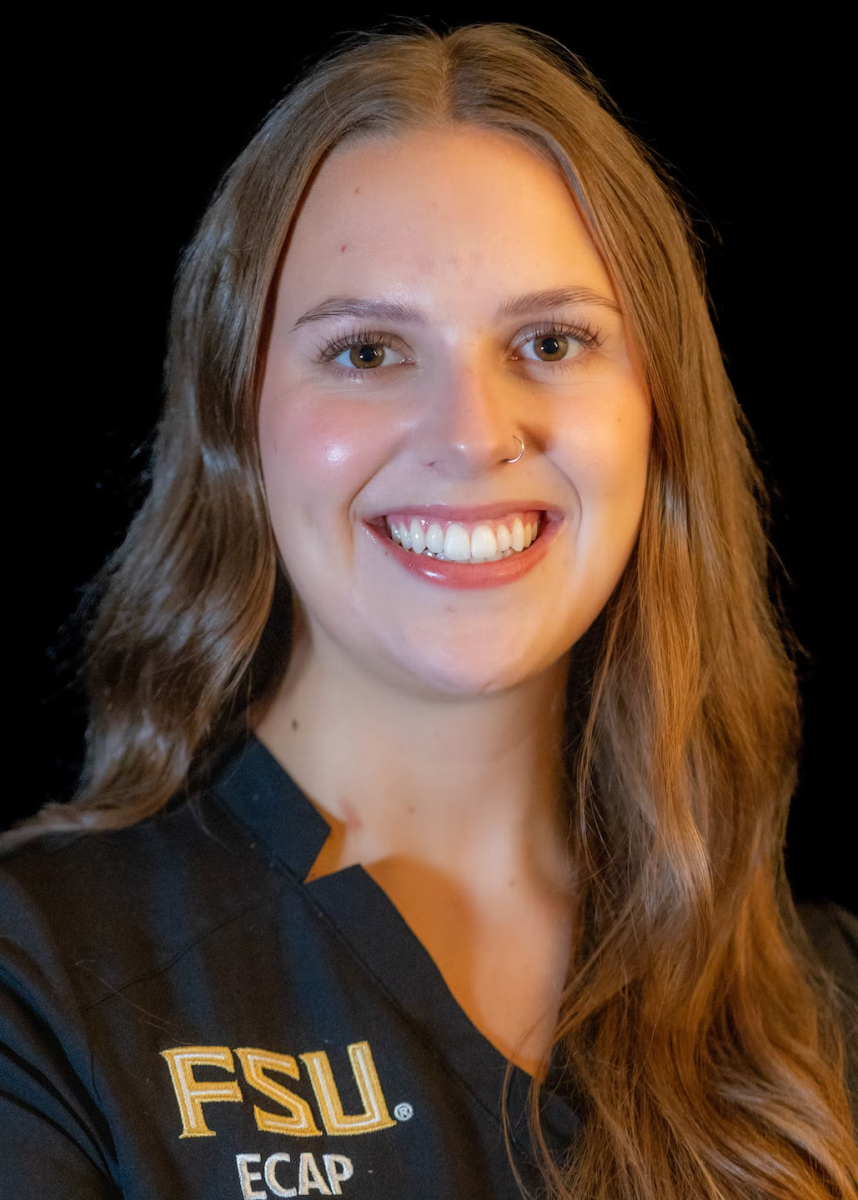
Psychology- Graduate Master's ABA | My name is Emily Parks and I am a graduate student at FSU's Master's in ABA program. I currently work at FSU's Early Childhood Autism Program (ECAP) as a registered behavior technician. I am from North Carolina and attended undergrad at University of North Carolina Wilmington. I enjoy being outdoors, swimming, reading, and having fun with the kids at work! | A Protocol for Early Vocal Manding and Tacting | The client is a four-year-old female diagnosed with autism spectrum disorder and currently receives ABA services at FSU’s Early Childhood Autism Program (ECAP). The client is an energetic girl who loves to play pretend, play with slime, color, and play on the playground. She has previously demonstrated significant progress with manding via pointing and consistently engages in spontaneous points for preferred items or locations. Her current programming targets early learner skills such as motor imitation, early echoic skills, and tacting common items. Throughout sessions at ECAP, clinicians have observed that she variably attempts to repeat words or approximations of words. Therefore, clinicians elected to introduce an Initial Manding and Tacting via Vocals protocol. This program intended to capitalize on her vocal attempts and continue to introduce her to a variety of words to add to her verbal repertoire. The acquisition of vocal manding and tacting may strengthen her communication repertoire by increasing opportunities for and rates of vocal speech sound production over time. Since the implementation of this program the client has shown significant progress with the rate per hour of words emitted and the number of different spontaneous and independent words emitted. | Zoe Bowden | FSU | Graduate- ABA | zcb25a@fsu.edu | Applied Behavior Analysis | Complete | Research Symposium.pdf301.71 KB
|
Yes | 2026 | 5th annual Undergraduate Research Symposium, April 17, 2025 | https://pc.fsu.edu/student-research/symposium/research-symposium-program-portal?element_parents=elements/student_photo&ajax_form=1&_wrapper_format=drupal_ajax&token=QC1HuqazMjAjFmVBw3vgUqMPdrc562jTQJjhGvqtSb0 | ||||
| 150 | 8998 | Synchronous Online Presentation | https://pc.fsu.edu/2026-synchronous-online-research-presentations | Student Research Symposium Program Portal: Submission #150 | a7b73707-b705-4a7f-a947-e98d408dad07 | No | Star/flag Student Research Symposium Program Portal: Submission #150 | Lock Student Research Symposium Program Portal: Submission #150 | Add notes to Student Research Symposium Program Portal: Submission #150 | Thu, 01/15/2026 - 01:24 PM | Thu, 01/15/2026 - 01:35 PM | Fri, 04/10/2026 - 03:52 PM | Anonymous | 2603:9001:4300:7e50:acdc:2ebe:24ff:44c2 | Brendan | Watson, and Corey Bemis | bsw23@fsu.edu |
|
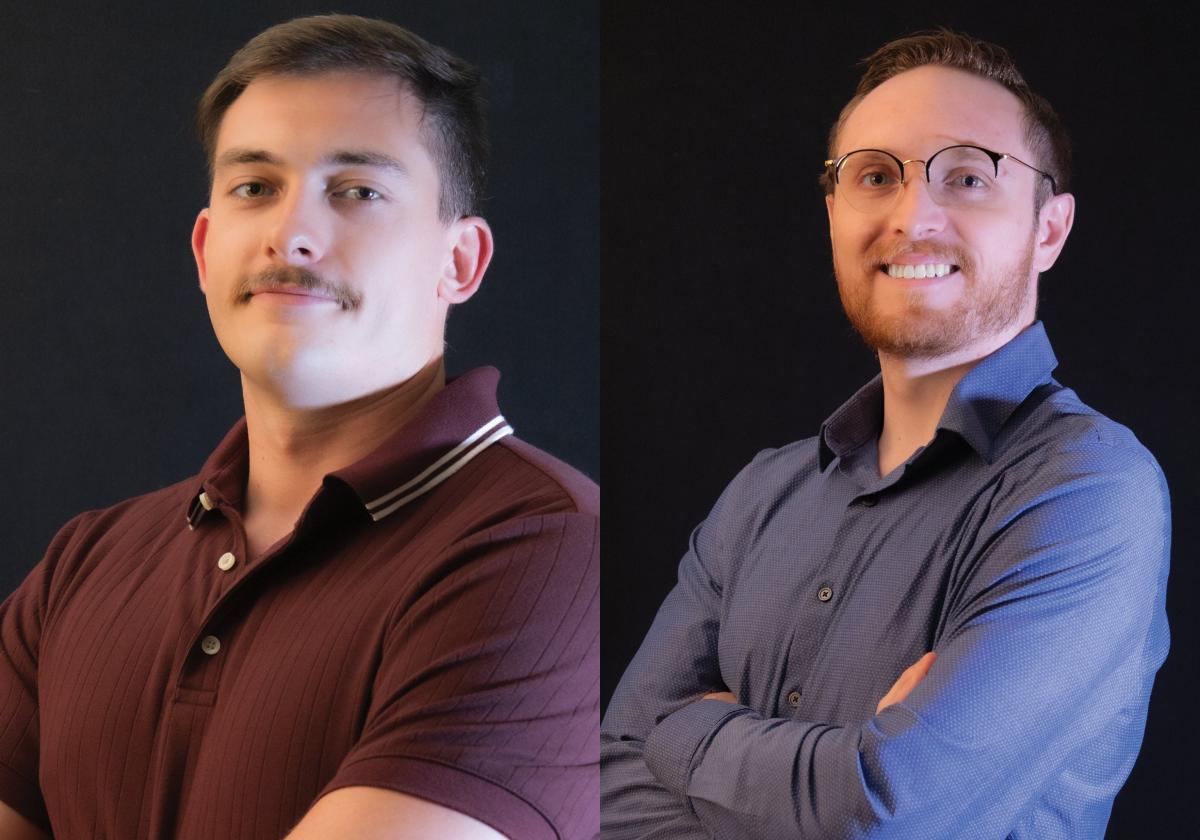
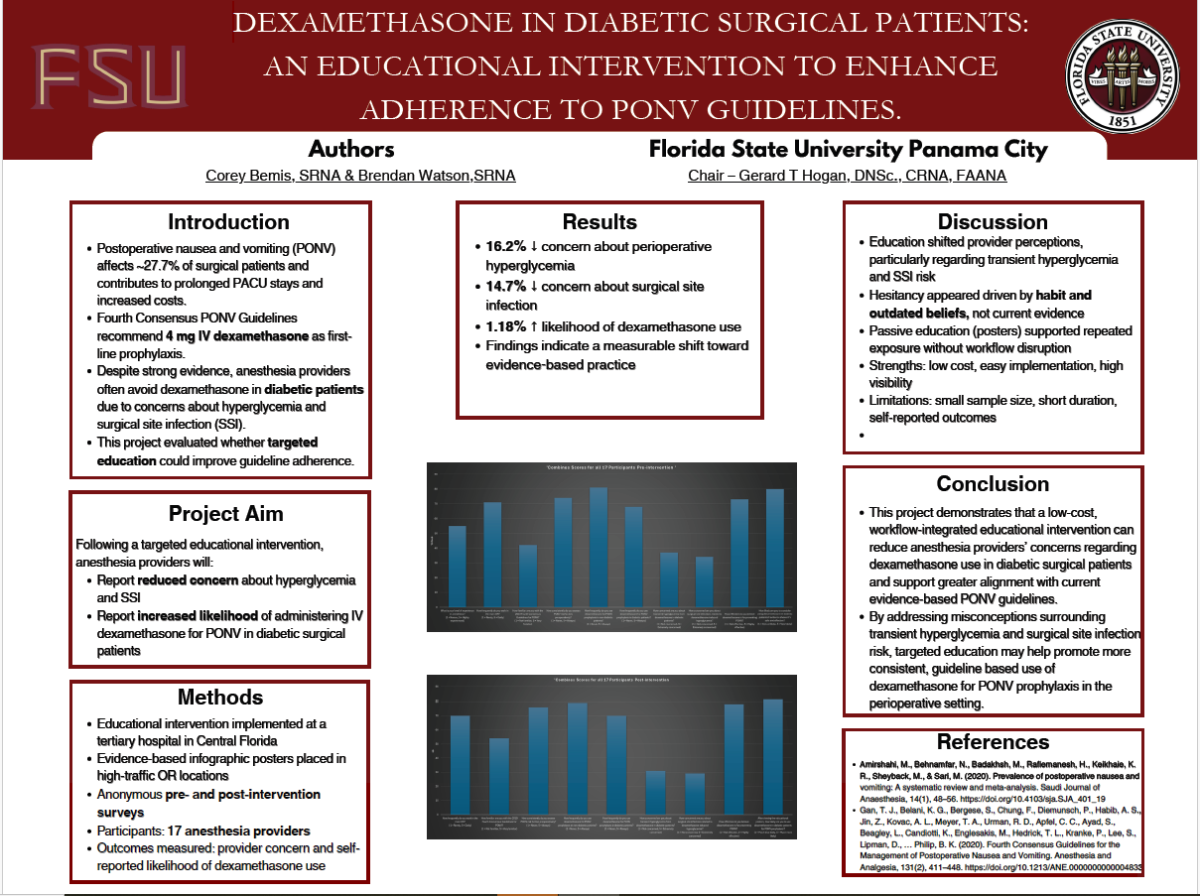
Doctor of Nurse Anesthesia Practice (DNAP) | Corey and Brendan are DNAP students excited to graduate and begin the next chapter of their careers in nurse anesthesia. | Dexamethasone in Diabetic Surgical Patients: An Educational Intervention to Enhance Adherence to PONV Guidelines | Postoperative nausea and vomiting (PONV) remain significant contributors to delayed recovery, prolonged post anesthesia care unit (PACU) stays, and reduces patient satisfaction. Evidence-based guidelines recommend dexamethasone as part of a multimodal PONV prevention strategy, yet many anesthesia providers remain hesitant to use it in diabetic patients due to concerns about hyperglycemia and surgical site infection (SSI). This quality improvement project sought to address these concerns through targeted education and will measure the success of the intervention by evaluating changes in provider perceptions. The PICO question was: In adult general surgical patients with diabetes (P), compared to non-diabetic patients (C), are those treated prophylactically for PONV (I) less likely to receive IV dexamethasone (O)? A pre and post educational intervention was conducted at a large tertiary hospital in the southeastern United States. Evidence-based posters summarizing current dexamethasone recommendations were displayed in high-traffic operating room areas. Pre- and post-intervention surveys assessed provider concerns, baseline practices, and likelihood of using dexamethasone in diabetic patients; responses were analyzed descriptively. Seventeen anesthesia providers completed both surveys. Results showed a 16.2% reduction in concern about hyperglycemia and a 14.7% reduction in concern about SSI after dexamethasone use, along with a small (1.18%) increase in reported likelihood of administering dexamethasone to diabetic patients. Although changes in attitudes were modest, the reduction in perceived risks indicates a positive shift toward evidence-based practice. These findings support continued education on PONV guidelines and suggest dexamethasone remains an appropriate option for diabetic patients when routine postoperative glucose monitoring is in place. |
Gerard T. Hogan, DNSc., CRNA, FAANA | Florida State University | Nurse Anesthesia Program (DNAP) | ghogan@pc.fsu.edu | dexamethasone, PONV, anesthesia | Complete | Bemis Watson Research Poster..pdf819.81 KB
|
|
No | 2026 | 5th annual Undergraduate Research Symposium, April 17, 2025 | https://pc.fsu.edu/student-research/symposium/research-symposium-program-portal?element_parents=elements/student_photo&ajax_form=1&_wrapper_format=drupal_ajax&token=d5DGkZLnsjoTILZUF4Z4rW1QRxoFf--hNz-R1cLTW3M | ||||
| 149 | 8997 | Face to Face Poster session | 11:15 High School presentations | Student Research Symposium Program Portal: Submission #149 | 4213b84d-0178-47e8-9feb-0bd65483eced | No | Star/flag Student Research Symposium Program Portal: Submission #149 | Lock Student Research Symposium Program Portal: Submission #149 | Add notes to Student Research Symposium Program Portal: Submission #149 | Wed, 01/14/2026 - 03:21 PM | Wed, 01/14/2026 - 03:31 PM | Fri, 04/03/2026 - 12:45 PM | Anonymous | 2600:382:10d0:3c98:88f6:fa90:f018:46df | Ivy | Dixon | She/her | xdixoil@baystudent.org |
|
AP Research | My name is Ivy Dixon, and I am a high school student currently enrolled in AP Research. My research focuses on how visual branding influences perceptions, specifically examining how the presence of a well-known logo compared to a generic logo affects students’ judgments. Through this project, I have developed skills in research design, data collection, and analysis while exploring how everyday visuals can shape opinions and decision-making. This experience has strengthened my interest in understanding human behavior and the impact of media and marketing on society. |
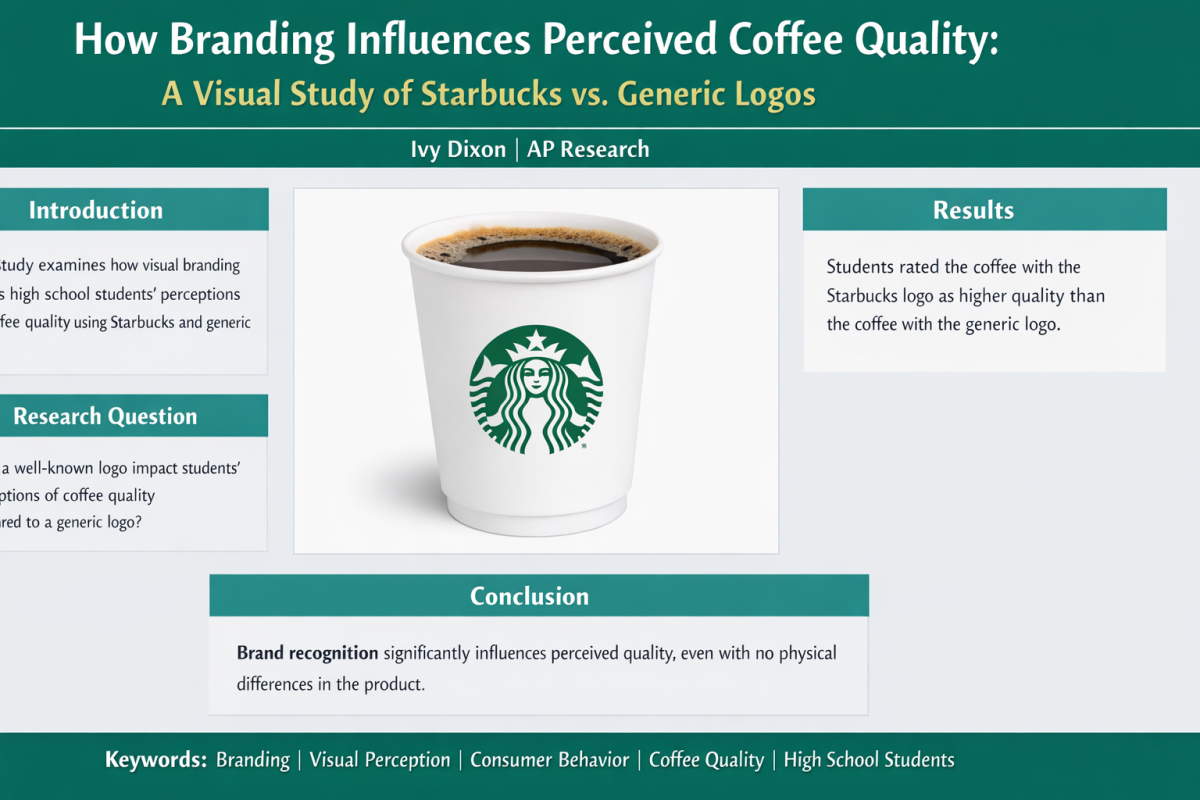
The Effect of Coffee Branding on High School Students’ Perceptions of Quality | This study examines how visual branding influences high school students’ perceptions of coffee quality based on appearance alone. Specifically, the research compares student responses to an image of coffee labeled with a well-known Starbucks logo versus an identical image labeled with a generic coffee logo. Participants were high school students who completed a visual-only survey in which they rated perceived coffee quality without tasting the product. By isolating branding as the independent variable, the study aimed to determine whether brand recognition affects judgments of quality. The findings suggest that recognizable branding plays a significant role in shaping perceptions, even when no physical differences in the product are present. This research highlights the impact of marketing and visual cues on consumer perception and decision-making among adolescents. |
Dodey Deal | Arnold High School | AP Research | dealdm@k12.fl.us | Branding, Visual Perception, Consumer Behavior, Coffee Quality, High School Students | Complete |
|
Yes | 2026 | 5th annual Undergraduate Research Symposium, April 17, 2025 | https://pc.fsu.edu/student-research/symposium/research-symposium-program-portal?element_parents=elements/student_photo&ajax_form=1&_wrapper_format=drupal_ajax&token=5z8czdjRAmTCabwLlYcWRUNRKBYWULQOcxEfS_Rx6ts | ||||
| 148 | 8996 | Face to Face Poster session | 11:15 High School presentations | Student Research Symposium Program Portal: Submission #148 | 510b08ca-9825-4d69-b7db-d2afcb81111a | No | Star/flag Student Research Symposium Program Portal: Submission #148 | Lock Student Research Symposium Program Portal: Submission #148 | Add notes to Student Research Symposium Program Portal: Submission #148 | Wed, 01/14/2026 - 11:25 AM | Wed, 01/14/2026 - 11:30 AM | Thu, 04/16/2026 - 10:08 PM | Anonymous | 150.176.163.200 | Dylan | Zeigler | He/Him | dez.ocean.08@gmail.com |
|
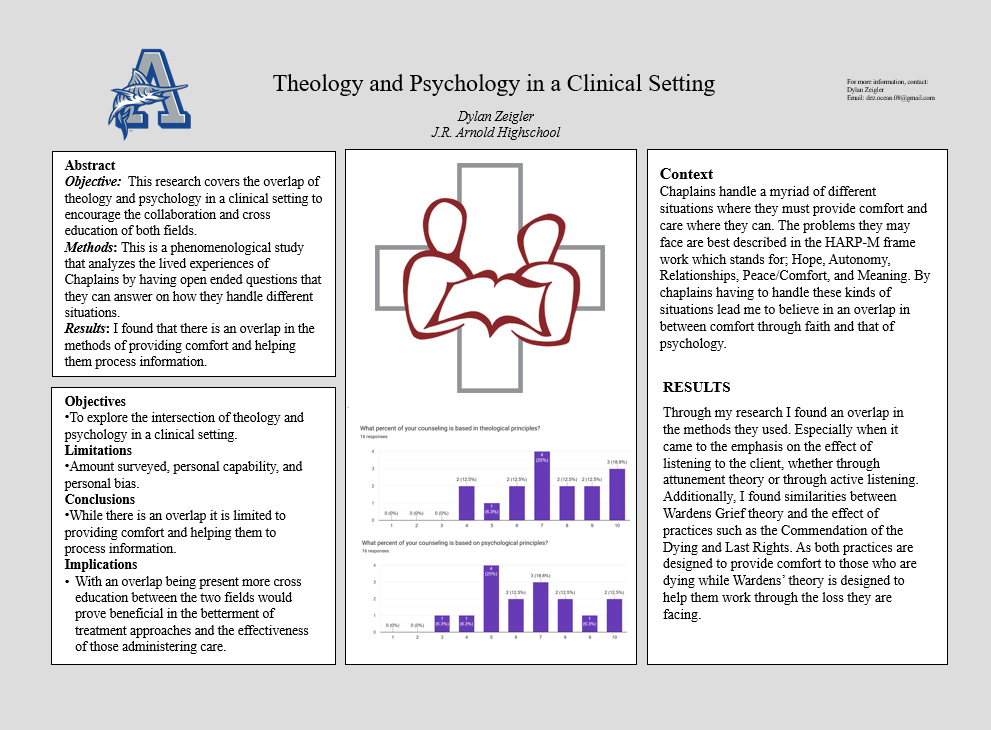
Theology | Hi my name is Dylan Zeigler, I am a senior at J.R. Arnold High School. To better prepare myself for my aspirations I have been studying theology for several years now. In doing this I found that I enjoy the practical side of theology and wanted to do research on that, which is what lead me to investigate how care methods overlap in a clinical setting. | The Overlap of Theology and Psychology | This research covers the overlap of theology and psychology in a clinical setting to encourage the collaboration and cross-education of both fields. Data was collected from chaplains who, in their career use both psychology and theology when dealing with patients. It was collected through a survey sent out to the Ascension Sacred Heart Hospital system and analyzed the lived experience and personal feelings of the chaplains surveyed. The means by which data was processed was by the use of a hermeneutic analysis of their experiences and their personal feelings of the integration, which was analyzed from a statistical approach to identify what the overall study believed. I found that although there is significant overlap between the field's methods and how the chaplains feel regarding the two, they still maintain significant differences in practices. While the methods that pertain to providing comfort or processing information remain similar in both fields, each has its limit before they are beyond the scope of their office. This is significant because it shows that there is a significant overlap between the fields, which would benefit from further interdisciplinary education, which could produce more counselors going forward who can look at things from both a psychological perspective along with that of a theological perspective. |
Doedy Deal | J.R. Arnold | AP Research | dealdm@bay.k12.fl.us | Theology, Psychology, Clinical, Chaplain | Complete |
|
No | 2026 | 5th annual Undergraduate Research Symposium, April 17, 2025 | https://pc.fsu.edu/student-research/symposium/research-symposium-program-portal?element_parents=elements/student_photo&ajax_form=1&_wrapper_format=drupal_ajax&token=6fFpMg4MGmd-g6AzsIRQSvSVrMxB3dbLu7-jtVKojdA | ||||
| 147 | 8995 | Synchronous Online Presentation | https://pc.fsu.edu/2026-synchronous-online-research-presentations | Student Research Symposium Program Portal: Submission #147 | 07b02ff9-0960-4473-9b45-ddfb0e01ad16 | No | Star/flag Student Research Symposium Program Portal: Submission #147 | Lock Student Research Symposium Program Portal: Submission #147 | Add notes to Student Research Symposium Program Portal: Submission #147 | Tue, 01/13/2026 - 07:30 PM | Tue, 01/13/2026 - 07:38 PM | Fri, 04/10/2026 - 03:52 PM | Anonymous | 2600:1700:e771:b0f0:8014:326b:7896:444c | Angela | Petche, Matthew Couch, and Felecia Dukes | aep23g@fsu.edu |
|
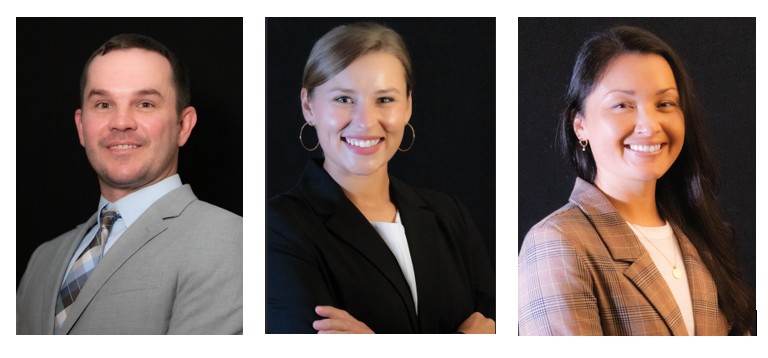
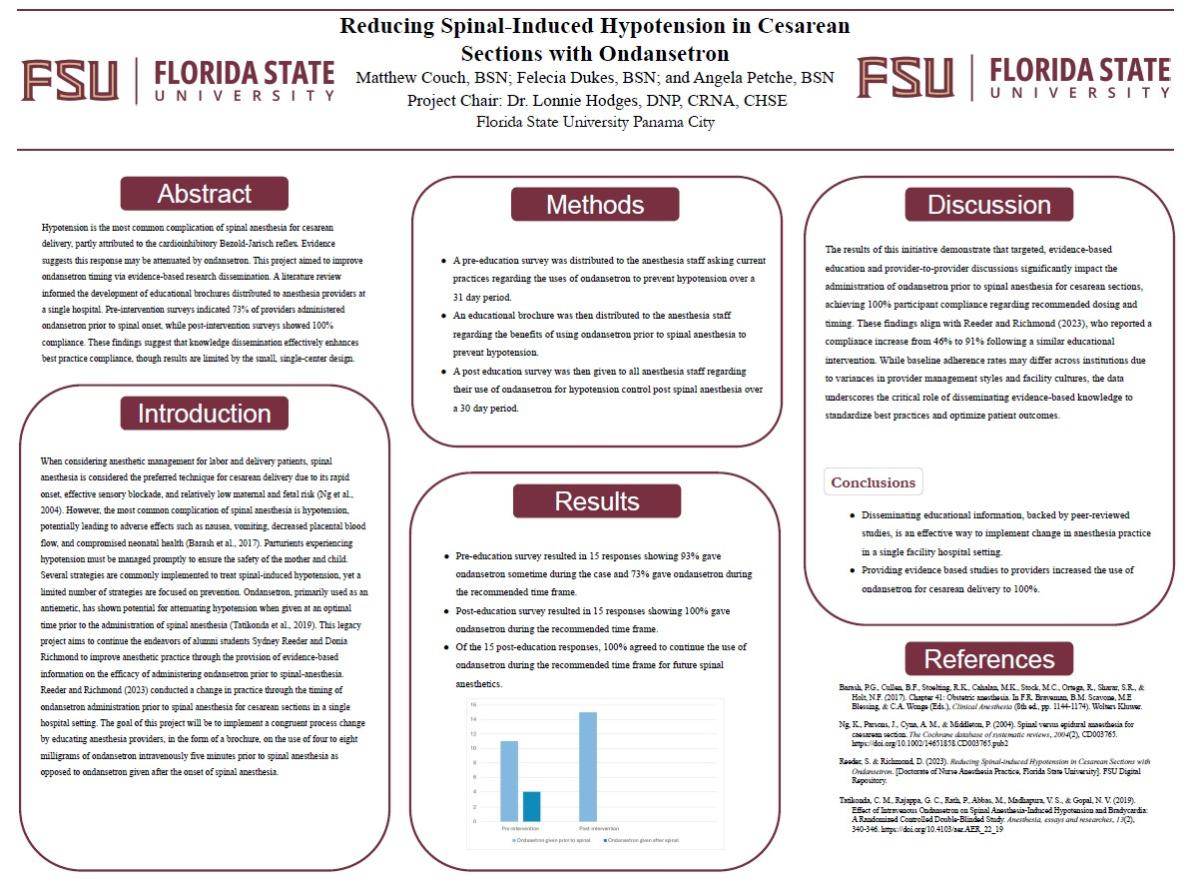
Doctor of Nurse Anesthesia Practice | Doctor of Nurse Anesthesia (DNAP) students with diverse nursing backgrounds and substantial experience in high-acuity critical care settings. United by a commitment to excellence in anesthesia practice, our academic and clinical interests focus on improving patient outcomes, advancing nurse anesthesia education, and contributing meaningfully to the profession. | Reducing Spinal-Induced Hypotension in Cesarean Sections with Ondansetron | The use of spinal anesthesia for cesarean delivery is widespread due to its simplicity and reliability. Though generally considered a safe technique, hypotension is the most common complication that anesthesia providers face when administering spinal anesthetics to parturients. In this population, hypotension is partly attributed to a cardioinhibitory response called the Bezhold-Jarish reflex which, evidence suggests, may be attenuated by non-vasoactive medications such as ondansetron. This project aims to build upon the foundational work of past initiatives and disseminate evidence-based research to improve the timing and administration of ondansetron prior to cesarean delivery to promote both maternal and fetal safety. Through the PICO framework: Do parturients receiving a spinal for cesarean delivery (P) that receive ondansetron before block onset (I) compared to after block onset (C) have reduced incidence of hypotension (O)? a literature search and review informed the development of educational brochures which were distributed to anesthesia providers at a single hospital setting. Prior to the introduction of the brochure, pre-intervention surveys indicated that 73% of anesthesia providers administered ondansetron prior to onset of spinal anesthesia. After educational materials were distributed, post-intervention surveys showed that 100% of providers administered ondansetron prior to spinal administration. The findings suggest that dissemination of knowledge may be an effective strategy in the enhancement of anesthesia care and may contribute to compliance with best practices. These results are, however, limited by the single-center design and small sample size. | Lonnie W. Hodges, DNP, CRNA, CHSE | Florida State University | Nurse Anesthesia | lwhodges@pc.fsu.edu | ondansetron, spinal anesthesia, cesarean section, hypotension, Zofran, parturient, obstetric anesthesia | Complete | Poster .pptx_.pdf252.81 KB
|
|
No | 2026 | 5th annual Undergraduate Research Symposium, April 17, 2025 | https://pc.fsu.edu/student-research/symposium/research-symposium-program-portal?element_parents=elements/student_photo&ajax_form=1&_wrapper_format=drupal_ajax&token=kPmBz7Pn3Xxp4X9xE7dMyDXwf8i-omobxzA2DoK-PS8 | ||||
| 146 | 8994 | Synchronous Online Presentation | https://pc.fsu.edu/2026-synchronous-online-research-presentations | Student Research Symposium Program Portal: Submission #146 | 6bfeaad8-7284-4154-9824-4abd1d7ba748 | No | Star/flag Student Research Symposium Program Portal: Submission #146 | Lock Student Research Symposium Program Portal: Submission #146 | Add notes to Student Research Symposium Program Portal: Submission #146 | Tue, 01/13/2026 - 03:42 PM | Tue, 01/13/2026 - 04:22 PM | Fri, 04/10/2026 - 03:53 PM | Anonymous | 2601:4c1:837f:e850:7161:8850:837c:362d | Elena | Smith, and Zachary Shiver | ec23f@fsu.edu |
|
Doctor of Nurse Anesthesia Practice | Elena Smith is a Tallahassee, Florida native with clinical interests in pediatric anesthesia and regional anesthesia, and a strong passion for multimodal anesthesia. In her free time, she enjoys playing the piano, tennis, and running with her dog. Zachary Shiver is a Thomasville, Georgia native with clinical interests in obstetric anesthesia and regional anesthesia, and a strong passion for multimodal anesthesia. In his free time, he enjoys hunting, playing sports, and spending time with friends and family. |
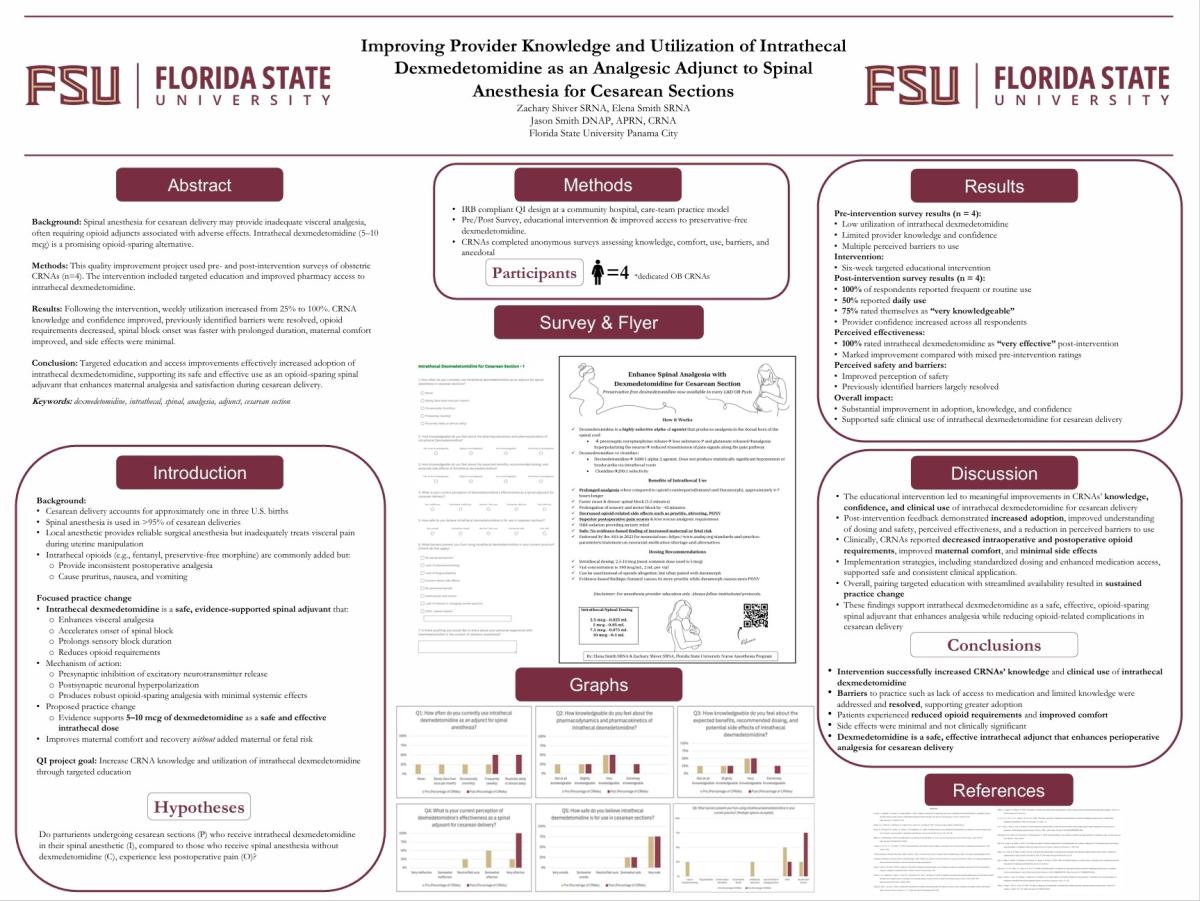
Improving Provider Knowledge and Utilization of Intrathecal Dexmedetomidine as an Analgesic Adjunct to Spinal Anesthesia for Cesarean Sections | Cesarean delivery commonly relies on spinal anesthesia, which may provide incomplete visceral analgesia and often requires opioid adjuncts associated with adverse effects. Intrathecal dexmedetomidine is a promising non-opioid alternative. This quality improvement project evaluated whether targeted education and improved access increased CRNA knowledge, confidence, and utilization. Following the intervention, weekly use increased from 25% to 100%, provider knowledge improved, opioid requirements decreased, spinal block onset was faster and duration prolonged, maternal comfort improved, and side effects were minimal. These findings support intrathecal dexmedetomidine as a safe, effective opioid-sparing spinal adjuvant. Keywords: dexmedetomidine, intrathecal, spinal, analgesia, adjunct, cesarean section |
Dr. Jason Smith | Florida State University Panama City | Nurse Anesthesia Program | jcsmith3@pc.fsu.edu | Dr. Gerard Hogan | dexmedetomidine, intrathecal, analgesia, adjunct, cesarean section | Complete |
|
No | 2026 | 5th annual Undergraduate Research Symposium, April 17, 2025 | https://pc.fsu.edu/student-research/symposium/research-symposium-program-portal?element_parents=elements/student_photo&ajax_form=1&_wrapper_format=drupal_ajax&token=DAaINWBEgLreGh9ilGEOzzLR2PgotuUM2r_kJxg27uU | ||||
| 145 | 8993 | Face to Face Poster session | 11:15 High School presentations | Student Research Symposium Program Portal: Submission #145 | 4ac1a484-cbcf-43ba-b3e3-79942ee20bbd | No | Star/flag Student Research Symposium Program Portal: Submission #145 | Lock Student Research Symposium Program Portal: Submission #145 | Add notes to Student Research Symposium Program Portal: Submission #145 | Tue, 01/13/2026 - 11:41 AM | Tue, 01/13/2026 - 11:48 AM | Fri, 04/03/2026 - 12:43 PM | Anonymous | 150.176.68.200 | Hannah | Bean | Her/She | hannahbean273@gmail.com |
|
Psychology | Hi I'm Hannah, I am a junior at Arnold High School. My research explores the relationship between age of first social media exposure and anxiety levels in high school students. I find this topic interesting because I think it is fascinating how different families have different rules regarding cell phones, social media, etc. | The Relationship Between Age of First Social media Exposure and Anxiety Levels in High School Students | Social media use is common among adolescents, but early exposure may affect mental health. This study examines the relationship between the age of first social media use and anxiety levels in high school students. Using anonymous surveys, students will report the age they began using social media and complete the Generalized Anxiety Disorder-7 (GAD-7) to measure anxiety. The study analyzes whether earlier exposure is associated with higher anxiety levels. Findings may help parents, educators, and schools promote healthier social media habits its and support student mental well-being. | Doedy Deal | Arnold High School | AP Research | dealdm@bay.k12.fl.us | Social Media, Anxiety, High School Students | Exploratory (the research question has been identified and design of approach is outlined) | AHS_Template.pptx-2.pdf276.96 KB
|
No | 2026 | 5th annual Undergraduate Research Symposium, April 17, 2025 | https://pc.fsu.edu/student-research/symposium/research-symposium-program-portal?element_parents=elements/student_photo&ajax_form=1&_wrapper_format=drupal_ajax&token=5xcjR60_bL4arnJMmQj9qwqntTecksd8K6Mba-m4b1Y | ||||
| 144 | 8992 | Synchronous Online Presentation | https://pc.fsu.edu/2026-synchronous-online-research-presentations | Student Research Symposium Program Portal: Submission #144 | 9f522cda-ec9d-46d4-9616-b835590941fa | No | Star/flag Student Research Symposium Program Portal: Submission #144 | Lock Student Research Symposium Program Portal: Submission #144 | Add notes to Student Research Symposium Program Portal: Submission #144 | Mon, 01/12/2026 - 03:25 PM | Mon, 01/12/2026 - 03:36 PM | Fri, 04/10/2026 - 03:53 PM | Anonymous | 2600:1700:4400:1cc0:2ca3:2bfa:471f:892 | Lindsey | Thorpe, Kaitlin Gallagher, Hannah Pimentel, and Andrew Trainor | lf12e@fsu.edu |
|
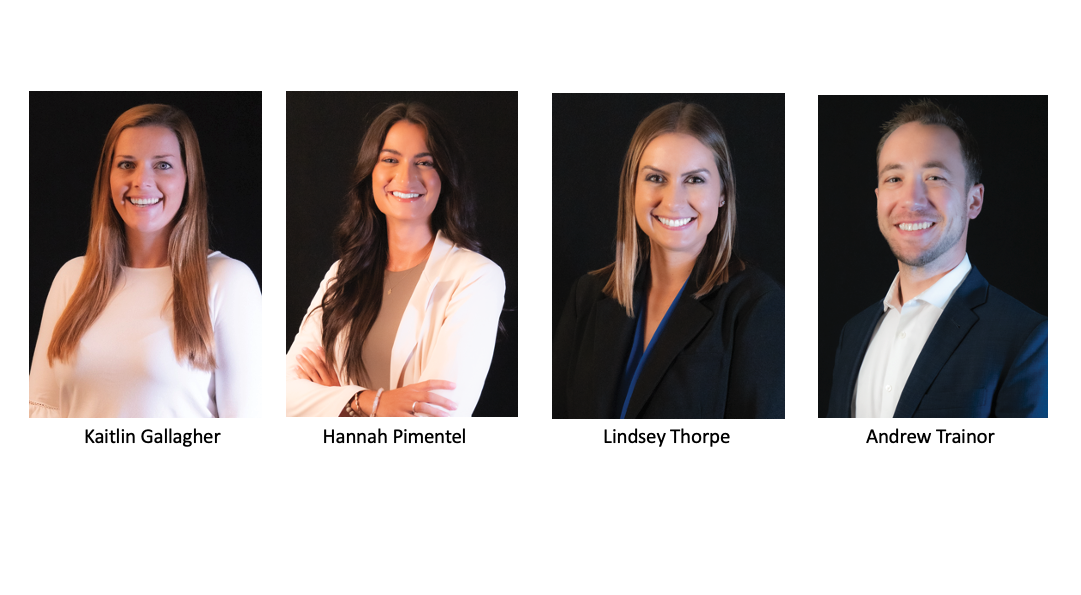
Doctor of Nurse Anesthesia Practice | Kaitlin Gallagher is from Vero Beach, Florida. An outdoor enthusiast with four years of neuro ICU critical care experience, she is drawn to a wide range of anesthesia specialties—from obstetrics to neuro and thoracic anesthesia—and is completing her third degree at Florida State University. Hannah Pimentel, from Normandy, Tennessee, is a registered nurse with seven years of experience. She has a strong interest in geriatric care and vulnerable populations and aspires to participate in a medical mission trip to deliver healthcare to underserved communities. Lindsey Thorpe is from Palm Harbor, Florida. She has ten years of nursing experience, including three years as a travel nurse, and has a strong interest in cardiothoracic anesthesia. Andrew Trainor is originally from Kansas City. He has enjoyed the opportunity to travel across the country to engage with new colleagues and patients while learning to be a nurse anesthetist along the way. |
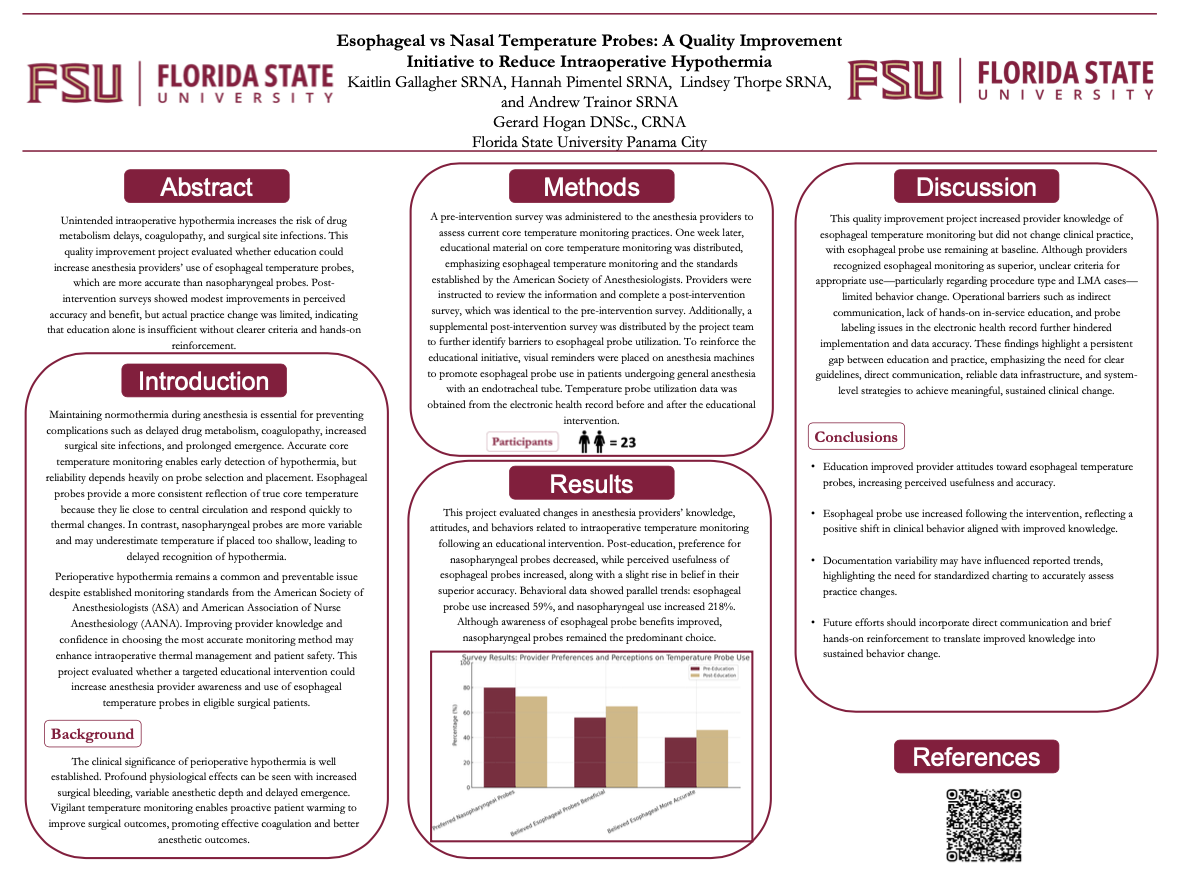
Esophageal vs Nasal Temperature Probes: A Quality Improvement Initiative to Reduce Intraoperative Hypothermia | Unintended intraoperative hypothermia is a frequent anesthesia-related complication associated with delayed drug metabolism, coagulopathy, and increased surgical site infections. Accurate core temperature monitoring is essential for prevention, yet probe selection significantly influences measurement reliability. Evidence supports esophageal temperature probes as a more accurate reflection of core body temperature compared to nasopharyngeal probes, offering earlier detection of hypothermia and improved thermal management. This quality improvement project aimed to evaluate whether an educational intervention promoting the use of esophageal temperature probes among anesthesia providers would reduce the incidence of intraoperative hypothermia in adult surgical patients receiving general anesthesia. Conducted at a large community hospital in northeast Florida, the initiative included a pre- and post-intervention survey, an educational handout summarizing American Society of Anesthesiologists temperature monitoring standards, laminated operating room reminders, and email communications. Retrospective data were analyzed using the Epic SlicerDicer tool to compare probe utilization and hypothermia incidence (defined as <35.5 °C) before and after the intervention. Following education, anesthesia provider awareness of esophageal probe accuracy increased from 40% to 45%, and perceived benefit rose from 56% to 65%. Esophageal probe use increased by 59% from 17 to 27 cases, while nasopharyngeal probe use increased by 218% from 27 to 86 cases. Although knowledge improved, practice patterns remained largely unchanged due to unclear probe selection criteria, limited in-person training, and documentation inconsistencies. These findings suggest that education alone may not sustain behavioral change; future initiatives should incorporate live training, clear criteria, and ongoing feedback. | Gerard Hogan DNSc., CRNA | College of Applied Studies | Nurse Anesthesia Practice | ghogan@pc.fsu.edu | intraoperative hypothermia, esophageal temperature probe, nasopharyngeal temperature probe | Complete |
|
No | 2026 | 5th annual Undergraduate Research Symposium, April 17, 2025 | https://pc.fsu.edu/student-research/symposium/research-symposium-program-portal?element_parents=elements/student_photo&ajax_form=1&_wrapper_format=drupal_ajax&token=KWuqPDGldqa6_e8xuE_jLWLvS2koh26wlyzrUyXZqGU |