
Student Research Symposium Program Portal: Submission #247
Submission information
Submission Number: 247
Submission ID: 9095
Submission UUID: 1888cf93-1b7b-4187-bf32-f4dc0c3c0b7c
Submission URI: /student-research/symposium/research-symposium-program-portal
Created: Mon, 02/02/2026 - 12:02 PM
Completed: Mon, 02/02/2026 - 12:16 PM
Changed: Fri, 04/03/2026 - 03:13 PM
Remote IP address: 146.201.10.6
Submitted by: Anonymous
Language: English
Is draft: No
Submitted to: Student Research Symposium Program Portal
| Primary Student Contact First Name | Skylar |
|---|---|
| Primary Student Contact Last Name | Markee |
| Pronouns | |
| Primary Student Contact FSU Student Email | sm24dl@fsu.edu |
| Photo of all individuals presenting this work |

|
| Major(s) of all individuals presenting this work | Civil Engineering |
| Bio of all individuals presenting this work | Hi, I'm Skylar Markee, and my research is on microplastics and how they are affecting the ocean and how they are affecting us and our health. Once I have completed my engineering degree, I hope to pursue a job at the national or state parks to help preserve more of our natural lands and create a way for us to safely explore our wonders without causing any environmental harm. |
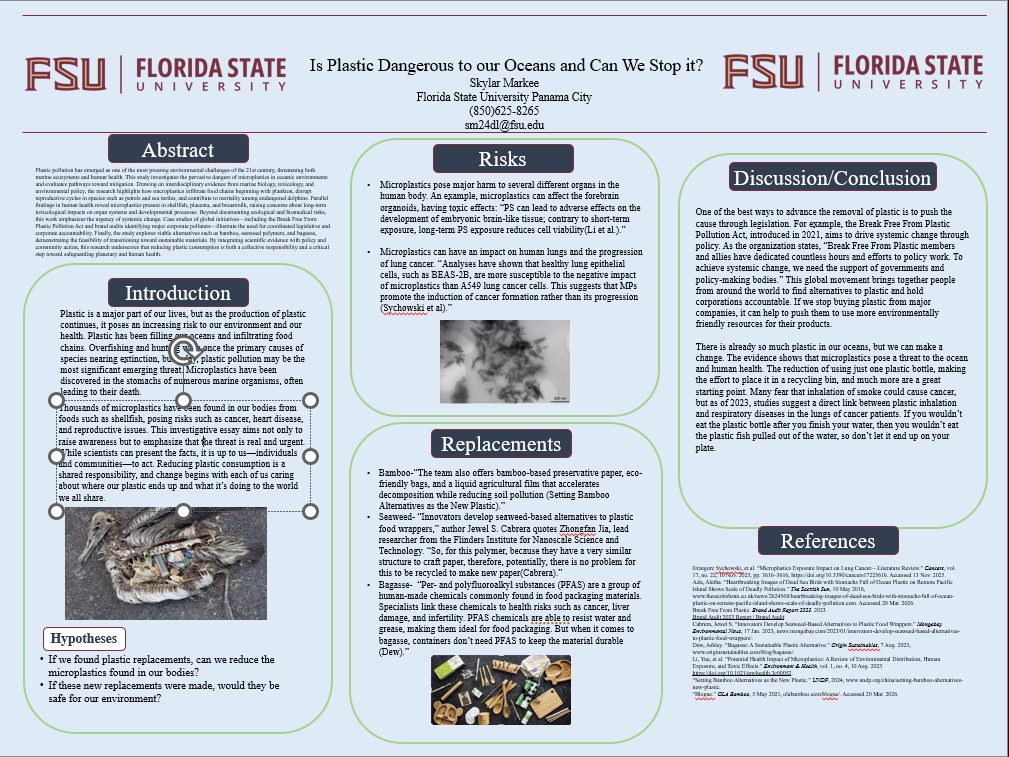
| Poster Title | Investigative Field Essay: Is Plastic Dangerous to our Oceans and Can We Stop it? |
| Abstract | Plastic pollution has emerged as one of the most pressing environmental challenges of the 21st century, threatening both marine ecosystems and human health. This study investigates the pervasive dangers of microplastics in oceanic environments and evaluates pathways toward mitigation. Drawing on interdisciplinary evidence from marine biology, toxicology, and environmental policy, the research highlights how microplastics infiltrate food chains beginning with plankton, disrupt reproductive cycles in species such as petrels and sea turtles, and contribute to mortality among endangered dolphins. Parallel findings in human health reveal microplastics present in shellfish, placentas, and breastmilk, raising concerns about long-term toxicological impacts on organ systems and developmental processes. Beyond documenting ecological and biomedical risks, this work emphasizes the urgency of systemic change. Case studies of global initiatives—including the Break Free From Plastic Pollution Act and brand audits identifying major corporate polluters—illustrate the need for coordinated legislative and corporate accountability. Finally, the study explores viable alternatives such as bamboo, seaweed polymers, and bagasse, demonstrating the feasibility of transitioning toward sustainable materials. By integrating scientific evidence with policy and community action, this research underscores that reducing plastic consumption is both a collective responsibility and a critical step toward safeguarding planetary and human health. |
| Research Mentor Name | Dr. Milinda Jay Stephenson |
| Research Mentor's College (or High School) | FSU PC |
| Research Mentor's Department (or Subject) | English |
| Research Mentor's Email | mjay@fsu.edu |
| Additional Research Mentor(s) | |
| Co-presenter(s) | |
| Keywords | Microplastic Pollution |
| Poster Session/Number | 10:00 Graduate and Undergraduate presentations |
| Work | Complete |
| Presentation Modality | Face to Face Poster session |
| Poster PDF or Powerpoint | Research Symposium Poster.pdf530.88 KB
|
| Poster Thumbnail |
|
| I will be printing my poster | No |
| Year | 2026 |
| Annual description | 5th annual Undergraduate Research Symposium, April 17, 2025 |
| Update URL | https://pc.fsu.edu/student-research/symposium/research-symposium-program-portal?element_parents=elements/student_photo&ajax_form=1&_wrapper_format=drupal_ajax&token=gUj00OWWzivKYjL4epTpdrpe8PzL-eaHSbYoanzF-No |