
Student Research Symposium Program Portal: Submission #219
Submission information
Submission Number: 219
Submission ID: 9067
Submission UUID: a83fd92c-3de2-407d-8e53-809bc0a45460
Submission URI: /student-research/symposium/research-symposium-program-portal
Created: Fri, 01/30/2026 - 01:38 PM
Completed: Fri, 01/30/2026 - 02:17 PM
Changed: Sun, 04/12/2026 - 03:44 PM
Remote IP address: 96.27.201.147
Submitted by: Anonymous
Language: English
Is draft: No
Submitted to: Student Research Symposium Program Portal
Noah
Owens
{Empty}

Mechanical Engineering
Noah is a senior mechanical engineering student from Panama City, Florida. His primary educational and research interests include materials engineering and mechanics. By integrating these fields, he hopes to push the design and development of innovative technologies to the next level. More specifically, Noah hopes to be at the forefront of the development of additive manufacturing for a variety of military applications. Having lived minutes from the Gulf his whole life, Noah wants to implement technologies that will keep people safe, whether they are in or on the sea.
Izod Impact Testing of 3D-Printed Polymers
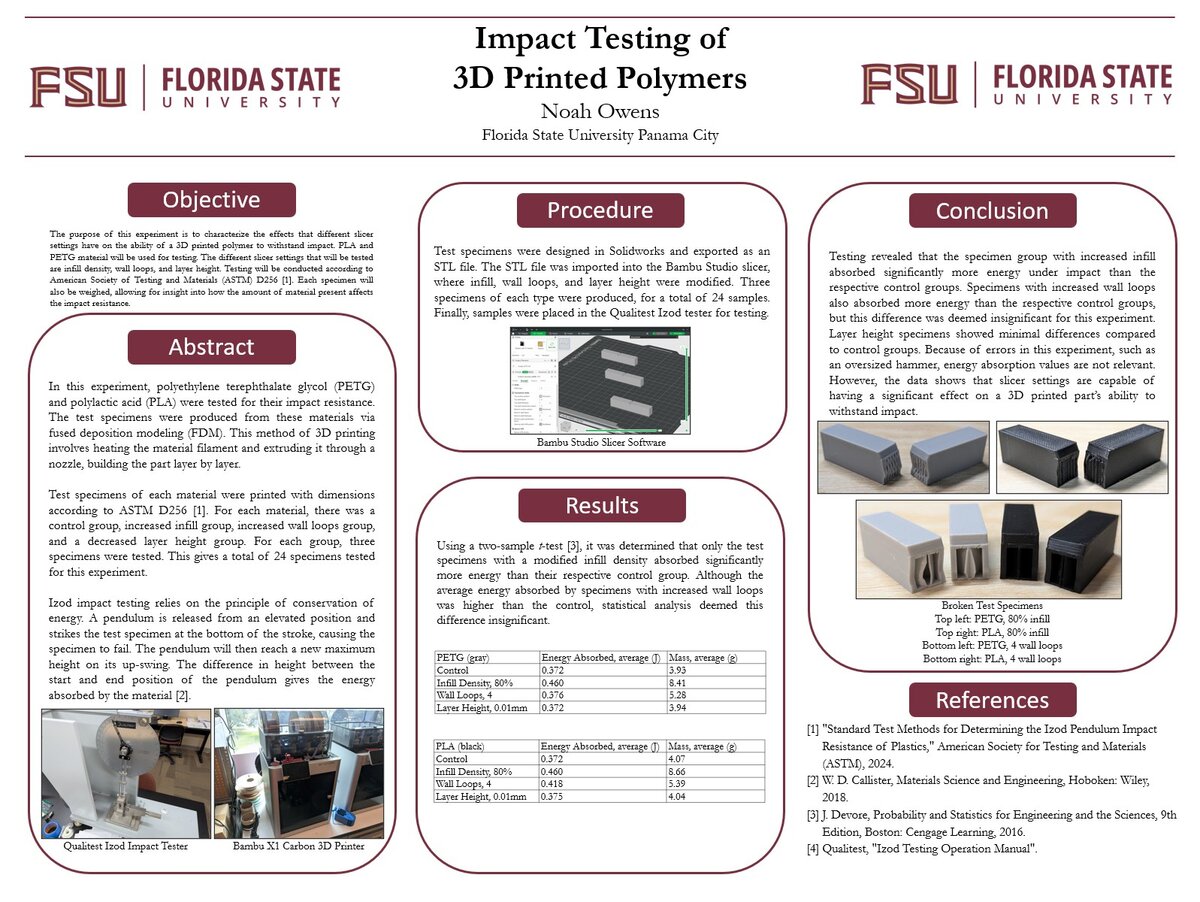
In this experiment, polyethylene terephthalate glycol (PETG) and polylactic acid (PLA) were tested for their impact resistance. The test specimens were produced from these materials via fused deposition modeling (FDM). This method of 3D printing involves heating the material filament and extruding it through a nozzle, building the part layer by layer.
Test specimens of each material were printed with dimensions according to ASTM D256 [1]. For each material, there was a control group, increased infill group, increased wall loops group, and a decreased layer height group. For each group, three specimens were tested. This gives a total of 24 specimens tested for this experiment. Testing of each specimen occurred using a pendulum Izod tester. The purpose of this experiment was to characterize the effects that 3D printer slicer settings have on a PETG and PLA additive manufacturing (AM) parts’ ability to absorb energy in an impact.
Testing revealed that the specimen group with increased infill absorbed significantly more energy under impact than the respective control groups. Specimens with increased wall loops also absorbed more energy than the respective control groups, but this difference was deemed insignificant for this experiment. Layer height specimens showed minimal differences compared to control groups. Because of errors in this experiment, such as an oversized hammer, energy absorption values are not relevant. However, the data shows that slicer settings are capable of having a significant effect on a 3D printed part’s ability to withstand impact.
Test specimens of each material were printed with dimensions according to ASTM D256 [1]. For each material, there was a control group, increased infill group, increased wall loops group, and a decreased layer height group. For each group, three specimens were tested. This gives a total of 24 specimens tested for this experiment. Testing of each specimen occurred using a pendulum Izod tester. The purpose of this experiment was to characterize the effects that 3D printer slicer settings have on a PETG and PLA additive manufacturing (AM) parts’ ability to absorb energy in an impact.
Testing revealed that the specimen group with increased infill absorbed significantly more energy under impact than the respective control groups. Specimens with increased wall loops also absorbed more energy than the respective control groups, but this difference was deemed insignificant for this experiment. Layer height specimens showed minimal differences compared to control groups. Because of errors in this experiment, such as an oversized hammer, energy absorption values are not relevant. However, the data shows that slicer settings are capable of having a significant effect on a 3D printed part’s ability to withstand impact.
Dr. Yvonne Traynham
Florida State University
Mechanical Engineering
ytraynham@eng.famu.fsu.edu
{Empty}
{Empty}
3D Printing, Impact Testing, Polymers
10:00 Graduate and Undergraduate presentations
Complete
Face to Face Poster session
No
2026
5th annual Undergraduate Research Symposium, April 17, 2025
https://pc.fsu.edu/student-research/symposium/research-symposium-program-portal?element_parents=elements/student_photo&ajax_form=1&_wrapper_format=drupal_ajax&token=xygE-yvQ4SiR9YlcA7ld-gqne0mZppqkohYoto6DXck
{Empty}