
Student Research Symposium Program Portal: Submission #188
Submission information
Submission Number: 188
Submission ID: 9036
Submission UUID: 76beca47-d440-48e7-9806-808ea24afe74
Submission URI: /student-research/symposium/research-symposium-program-portal
Created: Wed, 01/28/2026 - 06:28 PM
Completed: Wed, 01/28/2026 - 06:28 PM
Changed: Fri, 04/03/2026 - 01:42 PM
Remote IP address: 146.201.10.18
Submitted by: Anonymous
Language: English
Is draft: No
Submitted to: Student Research Symposium Program Portal
| Primary Student Contact First Name | Lydia |
|---|---|
| Primary Student Contact Last Name | Wilkinson |
| Pronouns | she/her |
| Primary Student Contact FSU Student Email | lkw21b@fsu.edu |
| Photo of all individuals presenting this work |

|
| Major(s) of all individuals presenting this work | Applied Behavior Analysis |
| Bio of all individuals presenting this work | Lydia Wilkinson is a second year graduate student at Florida State University and a clinician with the Early Childhood Autism Program. Her academic and clinical interests focus on communication behaviors, early language development, and prevention-oriented interventions for children with autism. Her current research examines the use of functional analysis methodology to inform spontaneous mand training. |
| Poster Title | A Functional Analysis of Communication Behaviors |
| Abstract | The purpose of the present study is to replicate and extend functional analysis procedures described by Plavnick and Ferreri (2013) to examine multiple topographies of communication and the motivating operations under which they occur in young children with autism spectrum disorder. One child aged 2–6 years with a limited vocal repertoire and established nonverbal communication will participate. A paired-stimulus preference assessment will identify preferred stimuli for experimental conditions. Using a multielement design, communication responses will be assessed across play (control), attention, tangible, and demand conditions to identify differential responding associated with specific environmental contingencies. Dependent variables will include the frequency or latency of gestural communication topographies identified through indirect assessment and pilot probes. A secondary purpose is to evaluate the correspondence between indirect assessment outcomes and directly observed communication behaviors. Results indicated that two of the three target behaviors occurred most frequently during the tangible condition; the third behavior (vocalizations) occurred across all conditions. These results indicate that the participant's nonvocal communication behavior is maintained by access to tangibles. This study contributes to prevention-oriented assessment practices in applied behavior analysis and early communication intervention. |
| Research Mentor Name | Leah Koehler |
| Research Mentor's College (or High School) | Florida State University |
| Research Mentor's Department (or Subject) | Psychology |
| Research Mentor's Email | koehler@pc.fsu.edu |
| Additional Research Mentor(s) | Brent Melvin P.E., David Melvin P.E., Brian Lemieux P.E., Grant Harris P.E., Scott Golden P.E., Leanna Bell E.I., Quaid VanHuss P.E., Russel Large P.E. |
| Co-presenter(s) | |
| Keywords | Autism Spectrum Disorder, Communication, Manding, Functional Analysis |
| Poster Session/Number | 10:00 Graduate and Undergraduate presentations |
| Work | Complete |
| Presentation Modality | Face to Face Poster session |
| Poster PDF or Powerpoint | Symposium Poster Draft LW .pptx1011.01 KB
|
| Poster Thumbnail |
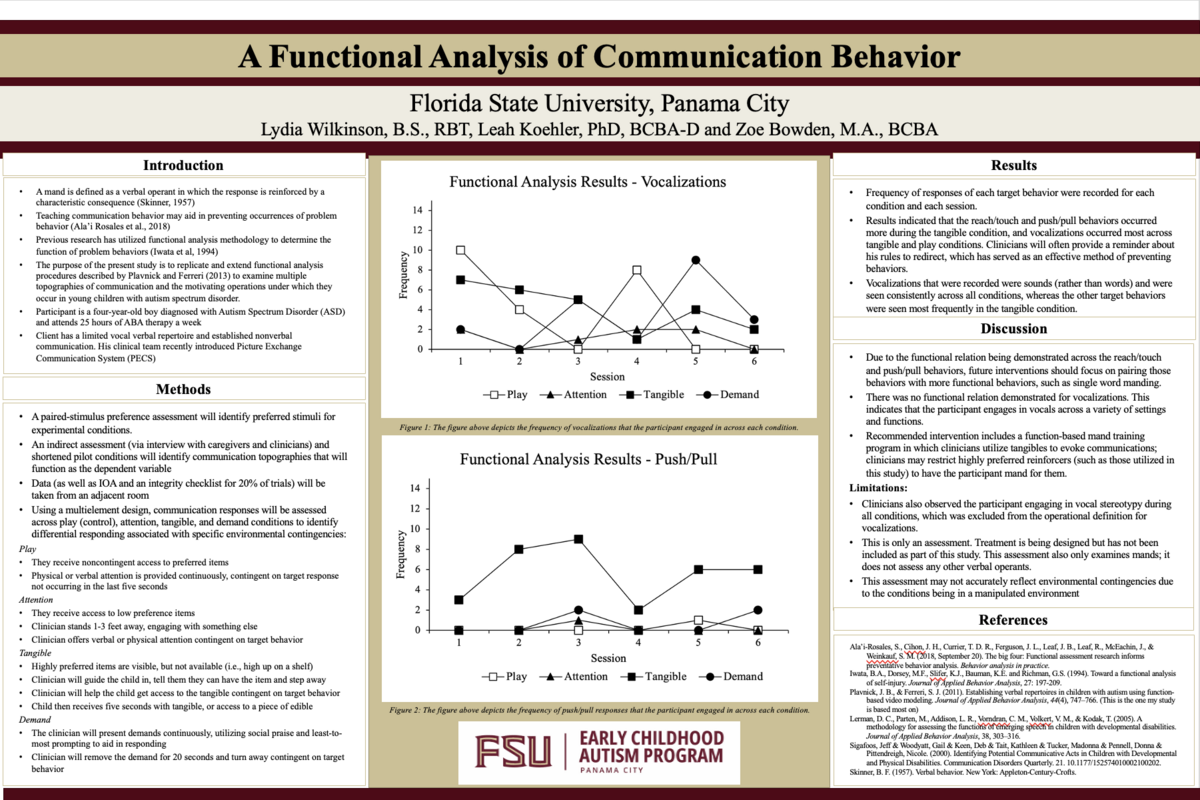
|
| I will be printing my poster | No |
| Year | 2026 |
| Annual description | 5th annual Undergraduate Research Symposium, April 17, 2025 |
| Update URL | https://pc.fsu.edu/student-research/symposium/research-symposium-program-portal?element_parents=elements/student_photo&ajax_form=1&_wrapper_format=drupal_ajax&token=w3nVstPOSoGPv5vh7xcGGqVA-7j7L3659AdLRnDXLpw |