

Student Research Symposium Program Portal: Submission #147
Submission information
Submission Number: 147
Submission ID: 8995
Submission UUID: 07b02ff9-0960-4473-9b45-ddfb0e01ad16
Submission URI: /student-research/symposium/research-symposium-program-portal
Submission Update: /student-research/symposium/research-symposium-program-portal?token=kPmBz7Pn3Xxp4X9xE7dMyDXwf8i-omobxzA2DoK-PS8
Created: Tue, 01/13/2026 - 07:30 PM
Completed: Tue, 01/13/2026 - 07:38 PM
Changed: Tue, 01/13/2026 - 07:38 PM
Remote IP address: 2600:1700:e771:b0f0:8014:326b:7896:444c
Submitted by: Anonymous
Language: English
Is draft: No
Webform: Research Symposium Program Portal WF
Submitted to: Student Research Symposium Program Portal
Angela
Petche
{Empty}

Doctor of Nurse Anesthesia Practice
Doctor of Nurse Anesthesia (DNAP) students with diverse nursing backgrounds and substantial experience in high-acuity critical care settings. United by a commitment to excellence in anesthesia practice, our academic and clinical interests focus on improving patient outcomes, advancing nurse anesthesia education, and contributing meaningfully to the profession.
Reducing Spinal-Induced Hypotension in Cesarean Sections with Ondansetron
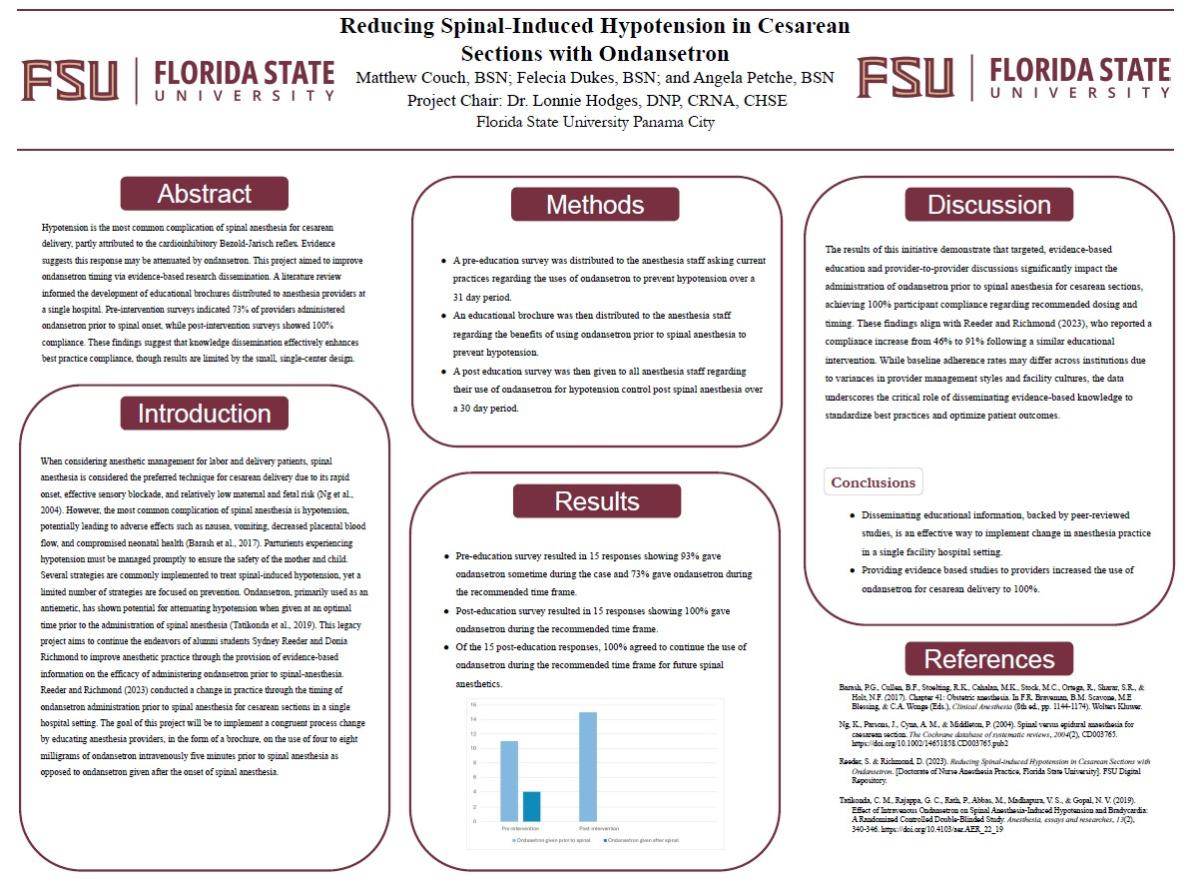
The use of spinal anesthesia for cesarean delivery is widespread due to its simplicity and reliability. Though generally considered a safe technique, hypotension is the most common complication that anesthesia providers face when administering spinal anesthetics to parturients. In this population, hypotension is partly attributed to a cardioinhibitory response called the Bezhold-Jarish reflex which, evidence suggests, may be attenuated by non-vasoactive medications such as ondansetron. This project aims to build upon the foundational work of past initiatives and disseminate evidence-based research to improve the timing and administration of ondansetron prior to cesarean delivery to promote both maternal and fetal safety. Through the PICO framework: Do parturients receiving a spinal for cesarean delivery (P) that receive ondansetron before block onset (I) compared to after block onset (C) have reduced incidence of hypotension (O)? a literature search and review informed the development of educational brochures which were distributed to anesthesia providers at a single hospital setting. Prior to the introduction of the brochure, pre-intervention surveys indicated that 73% of anesthesia providers administered ondansetron prior to onset of spinal anesthesia. After educational materials were distributed, post-intervention surveys showed that 100% of providers administered ondansetron prior to spinal administration. The findings suggest that dissemination of knowledge may be an effective strategy in the enhancement of anesthesia care and may contribute to compliance with best practices. These results are, however, limited by the single-center design and small sample size.
Lonnie W. Hodges, DNP, CRNA, CHSE
Florida State University
Nurse Anesthesia
lwhodges@pc.fsu.edu
{Empty}
{Empty}
ondansetron, spinal anesthesia, cesarean section, hypotension, Zofran, parturient, obstetric anesthesia
{Empty}
Complete
Synchronous Online Presentation
Poster .pptx_.pdf252.81 KB
No
2026
5th annual Undergraduate Research Symposium, April 17, 2025
https://pc.fsu.edu/student-research/symposium/research-symposium-program-portal?element_parents=elements/student_photo&ajax_form=1&_wrapper_format=drupal_ajax&token=kPmBz7Pn3Xxp4X9xE7dMyDXwf8i-omobxzA2DoK-PS8
{Empty}