
Research Symposium Program - Individual Details
Yelyzaveta Kovalenko She/Her 11:15 High School presentations

BIO
My name is Yelyzaveta Kovalenko, I am a junior at J.R. Arnold High School, and I am enrolled in the AP Research course. I was born and raised in Ukraine until I moved to the United States at the age of 10. One of the biggest differences I noticed after moving was the difference in what types of cartoons my peers and I grew up watching. I saw how differently the cartoons shaped my identity and how the cartoons that my peers grew up watching have shaped their personalities and identities. I found it very interesting to learn more about how diverse cartoons shape children's identity and development.
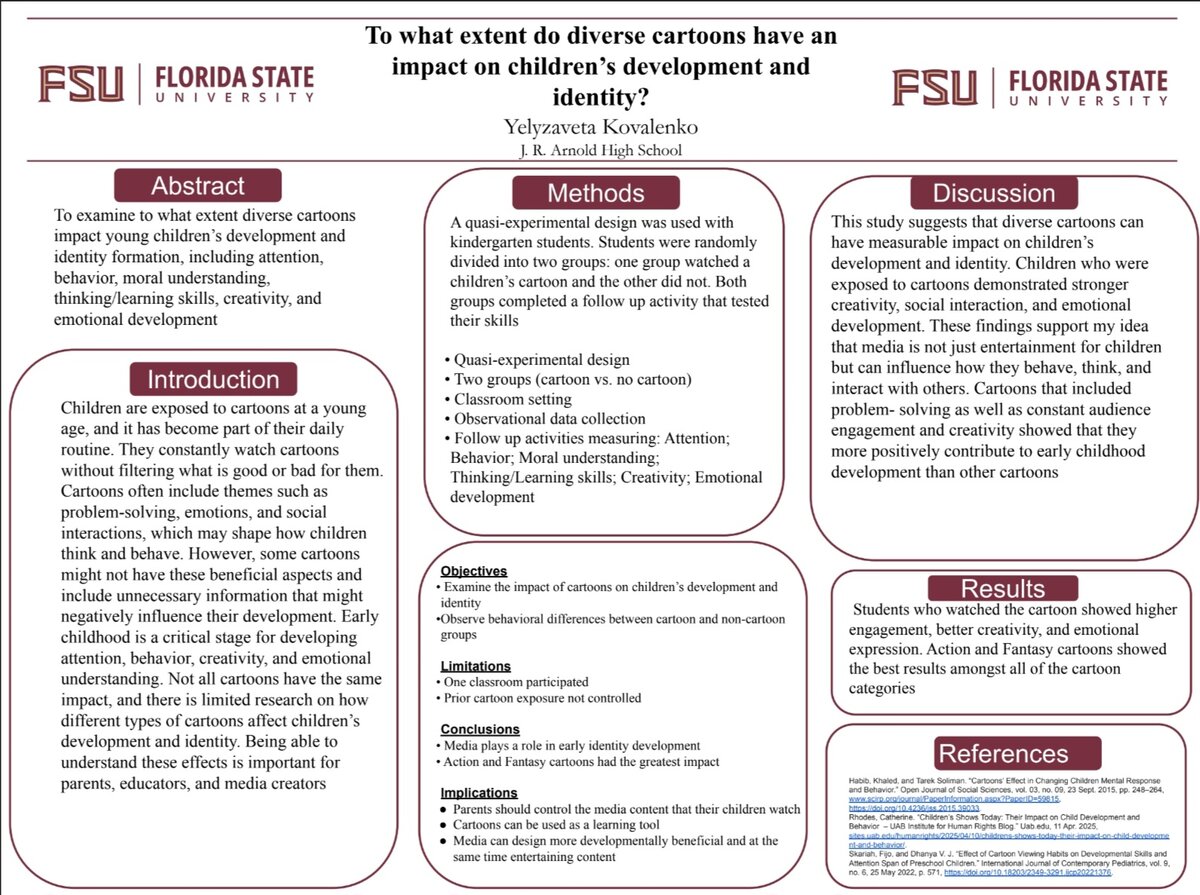
To what extent do diverse cartoons have an impact on children's development and identity?
Authors: Yelyzaveta Kovalenko, Doedy DealStudent Major: AP Research
Mentor: Doedy Deal
Mentor's Department: AP Research Mentor's College: J.R. Arnold High School Co-Presenters:
Abstract
This study examines how cartoons impact children's development and identity formation. I wanted to focus specifically on diverse cartoons, meaning researching the effect of different genre categories and not grouping all cartoons into a single category. The categories are educational, moral/value- based, action, comedy, fantasy, emotional/social learning, problem-solving, and friendship cartoons. My research focuses on finding out the relationship between the cartoons and how they affect children's aspects in development, such as attention, behavior, moral understanding, thinking/learning skills, creativity, and emotional development. In order to find out the effects of the cartoons, I did an experiment in a kindergarten class, where I observed the difference in children's behavior and actions between the ones that watched a cartoon and the ones that did not. I used the quasi-experimental research design with an observational method in order to examine how diverse cartoons affect children's development and identity at a young age. My main findings from this experiment are that children tend to show better results after watching comedy, action, and fantasy cartoons, as they are more engaged in the process and communicate more and give more and better answers. Cartoons such as problem-solving, educational, value-based, and emotional cartoons did not impact the tested aspects as much as the other cartoons did.
Keywords: Cartoons, Diverse Cartoons, Identity Formation, Development