
Research Symposium Program - Individual Details
Rachel Raffield 10:00 Graduate and Undergraduate presentations
BIO
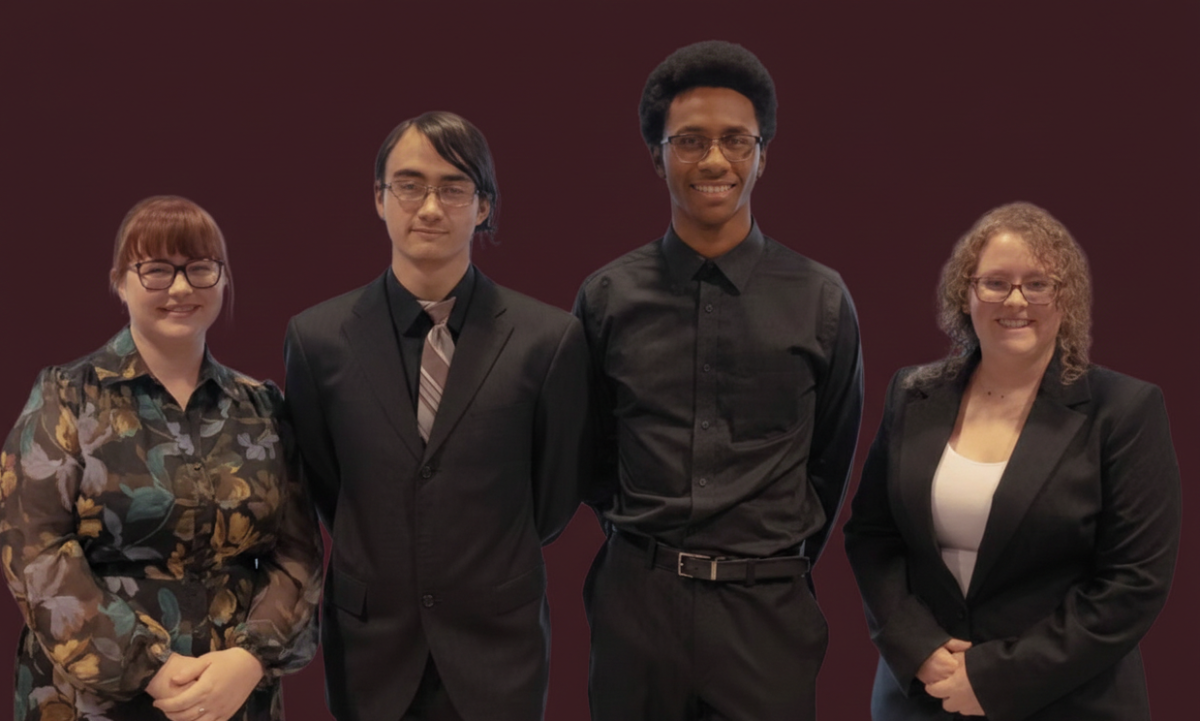
Shelby Godbee
Beginning my academic career as a computer science major, I found that my skills and interests were more aligned with that of electrical engineering. I loved learning about power systems, robotics, and microelectronic systems, and I am looking to pursue a career that involves these areas. I graduate in Fall of 2026.
Dominic Weiland
I transferred from Chipola College in Mariana and came to Panama City FSU. My interests are in computers and working around and with them, both with software and hardware.
Titus Campbell
I am from Panama City Florida, I am interested in a career in software engineering, and I graduate this Spring.
Rachel Raffield
After earning my AA in Music at Gulf Coast State College, I realized that I'd rather perform music as a hobby rather than as a career. I then made the decision to pursue electrical engineering at FSU-PC. The field immediately captured my interest; the endless amount of knowledge to pursue is both fascinating and motivating to me. I am interested in a career in defense, particularly one with a focus on communication systems, radar, and/or electronic warfare and protection. I graduate in Fall 2026.
Electronic Nose
Authors: Rachel Raffield, Dr. Saeed RajputStudent Major: Shelby Godbee - Electrical Engineering; Dominic Weiland - Computer Engineering; Titus Campbell - Computer Engineering; Rachel Raffield - Electrical Engineering
Mentor: Dr. Saeed Rajput
Mentor's Department: Electrical Engineering Mentor's College: FSU-PC Co-Presenters:
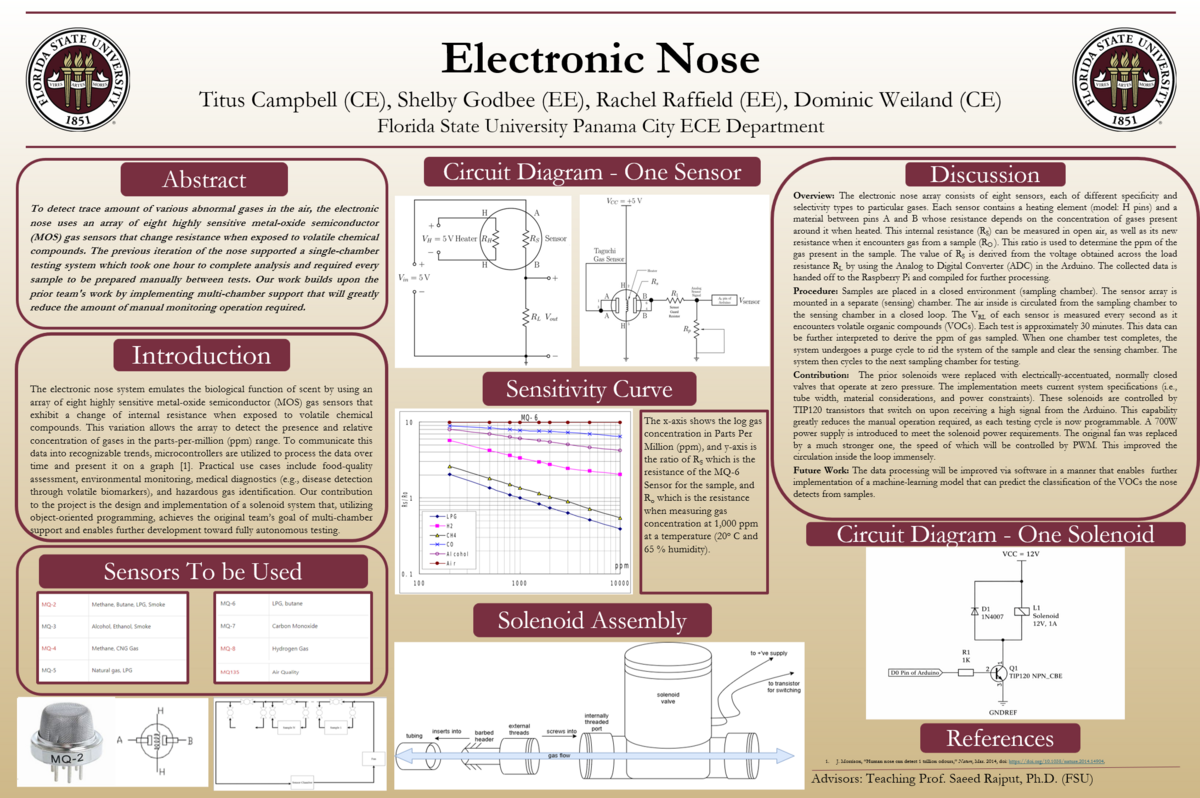
Abstract
To detect trace amount of various abnormal gases in the air, the electronic nose uses an array of eight highly sensitive metal-oxide semiconductor (MOS) gas sensors that change resistance when exposed to volatile chemical compounds. The previous iteration of the nose supported a single-chamber testing system which took one hour to complete analysis and required every sample to be prepared manually between tests. Our work builds upon the prior team's work by implementing multi-chamber support that will greatly reduce the amount of manual monitoring operation required.
Keywords: electronic, nose, gas, detection, sensors