
Research Symposium Program - Individual Details
Deina Escribano 10:00 Graduate and Undergraduate presentations

BIO
Deina Escribano is a graduate student in the M.S. program in Applied Behavior Analysis at Florida State University's Panama City campus, where she will graduate in May 2026. She earned her Bachelor of Arts degree as well as minors in Criminal Justice as well as Religious Studies from the University of Washington in 2024. Currently, she works with the Early Childhood Autism Program as a Registered Behavior Technician and training case manager. Her research and clinical interests focus on stimulus control, skill acquisition, and the development of functional life skills that promote independence and meaningful outcomes for individuals with developmental disabilities. Deina has presented multiple research posters at university and professional events, where she has received recognition for applied clinical research. She is committed to evidence-based practice and professional growth, particularly as it relates to the fields of behavior analysis and medicine . Following graduation, she plans to pursue her BCBA licensure while continuing to integrate high-quality clinical practice with applied research dissemination during her pursuit of an acceptance into medical school.
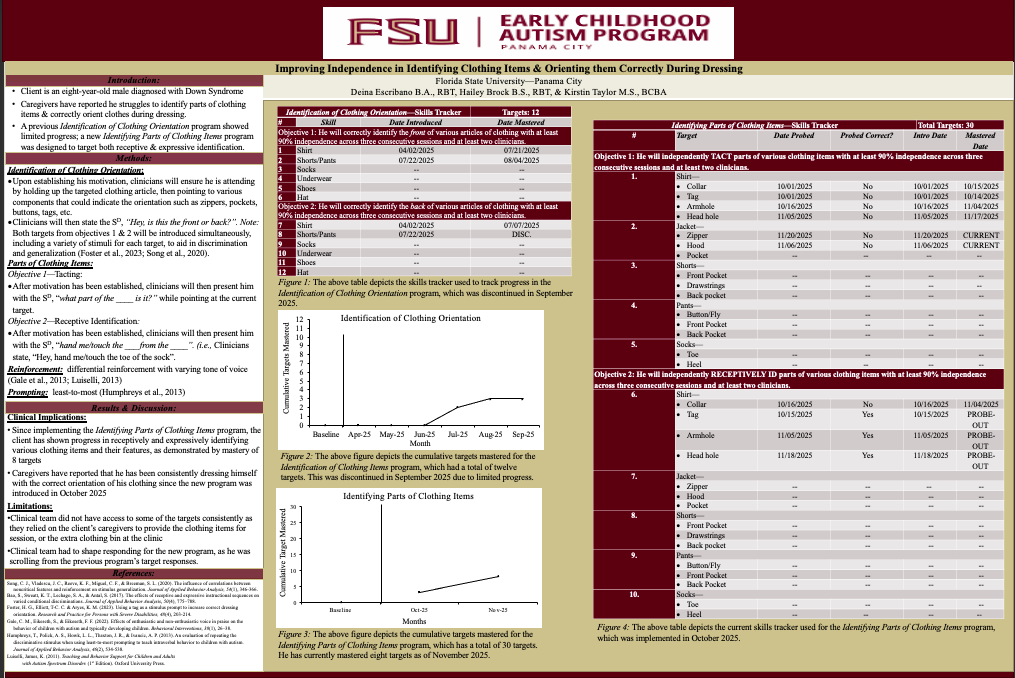
Improving Independence in Identifying Clothing Items & Orienting them Correctly During Dressing
Authors: Deina Escribano, Kirstin TaylorStudent Major: Psychology--Applied Behavior Analysis
Mentor: Kirstin Taylor
Mentor's Department: Psychology--Applied Behavior Analysis Mentor's College: Florida State University Co-Presenters:
Abstract
Dressing independence is a critical daily living skill that supports autonomy and quality of life for individuals with developmental disabilities. The present poster describes a clinical intervention designed to improve clothing orientation and identify various parts of clothing items for an 8-year-old male diagnosed with Down syndrome who demonstrated persistent difficulties with dressing independently. A previously implemented clothing orientation program yielded limited progress, prompting the development of a revised program targeting both receptive and expressive identification of clothing components (i.e., tags, pockets, zippers, sleeve, etc.) to strengthen stimulus control and promote generalization. Instruction was delivered within a naturalistic-contrived teaching framework and incorporated the use of least-to-most prompting as well as differential reinforcement strategies to aid in discrimination of correct versus incorrect responding. Multiple targets were introduced concurrently to support discrimination across varied stimuli too. Progress was tracked using a detailed skills tracker documenting target mastery across sessions. Following implementation of the revised program, the client demonstrated measurable improvements by mastering eight targets and showing consistent accuracy in orienting his clothing correctly during dressing routines. Caregiver reports have confirmed that these clinically observed gains have generalized to the home environment. Limitations included inconsistent access to specific clothing items and the need to shape responding due to prior learning history. Findings highlight the importance of precise target selection and clear stimulus control when teaching foundational life skills. This project demonstrates how integrating receptive and expressive identification within dressing can improve functional outcomes.
Keywords: Dressing Independence; Receptive/Expressive Identification; Skill Acquisition; Developmental Disabilities