
Research Symposium Program - Individual Details
Dalton Bradley, and David Ertle https://pc.fsu.edu/2026-synchronous-online-research-presentations

BIO
Dalton Bradley, from Jay, Florida, is a Doctor of Nurse Anesthesia Practice student with a background that includes one year in a medical / surgical nursing department and one and a half years in a medical intensive care unit. David Ertle, from Pensacola, Florida, is a Doctor of Nurse Anesthesia Practice student with a background that includes one year in the emergency department, one year in a Level I trauma intensive care unit, and one year in a cardiovascular intensive care unit. As they complete their training at Florida State University, they are interested in pursuing CRNA positions that emphasize clinical excellence, autonomy, and professional growth.
Reducing Postoperative Opioid Consumption in Patients Undergoing General Anesthesia for Abdominal Surgery with the Administration of 2g of Magnesium Sulfate IV
Authors: Dalton Bradley, and David Ertle , Scott Stewart, DNAP, CRNAStudent Major: Doctor of Nurse Anesthesia Practice
Mentor: Scott Stewart, DNAP, CRNA
Mentor's Department: Nurse Anesthesia Mentor's College: College of Applied Studies Co-Presenters:
Abstract
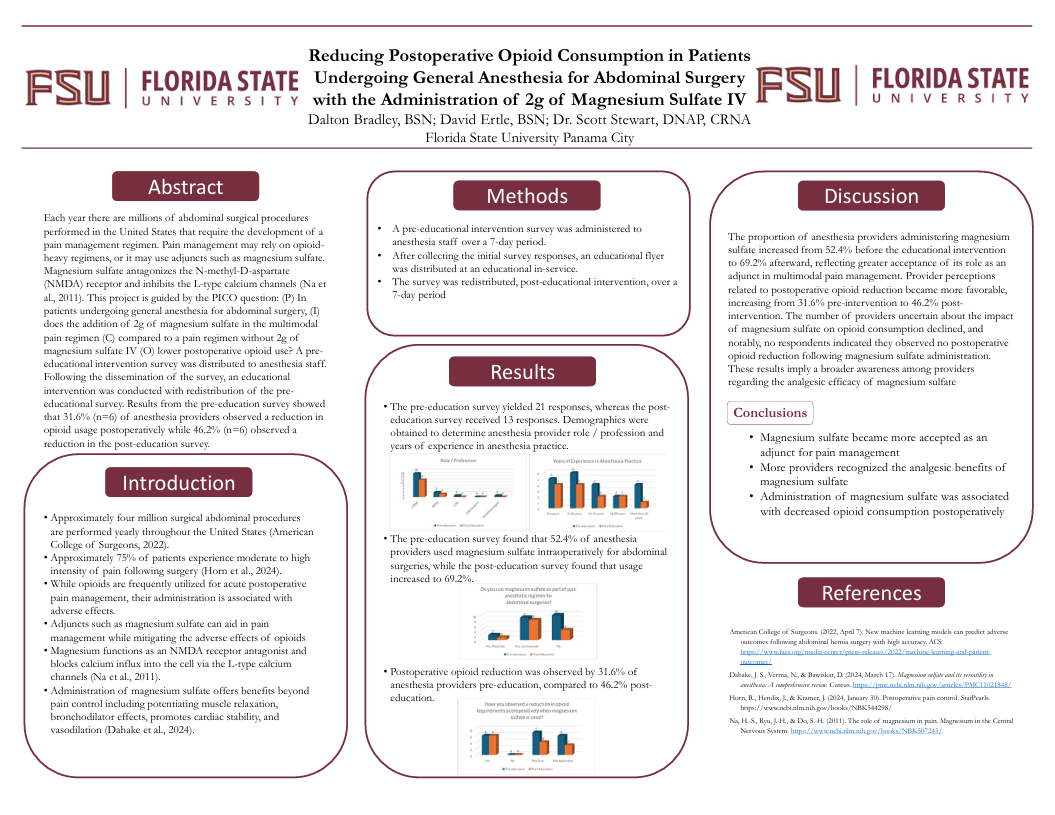
Each year there are millions of abdominal surgical procedures performed in the United States that require the development of a pain management regimen. Pain management may rely on opioid-heavy regimens, or it may use adjuncts such as magnesium sulfate. Magnesium sulfate antagonizes the N-methyl-D-aspartate (NMDA) receptor and inhibits the L-type calcium channels (Na et al., 2011). This project is guided by the PICO question: (P) In patients undergoing general anesthesia for abdominal surgery, (I) does the addition of 2g of magnesium sulfate in the multimodal pain regimen (C) compared to a pain regimen without 2g of magnesium sulfate IV (O) lower postoperative opioid use? A pre-educational intervention survey was distributed to anesthesia staff. Following the dissemination of the survey, an educational intervention was conducted with redistribution of the pre-educational survey. Results from the pre-education survey showed that 31.6% (n=6) of anesthesia providers observed a reduction in opioid usage postoperatively while 46.2% (n=6) observed a reduction in the post-education survey.
Keywords: Analgesia, Analgesic Adjuncts, Magnesium Sulfate