
Research Spotlight: “Contemporary Political Participation and its Countervailing Effects on Civic Culture”
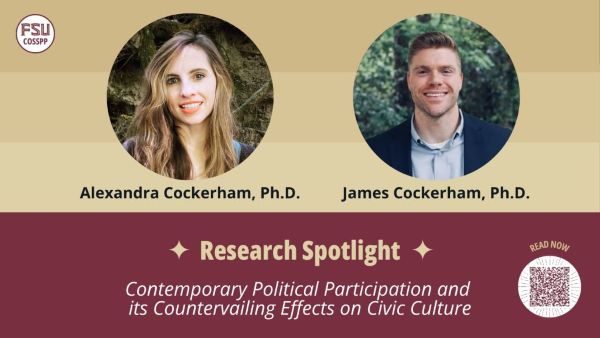
Alexandra Cockerham, Ph.D., Associate Teaching Professor of Interdisciplinary Social Science and Director of the Public Policy Certificate at Florida State University, co-edited the volume “Contemporary Political Participation and its Countervailing Effects on Civic CultureExternal Link” with James Cockerham, Ph.D., assistant teaching professor in the Public Safety and Security program at FSU Panama City. The following summary was written by Myá Wrisper (M.S. Strategic Communication ’26).
Florida State University Associate Teaching Professor of Interdisciplinary Social Science Alexandra Cockerham, Ph.D., and FSU Panama City faculty member James Cockerham, Ph.D., co-edited and co-authored “Contemporary Political Participation and its Countervailing Effects on Civic Culture,” which was recently published by Vernon Press in 2026.
The authors explore contemporary political participation and its impact on civic culture. In the book, they argue that citizen participation stands as a pillar of democracy, but the motivating factors for and effects of modern political participation are complex. Although technological advances of the twenty-first century have lowered some of the barriers to political engagement, they have also facilitated new ways of spreading disinformation and simplified messaging.
“This compiled volume expands our understanding of the many varied contemporary forms of political participation and unpacks the implications of contemporary civic engagement on civic culture,” said Dr. Alexandra Cockerham. They argue that the motivating factors for and effects of political participation are complex. The ways in which humans use the varying avenues and opportunities to engage with the government have been complicated by the increasing ubiquity of social media. Under certain conditions, citizen participation may serve to increase trust in public institutions, with implications for civil service, courts, police, the military, and other public services. While at other times, modern political participation may create a countervailing influence on productive civic engagement and civic culture.
The volume is organized into four sections. Section 1 introduces political participation in the twenty-first century and the nuances therein, both serving to expand our understanding of civic engagement as well as considering the tradeoffs with increased use of social media. Section 2 focuses on civic engagement within the criminal justice system investigating the act of jury nullification as a form of participatory democracy. This section also contains a chapter co-authored by Dr. James Cockerham and Dr. Alexandra Cockerham that examines the way citizens engage with law enforcement agencies by exploring agencies’ propensity to respond to public information requests.
Section 3 focuses on the interface between civic engagement, the use of social media, and political activism. While the first chapter in this section highlights the role of Twitter/X in coordinating political activism, the other chapter examines a more controversial use of social media in the dissemination of conspiracist ideologies. Finally, section 4 examines political engagement in an international context and the relationship between public participation and trust in governmental institutions. For example, the last chapter of this section examines Rwanda focusing on the intricacies of implementing direct citizen participation in post-conflict scenarios, highlighting challenges, discrepancies between willingness and action, and the risks associated.
In editing and authoring this volume, they found that citizen participation can both strengthen and challenge civic culture. Some forms of engagement serve as a countervailing influence on social cohesion, while others positively contribute to civic culture in the twenty-first century. Taken together, the findings also show that participation within flawed institutions can still support collective action and shape democratic outcomes such as transparency, public trust in government, and perceived public service quality.
They argue that the next chapter of democracy is dependent on our ability to evolve, pioneer, and maintain the commitment toward our collective welfare through civic engagement, fostering the shared democratic values and community ties that are so important to our civic culture. They believe that policymakers, educators, and leaders should adapt to the ever-changing participatory environment by constructing strategies that facilitate varied forms of engagement with an eye towards their nuanced effects on civic culture. These strategies should look to inoculate citizens against misinformation through education.
Emphasizing the importance of civic engagement at the state level, Dr. Alexandra Cockerham said, “State leaders must continue to highlight and make available grassroots participation efforts in order to increase opportunities for productive participation and civic engagement in Florida. This may include promoting local issues, town hall meetings, and even the parameters surrounding a citizen’s right to assemble or demonstrate on issues.”
To learn more about Dr. Alexandra Cockerham and her work, visit cosspp.fsu.edu/iss/faculty/alexandra-cockerham. For more about Dr. James Cockerham and his work, visit appliedstudies.fsu.edu/faculty-staff/james-cockerham-phd.
Cockerham, J., & Cockerham, A. (Eds.). (2026). Contemporary Political Participation and its Countervailing Effects on Civic Culture. Vernon Press.
Cockerham, J., & Cockerham, A. (2026). Public information requests and law enforcement transparency. In J. Cockerham & A. Cockerham (Eds.), Contemporary Political Participation and its Countervailing Effects on Civic Culture. Vernon Press.